A Journey Through the Florida Everglades
by Ted Levin
Another book about swampy regions, this one exactly the opposite of Stirring the Mud. While that little book was poetic and musing, this one is jammed up with hard facts. A bit too many of them, for my taste. Liquid Land is about the ecology of Florida, focusing mostly on how acts of man have altered the landscape, severely changed the habitats of wildlife, and what some people are doing to try and restore it (if such a thing can ever be done). The main points I gathered are that the Florida Everglades are made up of a huge, very flat expanse of interconnected and constantly moving water, affected not only by tides and tropical storms but also periods of fire and drought which all contribute to how the plants and animals live and reproduce. When people started coming in with developments, draining certain areas, walling up others, making ditches and canals and roadways, lots of things were changed beyond repair- most often not for the better. Some animals that used to be present in staggering numbers have dwindled to tiny populations, others disappeared entirely.
Most of the book seems to be recounting various lawsuits and actions of corporations and conservation groups, and the details of those just got so boring. I know they're important, but they're not very fun or engaging to read about. The parts I liked better were where Levin described meeting individuals who were directly involved with environmental issues- a man who took it upon himself personally to relocate vividly-striped tree snails (a beautiful creature I never knew existed before! - see the bottom of the page linked to for some beautiful photographs) from an area where they were threatened to a more secure location, or where he accompanied one of the few men who still hunts frogs for a living, then a scientist who tracks Florida panthers and another who studies the snail kite, an endangered raptor. But even those parts of the book were a bit too dry for my taste, and it was with some effort I forced myself to finish the thing, still hoping to glean something interesting out of it all. It did give me an introduction into a landscape I hardly ever encountered before (the only book I think I've read set in Florida swamps before is The Yearling) and made me more curious about the wildlife there. I also want to find out now what's happened to all those places Levin feared were irreparably damaged; it's been eight years since this book was written so I wonder if things have gotten better or worse since then. (But I have to wait until my computer's back up before I can look things up).
Rating: 2/5 ........ 286 pages, 2003
anyone else read it?
Mar 4, 2011
Stirring the Mud
On Swamps, Bogs, and Human Imagination
by Barbara Hurd
What a unique little book! Stirring the Mud is just that- a book all about mud, of all things. It's an odd mixture of poetry, literary allusion, childhood memories and biological curiosities, all revolving around the muck of a swamp. Hurd writes about swamps and bogs as places of beauty, mystery and (as they have so often been viewed) sources of revulsion and disease. She ponders on the lives and doings of creatures that live in these muddy, watery domains, and draws parallels between the swamp and things like the depths of the subconscious, the stewing of imagination, the unformed beginnings of things. You'd be surprised what she ends up mentioning in connection to mud- anything from burial customs and Superbowl games to watercolor painting techniques and the dynamics of relationships. Her metaphors often slide one into the other, shifting focus several times in the same paragraph (rather like elusively flowing mud itself) and it can be either frustrating or entertaining trying to keep pace with it all! Sometimes I was befuddled, often intrigued. Of course I rather liked the natural history bits but they weren't very extensive or detailed, just enough to whet my appetite.
Rating: 3/5 ........ 143 pages, 2001
more opinions at:
Rick Librarian
Wild Clutter
by Barbara Hurd
What a unique little book! Stirring the Mud is just that- a book all about mud, of all things. It's an odd mixture of poetry, literary allusion, childhood memories and biological curiosities, all revolving around the muck of a swamp. Hurd writes about swamps and bogs as places of beauty, mystery and (as they have so often been viewed) sources of revulsion and disease. She ponders on the lives and doings of creatures that live in these muddy, watery domains, and draws parallels between the swamp and things like the depths of the subconscious, the stewing of imagination, the unformed beginnings of things. You'd be surprised what she ends up mentioning in connection to mud- anything from burial customs and Superbowl games to watercolor painting techniques and the dynamics of relationships. Her metaphors often slide one into the other, shifting focus several times in the same paragraph (rather like elusively flowing mud itself) and it can be either frustrating or entertaining trying to keep pace with it all! Sometimes I was befuddled, often intrigued. Of course I rather liked the natural history bits but they weren't very extensive or detailed, just enough to whet my appetite.
Rating: 3/5 ........ 143 pages, 2001
more opinions at:
Rick Librarian
Wild Clutter
Homebirth in the Hospital
Integrating Natural Childbirth with Modern Medicine
by Stacey Marie KerrThis little book wasn't really what I expected. For once, I thought I was going to be reading a mostly technical book, and ended up surprised to find a collection of anecdotal stories. Homebirth in the Hospital is written by a physician who started out her practice in the traditional medical field, then became involved with midwives and homebirthing experiences for a while. She ended up working in a regular hospital, but does her best to provide midwife-type, non-invasive care in the hospital setting. The introduction to the book describes her background and how she came to choose this avenue, of providing expectant mothers with more natural methods of childbirth in the hospital, where medical assistant is close at hand if needed. The opening chapter describes exactly what it means to integrate homebirth in the hospital, and goes into different aspects- like allowing the mother to make choices, having good communication between doctor and patient, creating an atmosphere of trust, keeping hospital protocols from overwhelming the experience, etc. The bulk of the book is a collection of stories from the doctor's own experience, showing how different parents went through childbirth with her. Some intended to birth at home or in a birthing center but ended up in the hospital due to complications. Others chose the hospital setting, with Kerr's guidelines and encouragement to keep interventions to a minimum. They're all quite different, and show just how varied childbirth can be- and more importantly, that nothing ever goes quite as you expect it to. In fact, she pretty much said throw the birth plan out the window- that doctors just roll their eyes at such things because they know it won't go the way you want it to (something I can attest to, myself!) The final chapter is pretty much just a repeat of the first chapter, except addressed to doctors instead of to prospective mothers. (It felt entirely redundant). I liked reading the stories of all the different women and how they handled birth, wondering all the time what mine will be like this time!
Rating: 3/5 ........ 211 pages, 2008
more opinions at:
Massachusetts Friends of Midwives
Citizens for Midwifery
update
Hello, hello. I've kind of been lurking about, snatching some computer time at the library but now we have a laptop temporarily on loan from my husband's work, so I can finally catch up on some reviews! In the meantime, with less hours spent online at home (you wouldn't believe- or maybe you would- how often I'm popping on to look things up I'm curious about, or find recipes for dinner or such) I've been getting lots of reading done! Cutting quite a big dent in both my TBR shelf at home and the list of stuff I'm borrowing from the library. I've almost got an entire shelf cleared off my TBR bookcase! That feels nice. So I'm going to cram in quite a few short reviews here, to catch up on things. New computer parts are in the mail, and then my husband will rearrange its innards (cross my fingers) so hopefully we'll be up and running again as normal sometime next week...
Feb 23, 2011
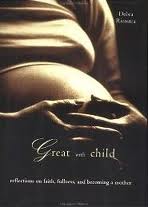
Great with Child
Reflections on faith, fullness, and becoming a mother
by Debra Rienstra
Contemplative, thoughtful writing on the inner changes that take place in a mother's soul, that's how I think of this book. Great with Child was written during and just after the author's pregnancy with her third child, and she chronicles with tender insightfulness all the impacts that bringing a new life into the world can have on a woman. Not just the physical changes- although those are addressed- the hormonal upheavals, pains and fatigue, wonders of first feeling the baby move- but more specifically the emotional territory and how being pregnant (and later, a new mom) alters her outlook on everything in life. Cultural norms, gender roles, shifting relationships with her parents and in-laws, body image, the nature of work, learning patience... More than any other this book is so honest about what's hard in becoming a mother (even though this is her third time)- painful breastfeeding sessions, severe lack of sleep (I'm glad to know I'm not the only one who falls to pieces on less than four hours!) the feeling of loosing your sense of self when all attention and energy must be focused on this helpless, demanding little infant- and what little is left divided among your other children and spouse. There is also great beauty here, love that unfolds, depth of character that grows through the trials of motherhood.
This is the kind of book you want to read slowly, to think over every passage. Although I have to admit I did quite a bit of skipping. Her writing is very faith-orientated, and sometimes the musings on God just did not resonate with me. Eventually I found myself glossing over every paragraph that started quoting scripture. I did appreciate more the metaphors and examples she drew from literature and art. Still, I don't feel like I missed much. I love how she writes about the inner workings childbearing can have on a woman's soul, so much that I'm contemplating adding this book to my personal collection.
Rating: 4/5 ........ 295 pages, 2002
by Debra Rienstra
Contemplative, thoughtful writing on the inner changes that take place in a mother's soul, that's how I think of this book. Great with Child was written during and just after the author's pregnancy with her third child, and she chronicles with tender insightfulness all the impacts that bringing a new life into the world can have on a woman. Not just the physical changes- although those are addressed- the hormonal upheavals, pains and fatigue, wonders of first feeling the baby move- but more specifically the emotional territory and how being pregnant (and later, a new mom) alters her outlook on everything in life. Cultural norms, gender roles, shifting relationships with her parents and in-laws, body image, the nature of work, learning patience... More than any other this book is so honest about what's hard in becoming a mother (even though this is her third time)- painful breastfeeding sessions, severe lack of sleep (I'm glad to know I'm not the only one who falls to pieces on less than four hours!) the feeling of loosing your sense of self when all attention and energy must be focused on this helpless, demanding little infant- and what little is left divided among your other children and spouse. There is also great beauty here, love that unfolds, depth of character that grows through the trials of motherhood.
This is the kind of book you want to read slowly, to think over every passage. Although I have to admit I did quite a bit of skipping. Her writing is very faith-orientated, and sometimes the musings on God just did not resonate with me. Eventually I found myself glossing over every paragraph that started quoting scripture. I did appreciate more the metaphors and examples she drew from literature and art. Still, I don't feel like I missed much. I love how she writes about the inner workings childbearing can have on a woman's soul, so much that I'm contemplating adding this book to my personal collection.
Rating: 4/5 ........ 295 pages, 2002
unplanned hiatus
Our computer died. I've managed to get to the library toady for a bit of computer use, but don't know how often I'll be able to do so in the coming week, so posting here will be sporadic for a while and my visiting to other blogs pretty much on hold. Never fear! I'll, be back to blogging as soon as we get "the Beast" (as my husband affectionately calls this electronic brian he built himself) running again.
In the meantime, enjoy your books!
Feb 21, 2011
What I Thought I Knew
by Alice Eve Cohen
Cohen had come to terms with the fact that she would never bear her own child, due to having a deformed uterus. She had an adopted daughter, a new happy relationship and a budding career. Then at age forty-four she starting having mysterious symptoms. Doctor after doctor told her she was just experiencing menopause, explaining away her sore breasts, frequent need to urinate, nausea and fatigue. None of them thought to question her years-old diagnosis of infertility. It wasn't until she had a CAT-scan to see if her bulging stomach had cancer that it was discovered she was actually six months pregnant. Thus began an immense emotional and physical trial in her life.
She didn't want the baby. Her first thought was to abort it, and later when she found out the myriad problems her infant could have- due to the fact that she had no prenatal care for six months, had been drinking and taking hormone supplements, etc. etc.- to possibly put it up for adoption. To make matters more complicated, she had awful insurance that wouldn't cover the medical costs and extreme difficulty finding a doctor willing to take her as a high-risk patient. It was overwhelming. I can't imagine having to fight the medical establishment for care while at the same time struggling with feelings of ambivalence towards the unborn child itself. Even after her baby was born (with unexpected health issues) she struggled to find love in her heart for it and wrestled with postpartum depression.
What I Thought I Knew must have been an incredibly painful book to write. I can't imagine going through what she experienced. The issues of her considering aborting or adopting out her child didn't bother me so much as the indifferent attitude of medical and insurance people. I couldn't believe that a gynecologist examined her at five months and didn't recognize she was pregnant! That infuriated me. And I was most disturbed by the lawsuit at the end of the story, where in order to pay for medical costs that were sinking her family, she had to go to court and present a wrongful-life case. Which basically states that if the doctors hadn't erred in not detecting her pregnancy for six months, she would never had had a child, that this baby shouldn't have been born. Can you imagine being that child, growing up and discovering that your mother went to court suing that you shouldn't have been allowed to live? Of course the author discusses how she struggled with that herself, but she really could see no other way to get money to pay for the astronomical medical costs. Still, it was the part of the book that I stewed over the most.
Somehow, I was expecting a bit more depth from this book. I breezed right through it; the storytelling is quick and vivid, the words flow easily. It's a book that can tear at your emotions and leave you closing the last page too quickly. I longed for just a bit more introspection, to slow me down and keep me immersed in the book longer. Yet I heartily admire the author for writing and sharing with all us readers what must have been a harrowing time in her life, and her complete honesty in sharing her ambivalent feelings and depression in the face of what many women would greet with unrestrained joy.
Rating: 3/5 ....... 194 pages, 2009
more opinions at:
Bermudaonion's Weblog
Book Addiction
Carolina Bookbinder
Cohen had come to terms with the fact that she would never bear her own child, due to having a deformed uterus. She had an adopted daughter, a new happy relationship and a budding career. Then at age forty-four she starting having mysterious symptoms. Doctor after doctor told her she was just experiencing menopause, explaining away her sore breasts, frequent need to urinate, nausea and fatigue. None of them thought to question her years-old diagnosis of infertility. It wasn't until she had a CAT-scan to see if her bulging stomach had cancer that it was discovered she was actually six months pregnant. Thus began an immense emotional and physical trial in her life.
She didn't want the baby. Her first thought was to abort it, and later when she found out the myriad problems her infant could have- due to the fact that she had no prenatal care for six months, had been drinking and taking hormone supplements, etc. etc.- to possibly put it up for adoption. To make matters more complicated, she had awful insurance that wouldn't cover the medical costs and extreme difficulty finding a doctor willing to take her as a high-risk patient. It was overwhelming. I can't imagine having to fight the medical establishment for care while at the same time struggling with feelings of ambivalence towards the unborn child itself. Even after her baby was born (with unexpected health issues) she struggled to find love in her heart for it and wrestled with postpartum depression.
What I Thought I Knew must have been an incredibly painful book to write. I can't imagine going through what she experienced. The issues of her considering aborting or adopting out her child didn't bother me so much as the indifferent attitude of medical and insurance people. I couldn't believe that a gynecologist examined her at five months and didn't recognize she was pregnant! That infuriated me. And I was most disturbed by the lawsuit at the end of the story, where in order to pay for medical costs that were sinking her family, she had to go to court and present a wrongful-life case. Which basically states that if the doctors hadn't erred in not detecting her pregnancy for six months, she would never had had a child, that this baby shouldn't have been born. Can you imagine being that child, growing up and discovering that your mother went to court suing that you shouldn't have been allowed to live? Of course the author discusses how she struggled with that herself, but she really could see no other way to get money to pay for the astronomical medical costs. Still, it was the part of the book that I stewed over the most.
Somehow, I was expecting a bit more depth from this book. I breezed right through it; the storytelling is quick and vivid, the words flow easily. It's a book that can tear at your emotions and leave you closing the last page too quickly. I longed for just a bit more introspection, to slow me down and keep me immersed in the book longer. Yet I heartily admire the author for writing and sharing with all us readers what must have been a harrowing time in her life, and her complete honesty in sharing her ambivalent feelings and depression in the face of what many women would greet with unrestrained joy.
Rating: 3/5 ....... 194 pages, 2009
more opinions at:
Bermudaonion's Weblog
Book Addiction
Carolina Bookbinder
Feb 20, 2011
winners!
I used Random.org to draw a winner for my latest bookmark giveaway. This time the winner is he who left comment #3- CB James! (No, you weren't too late!)
Rhonda has won the cougar bookmarks from the week before.
Congrats, readers! Send your address to me and I'll get them out in the mail to you.
I'm thinking I need to make my giveaways more tempting, only had three entrants this time... wait and see if I manage to come up with something better next week...
Rhonda has won the cougar bookmarks from the week before.
Congrats, readers! Send your address to me and I'll get them out in the mail to you.
I'm thinking I need to make my giveaways more tempting, only had three entrants this time... wait and see if I manage to come up with something better next week...
Feb 19, 2011
Birth Day
A Pediatrician Explores the Science, the History, and the Wonder of Childbirth
by Mark Sloan
I think this is my favorite yet of all the baby/pregnancy books I've read so far this year. Pediatrician and father Mark Sloan examines the miracle of birth in all its myriad ways. There are so many subjects covered in his book, and they were all relevant and fascinating. Drawing on his personal experiences helping deliver babies, on the event of watching his own child being born, on medical studies and historical events, he delves into everything from how childbirth is managed to what the baby itself is experiencing. Some of the topics include: the role of fathers has changed throughout the centuries, how attitudes towards birth have changed through the centuries, methods of pain management, the infant's abilities right after being born, why we have evolved to need so much assistance giving birth (all other primates manage quite fine by themselves), and how newborn health is assessed. Of course, being written by a doctor who worked in a hospital there are quite a few alarming stories of births that go wrong, and lots of details that might tell you more than you ever wanted to know- but for the most part it's a very positive book. It also manages to be un-biased; even when discussing issues that can be controversial like circumcision, alternative birthing options, invasive procedures, the rise of cesarean sections, etc. he always presents the pros and cons quite fairly, leaving the reader to draw her own conclusions. I learned so much that I had never even wondered about before! Like how exactly a baby transitions from living in a dark, aquatic environment to suddenly breathing air and circulating its own blood, or what all those funny reflexes babies have are actually for. Birth Day is on the whole an intriguing, informative and wonderful book, not without plenty of humor as well.
Rating: 4/5 ........ 370 pages, 2009
more opinions at:
Enjoy Birth
Mari Reads
by Mark Sloan
I think this is my favorite yet of all the baby/pregnancy books I've read so far this year. Pediatrician and father Mark Sloan examines the miracle of birth in all its myriad ways. There are so many subjects covered in his book, and they were all relevant and fascinating. Drawing on his personal experiences helping deliver babies, on the event of watching his own child being born, on medical studies and historical events, he delves into everything from how childbirth is managed to what the baby itself is experiencing. Some of the topics include: the role of fathers has changed throughout the centuries, how attitudes towards birth have changed through the centuries, methods of pain management, the infant's abilities right after being born, why we have evolved to need so much assistance giving birth (all other primates manage quite fine by themselves), and how newborn health is assessed. Of course, being written by a doctor who worked in a hospital there are quite a few alarming stories of births that go wrong, and lots of details that might tell you more than you ever wanted to know- but for the most part it's a very positive book. It also manages to be un-biased; even when discussing issues that can be controversial like circumcision, alternative birthing options, invasive procedures, the rise of cesarean sections, etc. he always presents the pros and cons quite fairly, leaving the reader to draw her own conclusions. I learned so much that I had never even wondered about before! Like how exactly a baby transitions from living in a dark, aquatic environment to suddenly breathing air and circulating its own blood, or what all those funny reflexes babies have are actually for. Birth Day is on the whole an intriguing, informative and wonderful book, not without plenty of humor as well.
Rating: 4/5 ........ 370 pages, 2009
more opinions at:
Enjoy Birth
Mari Reads
Feb 18, 2011
Just Herb Gardening
by Karen Kenny
As spring is approaching and things poking out of the ground outside, I'm finding the urge to read some of the gardening books that have been sitting on my shelf for ages.
Just Herb Gardening is exactly that: a little book about growing herbs. It's pretty brief. That was my main problem with it: a lot of the information seemed incomplete or just not detailed enough for me. The history on herb uses in the beginning didn't really teach me anything at all. The growing information: how to start seeds, propagate from cuttings or dividing plants, etc. seemed solid enough, but it didn't always tell you which plants were most suitable for which methods (nor is this info available in the glossary). There's a little bit about garden layout and design, and scattered spotlights on certain plants throughout the book. Again, the level of information here is spotty. Some plants it tells you their uses- medicinal, cooking, attracting/deterring insects in the garden, etc.- but others just get named and that's it. I wish there had been the same level of detail on all the plants. Even the illustration quality was uneven- some of the photos are just beautiful, one was badly pixelated! There are also hand-drawn and watercolor illustrations, nice enough but very plain- not enough descriptive detail. Most aren't labeled, so sometimes I didn't know what plant I was looking at.
I did learn a few things about herbs that really intrigued me: like that nettles are high in nitrogen and can be used to activate your compost pile, or that russian comfrey can be used to feed plants that like lots of potassium. Lots of herbs were mentioned that I'm completely unfamiliar with: hyssop, marjoram, angelica, etc. I never used any of these before. All in all, the book had just enough in it to whet my appetite to know more. So far I only use basil leaves to deter pests, and a few other herbs for cooking. I'd like to learn and apply more uses for them. So really what this book has done for me is galvanize my desire to find a good, detailed book on herbs that will teach me more!
I think this one came from a swap site online, because I remember being surprised (in a disappointed way) with its format. My edition is spiral-bound, which dismays me because I know if I use it much the pages would start to fall out. Another annoying thing is that the page numbers are spelled out, and printed in a handwriting kind of font, both of which make them hard to read. I don't think I'd need to though, as there's no proper index. It does have a glossary of herbs in the back, which is laid out in a kind of grid made of colored stripes (that was hard to read, too). All in all, it's a cute little book but a lot of the ways it was formatted and organized just bugged me. However, there are enough little nuggets of info I don't have elsewhere that I'm going to hold onto this book until I get a better, more comprehensive one about herbs.
Rating: 2/5 ........128 pages, 2005
As spring is approaching and things poking out of the ground outside, I'm finding the urge to read some of the gardening books that have been sitting on my shelf for ages.
Just Herb Gardening is exactly that: a little book about growing herbs. It's pretty brief. That was my main problem with it: a lot of the information seemed incomplete or just not detailed enough for me. The history on herb uses in the beginning didn't really teach me anything at all. The growing information: how to start seeds, propagate from cuttings or dividing plants, etc. seemed solid enough, but it didn't always tell you which plants were most suitable for which methods (nor is this info available in the glossary). There's a little bit about garden layout and design, and scattered spotlights on certain plants throughout the book. Again, the level of information here is spotty. Some plants it tells you their uses- medicinal, cooking, attracting/deterring insects in the garden, etc.- but others just get named and that's it. I wish there had been the same level of detail on all the plants. Even the illustration quality was uneven- some of the photos are just beautiful, one was badly pixelated! There are also hand-drawn and watercolor illustrations, nice enough but very plain- not enough descriptive detail. Most aren't labeled, so sometimes I didn't know what plant I was looking at.
I did learn a few things about herbs that really intrigued me: like that nettles are high in nitrogen and can be used to activate your compost pile, or that russian comfrey can be used to feed plants that like lots of potassium. Lots of herbs were mentioned that I'm completely unfamiliar with: hyssop, marjoram, angelica, etc. I never used any of these before. All in all, the book had just enough in it to whet my appetite to know more. So far I only use basil leaves to deter pests, and a few other herbs for cooking. I'd like to learn and apply more uses for them. So really what this book has done for me is galvanize my desire to find a good, detailed book on herbs that will teach me more!
I think this one came from a swap site online, because I remember being surprised (in a disappointed way) with its format. My edition is spiral-bound, which dismays me because I know if I use it much the pages would start to fall out. Another annoying thing is that the page numbers are spelled out, and printed in a handwriting kind of font, both of which make them hard to read. I don't think I'd need to though, as there's no proper index. It does have a glossary of herbs in the back, which is laid out in a kind of grid made of colored stripes (that was hard to read, too). All in all, it's a cute little book but a lot of the ways it was formatted and organized just bugged me. However, there are enough little nuggets of info I don't have elsewhere that I'm going to hold onto this book until I get a better, more comprehensive one about herbs.
Rating: 2/5 ........128 pages, 2005
Feb 17, 2011
Caribou and the Barren-Lands
by George Calef
One of those oversize, coffee-table books full of large, beautiful photographs that I picked up at a library sale once just because it seemed a shame to leave it there!
Caribou and the Barren-Lands is mostly about survival of these animals in Northern Canada and Alaska. How the deer manage to live in the harsh northern environment; the land covered with snow much of the year, six months of winter, nights on end with barely any light at all in the depths of it. At every season it seems they have something to struggle against- the cold and deep snow of winter, the maddening onslaught of insects in summer, the energy-sapping frenzy of the fall rut that coincides with hunting pressures by man. And yet they still roam the tundra in countless thousands. I found myself educated out of a few misconceptions, particularly at the end of the book when it discusses how caribou herds have been affected by man. One preconception I had was that caribou mostly eat lichens; that's not true. They eat a wide variety of plants, and could not survive on lichens alone. Another idea was that wolves only kill the sick and weak deer, keeping the herds healthy. Studies have shown that wolves are capable of and often kill healthy calves; there are also quite large herds that remain healthy in areas where wolves have been exterminated. Yet another was that habitat encroachment in the form of roads, pipelines, etc. would adversely affect the caribou herds. More threatening to them (at least when this book was written) is overhunting made extremely easy by modern weapons and aircraft.
The book is organized in a manner I haven't seen before, each section (describing in order the migration, calving time, summer aggregations, the fall rut, and winter survival) begins with a narrative describing typical events. In the calving section it tells of a female caribou leaving the herd to give birth, and how she first cares for and bonds with her calf. In the autumn section it begins describing a hunt from the viewpoint of a native hunter, then moves into the behavior of a particular bull sparring with other bulls and seeking females. After each narrative are a few more pages delving into purely factual information, ecology, behavior patterns, etc. I rather liked this setup. I'm more used to non-fiction animal books either being just all facts, or narrative with the facts wedged in. This was a bit different, and refreshing.
I thought at first the caribou were rather dull creatures: they seem to walk around a lot, search for food, sleep and that's it. But the more I read about them the more I was intrigued by their survival skills; like why they choose certain areas to bear their calves and travel so far to get there, or why only pregnant females keep their antlers through the entire winter. They're a lot more interesting than you might think!
Rating: 3/5 ........ 176 pages, 1981
One of those oversize, coffee-table books full of large, beautiful photographs that I picked up at a library sale once just because it seemed a shame to leave it there!
Caribou and the Barren-Lands is mostly about survival of these animals in Northern Canada and Alaska. How the deer manage to live in the harsh northern environment; the land covered with snow much of the year, six months of winter, nights on end with barely any light at all in the depths of it. At every season it seems they have something to struggle against- the cold and deep snow of winter, the maddening onslaught of insects in summer, the energy-sapping frenzy of the fall rut that coincides with hunting pressures by man. And yet they still roam the tundra in countless thousands. I found myself educated out of a few misconceptions, particularly at the end of the book when it discusses how caribou herds have been affected by man. One preconception I had was that caribou mostly eat lichens; that's not true. They eat a wide variety of plants, and could not survive on lichens alone. Another idea was that wolves only kill the sick and weak deer, keeping the herds healthy. Studies have shown that wolves are capable of and often kill healthy calves; there are also quite large herds that remain healthy in areas where wolves have been exterminated. Yet another was that habitat encroachment in the form of roads, pipelines, etc. would adversely affect the caribou herds. More threatening to them (at least when this book was written) is overhunting made extremely easy by modern weapons and aircraft.
The book is organized in a manner I haven't seen before, each section (describing in order the migration, calving time, summer aggregations, the fall rut, and winter survival) begins with a narrative describing typical events. In the calving section it tells of a female caribou leaving the herd to give birth, and how she first cares for and bonds with her calf. In the autumn section it begins describing a hunt from the viewpoint of a native hunter, then moves into the behavior of a particular bull sparring with other bulls and seeking females. After each narrative are a few more pages delving into purely factual information, ecology, behavior patterns, etc. I rather liked this setup. I'm more used to non-fiction animal books either being just all facts, or narrative with the facts wedged in. This was a bit different, and refreshing.
I thought at first the caribou were rather dull creatures: they seem to walk around a lot, search for food, sleep and that's it. But the more I read about them the more I was intrigued by their survival skills; like why they choose certain areas to bear their calves and travel so far to get there, or why only pregnant females keep their antlers through the entire winter. They're a lot more interesting than you might think!
Rating: 3/5 ........ 176 pages, 1981
Feb 16, 2011
my eyes
are always bigger than time allows; or: I will never be able to read all the books I want to! Especially when fabulous bloggers like the ones below keep tempting me. Ah, well. It's fun to stack the titles all up and hope I'll get to them someday...
Among Others by Jo Walton- Things Mean a Lot
Annabel by Kathleen Winter- Reading Through Life
Fiela's Child by Dalene Matthee
Zoo Story by Thomas French- At Home with Books
A Blue So Dark by Holly Schindler- Melody's Reading Corner
Alone in her Garden by Elizabeth von Armin- A Work in Progress
Labor of Love by Cara Muhlhahn- Superfast Reader
The Summer Book by Tove Jansson- A Work in Progress
Your Baby is Speaking to You by Nugent from SMS Book Reviews
Among Others by Jo Walton- Things Mean a Lot
Annabel by Kathleen Winter- Reading Through Life
Fiela's Child by Dalene Matthee
A Blue So Dark by Holly Schindler- Melody's Reading Corner
Alone in her Garden by Elizabeth von Armin- A Work in Progress
Labor of Love by Cara Muhlhahn- Superfast Reader
The Summer Book by Tove Jansson- A Work in Progress
Feb 15, 2011
Most of My Patients Are Animals
by Robert Miller
Double-duty again, on an old book I thought I'd never find. But just a few weeks after I mentioned it here, it came up on a swap site and I got my own copy! So I sat down and read it again. Very enjoyable.
The author set up his veterinary practice during the 1950's in the Conejo Valley of California, near Thousand Oaks and not too far from Los Angeles. There were quite a few wild-animal parks and circuses in the locale- most of which trained animals for use in films and performances. Also lots of ranches and farms, so not only did he treat the usual small clientele of pet cats and dogs, as well as ordinary livestock, but also tigers, elephants, chimpanzees and other exotic beasts. Miller's stories are pretty brief but well-written and often amusing. Funny incidents that happen, and also pranks he used to play on co-workers and sometimes even clients that annoyed him! I was surprised to find this time that I recognized quite a few other people mentioned in the book- something I don't remember noticing before, perhaps I hadn't read of them yet back then. James Herriot, my favorite-ever animal author, was Miller's contemporary and wrote the forward. Miller mentions treating a sick lion that belong to Ralph Helfer (who wrote Zamba and Modoc). He also several times tells of interactions with George Keller, treating his big cats for poisoning and other ailments. It always makes me smile to come across people I've "met" in a previous book in the one I'm currently reading. I have the same response when I find characters discussing books I know from other fiction, but even more so when it's real-life people I come across in non-fiction. Have you ever had that happen? Does it give you a little thrill of recognition, too?
Rating: 3/5 ........ 181 pages, 1985
Double-duty again, on an old book I thought I'd never find. But just a few weeks after I mentioned it here, it came up on a swap site and I got my own copy! So I sat down and read it again. Very enjoyable.
The author set up his veterinary practice during the 1950's in the Conejo Valley of California, near Thousand Oaks and not too far from Los Angeles. There were quite a few wild-animal parks and circuses in the locale- most of which trained animals for use in films and performances. Also lots of ranches and farms, so not only did he treat the usual small clientele of pet cats and dogs, as well as ordinary livestock, but also tigers, elephants, chimpanzees and other exotic beasts. Miller's stories are pretty brief but well-written and often amusing. Funny incidents that happen, and also pranks he used to play on co-workers and sometimes even clients that annoyed him! I was surprised to find this time that I recognized quite a few other people mentioned in the book- something I don't remember noticing before, perhaps I hadn't read of them yet back then. James Herriot, my favorite-ever animal author, was Miller's contemporary and wrote the forward. Miller mentions treating a sick lion that belong to Ralph Helfer (who wrote Zamba and Modoc). He also several times tells of interactions with George Keller, treating his big cats for poisoning and other ailments. It always makes me smile to come across people I've "met" in a previous book in the one I'm currently reading. I have the same response when I find characters discussing books I know from other fiction, but even more so when it's real-life people I come across in non-fiction. Have you ever had that happen? Does it give you a little thrill of recognition, too?
Rating: 3/5 ........ 181 pages, 1985
Feb 12, 2011
bookmarks giveaway
This week's giveaway features a pair of laminated bookmarks I made from my scrap file, with a sort of Asian theme. If you like them, just leave a comment for an entry to win! I'll use random.org to pick a name next weekend.

By the way, last week's adult cougar bookmarks are still available. The winner never contacted me with mailing info. I think waiting a week for them to be claimed is fair enough. If you'd like to have the cougars, just let me know. If more than one person wants them, I'll draw a name for those too.

By the way, last week's adult cougar bookmarks are still available. The winner never contacted me with mailing info. I think waiting a week for them to be claimed is fair enough. If you'd like to have the cougars, just let me know. If more than one person wants them, I'll draw a name for those too.
Feb 11, 2011
Woman's Doctor
A Year in the Life of an Obstetrician-Gynecologist
by Dr. William J. Sweeney and Barbara Lang Stern
A collection of stories from the practice of an OBGYN who at first focused mostly on obstetrics but by the end of the book had decided to make cancer surgery his speciality. His stories encompass many aspects of women's health: menstruation, pregnancy, childbirth, ovarian cancer, menopause, infertility, etc. The stories are all candid and show a great compassion and sensitivity this doctor had towards his patients. They're also easy to read; he's a pretty good storyteller (or his co-author is). The hardest chapter for me to read was the one about abortions, which had just recently been legalized when this book was published. It's pretty dated. So I know medicine isn't practiced this way anymore, but it was still intriguing to read about. Reminded me quite a bit of Intern. Some things really jumped out at me, like when the author referred to Alzheimer's as a rare condition- was it really uncommon some forty years ago, or just not diagnosed as frequently? I was also surprised to read things like the doctor thinking that smoking eight cigarettes a day wouldn't hurt a pregnant woman's baby, that he used hypnosis to help women in labor manage pain, or that to procure sperm for an infertile couple to use for artificial insemination they would simply ask young doctors and medical students at the hospital to provide a sperm sample on the spot, paying them $15 or $20! (Which apparently was a lot of money back then. Sperm banks that screened donors were a very new thing at the time). Things sure were different. But people were still people, and women faced many of the same problems they do today; I guess that's what makes these stories still interesting to read even though treatments are so different now.
I picked up my copy of Woman's Doctor at a thrift store, out of pure curiosity. It wasn't a disappointing read!
Rating: 3/5 ........ 318 pages, 1973
anyone else read it?
by Dr. William J. Sweeney and Barbara Lang Stern
A collection of stories from the practice of an OBGYN who at first focused mostly on obstetrics but by the end of the book had decided to make cancer surgery his speciality. His stories encompass many aspects of women's health: menstruation, pregnancy, childbirth, ovarian cancer, menopause, infertility, etc. The stories are all candid and show a great compassion and sensitivity this doctor had towards his patients. They're also easy to read; he's a pretty good storyteller (or his co-author is). The hardest chapter for me to read was the one about abortions, which had just recently been legalized when this book was published. It's pretty dated. So I know medicine isn't practiced this way anymore, but it was still intriguing to read about. Reminded me quite a bit of Intern. Some things really jumped out at me, like when the author referred to Alzheimer's as a rare condition- was it really uncommon some forty years ago, or just not diagnosed as frequently? I was also surprised to read things like the doctor thinking that smoking eight cigarettes a day wouldn't hurt a pregnant woman's baby, that he used hypnosis to help women in labor manage pain, or that to procure sperm for an infertile couple to use for artificial insemination they would simply ask young doctors and medical students at the hospital to provide a sperm sample on the spot, paying them $15 or $20! (Which apparently was a lot of money back then. Sperm banks that screened donors were a very new thing at the time). Things sure were different. But people were still people, and women faced many of the same problems they do today; I guess that's what makes these stories still interesting to read even though treatments are so different now.
I picked up my copy of Woman's Doctor at a thrift store, out of pure curiosity. It wasn't a disappointing read!
Rating: 3/5 ........ 318 pages, 1973
anyone else read it?
Feb 10, 2011
Scent of the Missing
Love and Partnership with a Search-and-Rescue Dog
by Susannah Charleson
This wonderful book is about a dog handler involved in search-and-rescue work. She began first by flying light aircraft, then later assisting search teams on the ground. The book gives a little background on how she got involved in this intense volunteer work, but mostly chronicles her first year with the search dog she trained and lived with- from first acquiring the puppy through training sessions, practice runs and final certification. I've read a little about search-and-rescue before, but this book really gets into the details of exactly how trying and rewarding it can be. I'm amazed that people do this work all night, often after long drives, tramping over rough terrain, and then get up next morning and go to their normal jobs. Add to that all the hours she had to spend training her dog- although it sounds more like a joy than a chore. And the adorable golden retriever, Puzzle, certainly loved to work! I was amazed not just at how well the dogs could use their noses, but also how subtly they could indicate to their handlers what they had found- no human scent at all, scent but not of the right person, scent of the person but too old, or fresh scent- and each dog communicated this differently. Although they trained for work at disaster sites, in burned or semi-collapsed buildings, most of the stories Charleson shares are of smaller searches through neighborhood streets. For wandering Alzheimer's patients, missing children, drowning victims. Some end happily, with the missing person found quickly, others are left open-ended, the volunteers not knowing if the case was ever solved. It can be a very emotional read. Scent of the Missing is a well-written, intense heart-tugger of a book. I'm really glad I got the chance to read it.
I first added this book to my TBR after reading Caribousmom's review, and then the publisher so kindly sent me a copy to read. Thanks to both of them. I'll probably be holding onto this book for several re-reads. It's that good.
Rating: 4/5 ........ 288 pages, 2010
by Susannah Charleson
This wonderful book is about a dog handler involved in search-and-rescue work. She began first by flying light aircraft, then later assisting search teams on the ground. The book gives a little background on how she got involved in this intense volunteer work, but mostly chronicles her first year with the search dog she trained and lived with- from first acquiring the puppy through training sessions, practice runs and final certification. I've read a little about search-and-rescue before, but this book really gets into the details of exactly how trying and rewarding it can be. I'm amazed that people do this work all night, often after long drives, tramping over rough terrain, and then get up next morning and go to their normal jobs. Add to that all the hours she had to spend training her dog- although it sounds more like a joy than a chore. And the adorable golden retriever, Puzzle, certainly loved to work! I was amazed not just at how well the dogs could use their noses, but also how subtly they could indicate to their handlers what they had found- no human scent at all, scent but not of the right person, scent of the person but too old, or fresh scent- and each dog communicated this differently. Although they trained for work at disaster sites, in burned or semi-collapsed buildings, most of the stories Charleson shares are of smaller searches through neighborhood streets. For wandering Alzheimer's patients, missing children, drowning victims. Some end happily, with the missing person found quickly, others are left open-ended, the volunteers not knowing if the case was ever solved. It can be a very emotional read. Scent of the Missing is a well-written, intense heart-tugger of a book. I'm really glad I got the chance to read it.
I first added this book to my TBR after reading Caribousmom's review, and then the publisher so kindly sent me a copy to read. Thanks to both of them. I'll probably be holding onto this book for several re-reads. It's that good.
Rating: 4/5 ........ 288 pages, 2010
Feb 9, 2011
Belly Laughs
the Naked Truth About Pregnancy and Childbirth
by Jenny McCarthy
I don't really follow the doings of celebrities, or even recognize who they are half the time, so I had no idea who Jenny McCarthy was when I picked up her book to read. All I can tell you is she's rather funny. And blunt. In Belly Laughs she shares anecdotes about all the uncomfortable, embarrasing things about being pregnant that most people won't talk about (at least in public). The nausea, constipation, vivid dreams (mine are much weirder than hers!) mood swings, bloating, acne, etc. I haven't experienced all the things she mentioned (nor did she; some of the stories are of her friends) but recognized plenty of what she went through. It's nice to know you're not alone, and nice to be able to laugh about it. But the book doesn't give you much more than that. You can read it all in one sitting. The stories are all very short, and not very descriptive. I was expecting a little bit more. She uses lots of profanity and crude humor, so be forewarned, if those things offend you. It did get rather tiresome (as did the constant mentions of her celebrity lifestyle).
Rating: 2/5 ........ 165 pages, 2004
more opinions at:
Musings of a Bookish Kitty
by Jenny McCarthy
I don't really follow the doings of celebrities, or even recognize who they are half the time, so I had no idea who Jenny McCarthy was when I picked up her book to read. All I can tell you is she's rather funny. And blunt. In Belly Laughs she shares anecdotes about all the uncomfortable, embarrasing things about being pregnant that most people won't talk about (at least in public). The nausea, constipation, vivid dreams (mine are much weirder than hers!) mood swings, bloating, acne, etc. I haven't experienced all the things she mentioned (nor did she; some of the stories are of her friends) but recognized plenty of what she went through. It's nice to know you're not alone, and nice to be able to laugh about it. But the book doesn't give you much more than that. You can read it all in one sitting. The stories are all very short, and not very descriptive. I was expecting a little bit more. She uses lots of profanity and crude humor, so be forewarned, if those things offend you. It did get rather tiresome (as did the constant mentions of her celebrity lifestyle).Rating: 2/5 ........ 165 pages, 2004
more opinions at:
Musings of a Bookish Kitty
Feb 8, 2011
Mormon Enigma
Emma Hale Smith
by Linda Newell and Valeen Avery
Not sure how many of you blog readers know this, but I grew up in the LDS church. I don't recall learning much about Emma beyond that she was Joseph Smith's first wife and founded the Relief Society. So it was with a lot of curiosity that I approached this book. For being a well-researched, historical text, Mormon Enigma is also a surprisingly good read. It's engaging and well-written and didn't bog me down like a lot of historical books tend to do. Although the authors are both members of the church, the book doesn't feel biased but simply presents facts. I appreciated that they only included information that was verified by at least two separately documented sources (including diary entries, letters, public and church records, and news articles). The book encompasses the life of Emma Smith, and tells a lot about early church history, particularly from the perspective of women. Emma was a very strong character and it's hard to imagine living through her trials. She faithfully followed her husband through all kinds of difficulties but bitterly opposed the introduction of polygamy. After her husband's death she raised his children by herself, and one of her sons became the leader of the Reorganized church, which she also joined. An interesting read, if you're curious about early church history or this remarkable woman.Rating: 4/5 ........ 432 pages, 1984
more opinions at:
Shelah Books It
Feb 7, 2011
How to Talk to Your Cat
by Jean Craighead George
I initially picked up this book at a used sale because of the author; I still remember how thrilled I was as a kid to read her descriptions of wolves communicating via body language with a lost child in Julie of the Wolves. What can this author teach me about communicating with my cat? I thought. A few days ago when I actually picked up the book to read, I felt a little more dubious. It's pretty brief, and kinda old, so I wondered if I'd actually learn anything new. Glad to say that I did, and this one is worth holding onto.
How to Talk to Your Cat isn't just about feline body language, although there are detailed sections on what different postures, tail waves, whisker positions, vocal sounds etc. can mean. But it's also a lot about cat behavior, what your cat does and why, that lets you understand it better. I didn't know how far an outdoor cat could roam; according to George my Irwin could have a ranging territory of up to 2 square kilometers! (That's twice what I'd previously imagined). I also had assumed that cats claim a patch of land and defend it against all other cats, keeping them out, but she says they're not like dogs in that regard. They keep other cats out of their particular home turf- which in this case would be my house- but in the greater ranging territory don't mind other cats using their pathways and hunting grounds, as long as they don't encounter each other doing so. They just like to keep their distance. It gave me a very different picture of what my cat does when he walks outside by himself.
One section I particularly enjoyed reading was about how a mother cat communicates with and teaches her kittens; the author had a cat who raised several litters in their house, and wrote about her observations (most things in the book are described via little anecdotes about her cats or the cats of people she knows). I can't ever picture myself allowing one of my cats to reproduce, so it was charming to read about what that's like, watching kittens be born and raised in the house.
This little book is actually an abridged version of a longer text. The opening and closing chapters talk about all kinds of animals communicating with people, and I gather that the original book then had a section on dogs and maybe a few other domestic animals too; this volume just focuses on the cat. I also gather there's a much newer edition with lively illustrations, which seems more geared towards children than my older copy (and I wonder if the newer version edited out all the parts that describe in detail the cat's mating behavior).
Rating: 3/5 ....... 101 pages, 1985
I initially picked up this book at a used sale because of the author; I still remember how thrilled I was as a kid to read her descriptions of wolves communicating via body language with a lost child in Julie of the Wolves. What can this author teach me about communicating with my cat? I thought. A few days ago when I actually picked up the book to read, I felt a little more dubious. It's pretty brief, and kinda old, so I wondered if I'd actually learn anything new. Glad to say that I did, and this one is worth holding onto.
How to Talk to Your Cat isn't just about feline body language, although there are detailed sections on what different postures, tail waves, whisker positions, vocal sounds etc. can mean. But it's also a lot about cat behavior, what your cat does and why, that lets you understand it better. I didn't know how far an outdoor cat could roam; according to George my Irwin could have a ranging territory of up to 2 square kilometers! (That's twice what I'd previously imagined). I also had assumed that cats claim a patch of land and defend it against all other cats, keeping them out, but she says they're not like dogs in that regard. They keep other cats out of their particular home turf- which in this case would be my house- but in the greater ranging territory don't mind other cats using their pathways and hunting grounds, as long as they don't encounter each other doing so. They just like to keep their distance. It gave me a very different picture of what my cat does when he walks outside by himself.
One section I particularly enjoyed reading was about how a mother cat communicates with and teaches her kittens; the author had a cat who raised several litters in their house, and wrote about her observations (most things in the book are described via little anecdotes about her cats or the cats of people she knows). I can't ever picture myself allowing one of my cats to reproduce, so it was charming to read about what that's like, watching kittens be born and raised in the house.
This little book is actually an abridged version of a longer text. The opening and closing chapters talk about all kinds of animals communicating with people, and I gather that the original book then had a section on dogs and maybe a few other domestic animals too; this volume just focuses on the cat. I also gather there's a much newer edition with lively illustrations, which seems more geared towards children than my older copy (and I wonder if the newer version edited out all the parts that describe in detail the cat's mating behavior).
Rating: 3/5 ....... 101 pages, 1985
Feb 6, 2011
The Birth of Love
by Joanna Kavenna
Four stories are woven together in this novel, each in some fashion related to birth. They span the centuries; the first is placed in the year 1865 when one Ignaz Semmelweis has realized that childbed fever or puerperal sepsis, which killed hundreds of women in hospitals annually, could be prevented by doctors simply washing their hands. He tries to convince other doctors to follow this simple practice but is ridiculed, ostracized and eventually goes mad (the story is actually centered on a man interviewing him in an insane asylum). The second storyline focuses on an author who decades later has just published a book about Semmelweis and is struggling to deal with the sudden publicity, which he finds very uncomfortable. Then there is a modern-day setting of a woman in London preparing to give birth to her second child at home with a midwife. The last story is set in a futuristic dystopia, when every womans' eggs are "harvested" and only those eggs considered genetically superior are fertilized and raised in laboratories. One woman is condemned for having given birth naturally, as a threat to the survival of the species.
All of the stories in The Birth of Love seemed to me to have a common theme of lack of control, on the part of those giving birth. Not only the women going through childbirth, but also those, in a sense, birthing new ideas. Semmelweis suffered mental agonies trying to make his ideas of cleanliness a reality that would save the lives of childbearing women. The fictional author Michael Stone is overwhelmed by events when his book is finally published (or "born")- being hustled here and there to events planned by others, forced into meetings with strangers, etc. The mother in London expects her second birth to be easier than the first, but instead finds herself struggling through hours of pain and finally capitulates to being moved to the hospital, things not at all going the way she'd planned. And of course the dystopian story is all about women having lost control of their bodies, not only can they never give birth, but some are forced to work in "sexual release centers" solely to please men, and when one does bear her own child, others refuse to even acknowledge that it happened.
I found every one of these storylines intriguing, even though none of the segments really went into the kind of character depth I love. After finishing the book, I was anxious to read more about Semmelweis and discover what finally convinced doctors in later years to follow his practices (germ theory was not yet known when he claimed that handwashing would stop the spread of contagion). Being interested in things bookish, I was curious to read about the turmoil the author went through after his words, written in solitude, were suddenly thrust into the public view and scrutinized. I could really relate to the woman in London, who worried about how her first child would adjust to having a new sibling, while she anticipated her new baby's arrival (although I thought it amusing that every time the older child- still not quite talking clearly- needed distracting he was offered food or drink. Didn't they ever give him a toy or game, but always ply him with food?). And of course it's always horrifyingly fascinating to think of the future and what extreme measures might be taken if we actually do destroy our planet with global warming, pollution and overcrowding, as the final tale vividly portrays.
Altogether a most interesting book. The interweaving of birthing themes kept me intent. I borrowed this one from the public library, read it after seeing the review on Farm Lane Books Blog.
Rating: 3/5 ........ 304 pages, 2010
more opinions at:
Savidge Reads
Reading Books, Reading Stories, Reading Life
Four stories are woven together in this novel, each in some fashion related to birth. They span the centuries; the first is placed in the year 1865 when one Ignaz Semmelweis has realized that childbed fever or puerperal sepsis, which killed hundreds of women in hospitals annually, could be prevented by doctors simply washing their hands. He tries to convince other doctors to follow this simple practice but is ridiculed, ostracized and eventually goes mad (the story is actually centered on a man interviewing him in an insane asylum). The second storyline focuses on an author who decades later has just published a book about Semmelweis and is struggling to deal with the sudden publicity, which he finds very uncomfortable. Then there is a modern-day setting of a woman in London preparing to give birth to her second child at home with a midwife. The last story is set in a futuristic dystopia, when every womans' eggs are "harvested" and only those eggs considered genetically superior are fertilized and raised in laboratories. One woman is condemned for having given birth naturally, as a threat to the survival of the species.All of the stories in The Birth of Love seemed to me to have a common theme of lack of control, on the part of those giving birth. Not only the women going through childbirth, but also those, in a sense, birthing new ideas. Semmelweis suffered mental agonies trying to make his ideas of cleanliness a reality that would save the lives of childbearing women. The fictional author Michael Stone is overwhelmed by events when his book is finally published (or "born")- being hustled here and there to events planned by others, forced into meetings with strangers, etc. The mother in London expects her second birth to be easier than the first, but instead finds herself struggling through hours of pain and finally capitulates to being moved to the hospital, things not at all going the way she'd planned. And of course the dystopian story is all about women having lost control of their bodies, not only can they never give birth, but some are forced to work in "sexual release centers" solely to please men, and when one does bear her own child, others refuse to even acknowledge that it happened.
I found every one of these storylines intriguing, even though none of the segments really went into the kind of character depth I love. After finishing the book, I was anxious to read more about Semmelweis and discover what finally convinced doctors in later years to follow his practices (germ theory was not yet known when he claimed that handwashing would stop the spread of contagion). Being interested in things bookish, I was curious to read about the turmoil the author went through after his words, written in solitude, were suddenly thrust into the public view and scrutinized. I could really relate to the woman in London, who worried about how her first child would adjust to having a new sibling, while she anticipated her new baby's arrival (although I thought it amusing that every time the older child- still not quite talking clearly- needed distracting he was offered food or drink. Didn't they ever give him a toy or game, but always ply him with food?). And of course it's always horrifyingly fascinating to think of the future and what extreme measures might be taken if we actually do destroy our planet with global warming, pollution and overcrowding, as the final tale vividly portrays.
Altogether a most interesting book. The interweaving of birthing themes kept me intent. I borrowed this one from the public library, read it after seeing the review on Farm Lane Books Blog.
Rating: 3/5 ........ 304 pages, 2010
more opinions at:
Savidge Reads
Reading Books, Reading Stories, Reading Life
Feb 5, 2011
winners!
Random.org has chosen the winners for my cougar bookmarks!
Jenny won the baby cougar set
Esperanza won the adult cougar set
If the winners would email their address to jeanenevarez (at) gmail(dot) com, I'll send your bookmarks out on Monday! If you didn't win the cute cougars, don't be sad. Check back again the coming weekend for my next giveaway!
Jenny won the baby cougar set
Esperanza won the adult cougar set
If the winners would email their address to jeanenevarez (at) gmail(dot) com, I'll send your bookmarks out on Monday! If you didn't win the cute cougars, don't be sad. Check back again the coming weekend for my next giveaway!
Feb 3, 2011
The Midwife
A Memoir of Birth, Joy and Hard Times
by Jennifer Worth
As a young nurse, Jennifer Worth moved into a convent in the 1950's, to become a midwife for the very poor. The dockside slums where she worked were dismal, squalid and packed full of humanity- many buildings were condemned and yet families with ten or more children often lived in just a few rooms. Birth control was non-existent, antibiotics barely making their appearance on the scene; doctors were mistrusted and the hospital setting feared. It was quite a different time period, and Worth really makes it come alive. Her storytelling is full of wonderful characters and descriptions of human suffering that will wring your heart. Two of the stories really moved me- I admit I literally cried tears when I read about the workhouse conditions that had rendered an old lady destitute with grief. And the family with twenty-four children (yes, twenty-four!) whose last baby was born under dangerous circumstances, very frail indeed, kept me breathless on my seat. I was amazed at that mother's love and tenderness for her child, even when her own life was in jeopardy.
There are darker sides, too. Neglect and ignorance, women beaten by their husbands, young girls forced into prostitution, children starving. To it all Worth brought her helping hand, sometimes extending herself beyond the call of duty. She absorbed the love of the nuns who taught her. On first arriving at the convent she (not being a religious sort) found the nuns and their way of life odd, perhaps even amusing, but throughout the book you see her attitude slowly changing towards them. It was just as intriguing to read about life in the convent as it was to read about her visits to patients; the book wasn't all entirely stories of childbirth as I rather expected. The Midwife is really about people, people doing their best and keeping their humor in the worst of circumstances.
I happened to really enjoy the appendix, where the author explains the Cockney dialect as its own language; it was very interesting and I enjoyed reading the sentences as they were written phonetically out loud, to see if I could figure out what they said before she explained it to me! It really added some extra flavor and depth.
Rating: 4/5 ........ 340 pages, 2002
More opinions at:
The Curious Reader
The Book Nest
Ardent Reader
by Jennifer Worth
As a young nurse, Jennifer Worth moved into a convent in the 1950's, to become a midwife for the very poor. The dockside slums where she worked were dismal, squalid and packed full of humanity- many buildings were condemned and yet families with ten or more children often lived in just a few rooms. Birth control was non-existent, antibiotics barely making their appearance on the scene; doctors were mistrusted and the hospital setting feared. It was quite a different time period, and Worth really makes it come alive. Her storytelling is full of wonderful characters and descriptions of human suffering that will wring your heart. Two of the stories really moved me- I admit I literally cried tears when I read about the workhouse conditions that had rendered an old lady destitute with grief. And the family with twenty-four children (yes, twenty-four!) whose last baby was born under dangerous circumstances, very frail indeed, kept me breathless on my seat. I was amazed at that mother's love and tenderness for her child, even when her own life was in jeopardy. There are darker sides, too. Neglect and ignorance, women beaten by their husbands, young girls forced into prostitution, children starving. To it all Worth brought her helping hand, sometimes extending herself beyond the call of duty. She absorbed the love of the nuns who taught her. On first arriving at the convent she (not being a religious sort) found the nuns and their way of life odd, perhaps even amusing, but throughout the book you see her attitude slowly changing towards them. It was just as intriguing to read about life in the convent as it was to read about her visits to patients; the book wasn't all entirely stories of childbirth as I rather expected. The Midwife is really about people, people doing their best and keeping their humor in the worst of circumstances.
I happened to really enjoy the appendix, where the author explains the Cockney dialect as its own language; it was very interesting and I enjoyed reading the sentences as they were written phonetically out loud, to see if I could figure out what they said before she explained it to me! It really added some extra flavor and depth.
Rating: 4/5 ........ 340 pages, 2002
More opinions at:
The Curious Reader
The Book Nest
Ardent Reader
Feb 2, 2011
Baby Owl
by Aubrey Lang
Baby Owl is a lovely little book about how great horned owls grow up. I really picked it up for the beautiful photographs (acquired when the author's husband, a wildlife photographer, built a platform 25 feet up in a nearby tree to observe the owl nest for nearly three months!) but was quite pleased with the text as well. It's easy to read and although written for a younger audience, very informative. Together the words and pictures describe how the young owls grow and develop, from the moment the eggs are laid until they are old enough to fly off on their own. It's really neat to see how the owlets change, from fuzzy little blobs, to getting the first patterned feathers, then finally becoming sleek adults. All the stages of their first year are well-illustrated; at first they just sit around the nest eating and sleeping, when a little bigger they stretch their legs and flap their wings, eventually the biggest one hops out of the nest to glide down to the forest floor where he perches on a short tree and the parents continue to feed and protect him. The owls are really striking animals and it's amazing to see how well-hidden they are with their stippled plumage blending into the surrounding tree bark. I'm so taken by this little book that I now want to look for others in the series and share them with my kid.
Rating: 4/5 ........ 36 pages, 2004
Baby Owl is a lovely little book about how great horned owls grow up. I really picked it up for the beautiful photographs (acquired when the author's husband, a wildlife photographer, built a platform 25 feet up in a nearby tree to observe the owl nest for nearly three months!) but was quite pleased with the text as well. It's easy to read and although written for a younger audience, very informative. Together the words and pictures describe how the young owls grow and develop, from the moment the eggs are laid until they are old enough to fly off on their own. It's really neat to see how the owlets change, from fuzzy little blobs, to getting the first patterned feathers, then finally becoming sleek adults. All the stages of their first year are well-illustrated; at first they just sit around the nest eating and sleeping, when a little bigger they stretch their legs and flap their wings, eventually the biggest one hops out of the nest to glide down to the forest floor where he perches on a short tree and the parents continue to feed and protect him. The owls are really striking animals and it's amazing to see how well-hidden they are with their stippled plumage blending into the surrounding tree bark. I'm so taken by this little book that I now want to look for others in the series and share them with my kid.
Rating: 4/5 ........ 36 pages, 2004
Feb 1, 2011
the Dare month!
Well, I've done it! Made it through January only reading off my shelves, thanks to CB's TBR Dare. I feel like I kinda outdid myself, reading a total of twelve books (usually my monthly reads only average to about six, I think). As you can see, there are now some nice leaning gaps opening up in my shelves! Soon I'll have to rearrange (and make space for more books, ha ha!)
In the last few days there I really crammed in a bunch of shorter books, because I have already reserved quite a few pregnancy books from the library and am anxious to get to them right away (some on hold by other patrons so I can't renew them) and thus I didn't want to have a new, longer book half-started on the first day of Feb. Silly me. The last one I read last night, a juvenile non-fiction about great horned owls, will get a review tomorrow as I feel I've already posted enough today!
It really feels nice to clear some of these books off my shelves, that have sat there so long waiting to be read. Even though I'm not officially going to be part of the Dare anymore I'll still be following along in spirit, reading as much off my shelves as I can between the books I borrow from the library. And now I'm going to dive into the pregnancy titles!
Good luck to the rest of you, who are sticking it out until April!
In the last few days there I really crammed in a bunch of shorter books, because I have already reserved quite a few pregnancy books from the library and am anxious to get to them right away (some on hold by other patrons so I can't renew them) and thus I didn't want to have a new, longer book half-started on the first day of Feb. Silly me. The last one I read last night, a juvenile non-fiction about great horned owls, will get a review tomorrow as I feel I've already posted enough today!
It really feels nice to clear some of these books off my shelves, that have sat there so long waiting to be read. Even though I'm not officially going to be part of the Dare anymore I'll still be following along in spirit, reading as much off my shelves as I can between the books I borrow from the library. And now I'm going to dive into the pregnancy titles!
Good luck to the rest of you, who are sticking it out until April!
Animal Attractions
A Tribute to the Love Between People and Animals
edited by Diana EdkinsRather like the previous two books I read these last few days, Animal Attractions is a mostly pictorial work with a few brief essays about the connections we share with other species (particularly cats and dogs). For the most part, this is a really beautiful book. The presented photographs, by a myriad of world-renowned artists, are absolutely beautiful. They depict many sorts of animals. Not just cats and dogs but also chickens, horses, goats, pigs, cows, parrots, elephants, sheep, chimpanzees, a rabbit and a few snakes. The only disappointment I have with the book is (again) the writing. The introduction by Diane Ackerman is eloquent and thoughtful, and really made me anticipate more of the same quality. But there are only three other essays in the book, and they all fell flat for me. The one about cats just tells about the different cats one woman owned throughout her life. The one focused on dogs was a bit more interesting but still, just about one guy's dog and how amazing his personality and intelligence was. The final essay, by Peter Beard "on population pressure and the plight of wild animals" really confused me. It was several very long sentences listing atrocities mankind has wrecked upon the earth (and ourselves). Shall I give you a sample?
Yes, this could be known as the century when all of us sanctimonious, anthrophomorphic, bleeding hearts from Walt Disney country, "man kind" pushed by excessive densities and stress and innumerable stress-related horrors- all echoes of Dr. Strangelove- hugging darling Dumbo- "buy an elephant a drink"- desperate disillusioned adults displaying infantile regression longing for their nursery pets- obsessive avoidance of their own natural aggressiveness- Sigmund Freud- Charles Darwin- Thomas Malthus- Dr. Norman Borlaug- from the biolabs in Bangladesh to the Calhoun rat study cages in Bethesda, Maryland: "separation of the sexes," "territorial neuroses"- heart disease from stress and pollution, competition from diminishing resources, cancer, HIV, personality disorders, hormone screw-ups, a sharp decline in tolerable human behavior- Somalia, Rwanda, Zaire, Mozambique, South Africa, Bosnia; and beyond- Hate and Blame- genocide, knife rape, kidnapping, incest, serial killing... we are literally going crazy, breaking the back of Nature, pressuring, squeezing, forcing our gross intrusion beyond the point of no return.... e.g. East Africa after a century of missionary manipulations: endless slum squalor, AID and AIDS, lost heritage, lost identity, corrugated iron, crime, pollution, garbage everywhere, tribal clashes, army rule, torture, assassinations, voodoo, overpopulation, unemployment, rape, rap, gangrenous graffiti, occasionally an open air zoo; tourism! - highway robbery.
Phew! That's one sentence. I looked very carefully. There's loads of commas, at least two ellipses, semicolons, colons and more dashes than my brain can process (can you do that all in the same sentence? isn't there some kind of rule?) Please tell me if you make sense of that. Because I don't. Maybe it's just the way Beard writes; horrors if I ever opened a book of his! Although I really shouldn't say that, I do have his End of the Game on my TBR, which I once perused in a bookstore and it was quite comprehensible, none of this jumble. So I really don't know what happened here.
It just made my head spin. The Beard essay, I mean (though the end of it was more readable). Overall I was surprised at the unevenness of writing quality in this book. Which is really a shame, as the photographs are so outstanding. I recommend it just to look at, if you like fine-art of books that feature animals.
Rating: 4/5 ........ 132 pages, 1995
Second Chances
More Tales of Found Dogs
by Elise LufkinThis book is a collection of stories about lucky dogs that got found and given a new home. Dogs picked up off the street, rescued when neighbors abandoned them, adopted from shelters, etc. Every one is a story with a happy ending, showing how a dog that was lost, wandering, or waiting for its end in a cage, was taken in by a loving family. Some had a rocky adjustment, coming from an unknown background (that was in many cases probably abusive) they were fearful and mistrusting at first, but all of them ended up happy dogs after realizing they were among people who loved them. Most became loved family pets, but there are also stories of rescued dogs that became service dogs or trained search-and-rescue dogs- just goes to show how much potential a creature can have.
Each story in Second Chances is accompanied by one or two images. While nothing spectacular, the photographs are all good, and many of the dogs are adorable or very handsome indeed. But what makes this just a nice book and not a great one, is that the pictures outshine the words. The stories are all incredibly brief, most no more than a page. They're written simply, most in a tell-don't-show fashion that just left me not feeling the emotion very much. I know these are all really special dogs to their people, but it just didn't come across very well. Sacrificing the number of stories to be able to give them more depth would have made a better quality book. I haven't seen the book's predecessor, Found Dogs, but I gather from a few reviews read online that the stories in that one are even more brief, which makes me not at all inclined to read it.
So... it's a nice enough book, lovely photographs, but just not a lot of substance and honestly an hour after reading the book I couldn't remember one of the stories to repeat to you.
Rating: 2/5 ........ 180 pages, 2003
Jan 31, 2011
A Dog's Book of Truths
by Nancy LeVine and Joseph Duemer
Here's a book I picked up at a library discard sale once, and never read until just yesterday. It's a beautiful tribute to one woman's two beloved dogs (Australian shepherds). Exquisite black-and-white photographs are paired with thoughtful, poetic sentiments on how dogs view and experience the world (text by Duemer). It's one of those books you could read in ten minutes but spend much longer lingering over the pictures and pondering the prose. My favorite passages:
Dogs make little of our music, but scent is as obscure to us.
Dogs know the world cannot be described from any one position- that everything must be explored by many circumnavigations.
Because they do not read the future, common wisdom says dogs know nothing of death, that it takes them by surprise- but the seriousness with which they watch the night come on is rich with knowledge of the dark.
On LeVine's website you can view some of the photographs from the book
Rating: 4/5 ........ 96 pages, 2002
Here's a book I picked up at a library discard sale once, and never read until just yesterday. It's a beautiful tribute to one woman's two beloved dogs (Australian shepherds). Exquisite black-and-white photographs are paired with thoughtful, poetic sentiments on how dogs view and experience the world (text by Duemer). It's one of those books you could read in ten minutes but spend much longer lingering over the pictures and pondering the prose. My favorite passages:
Dogs make little of our music, but scent is as obscure to us.
Dogs know the world cannot be described from any one position- that everything must be explored by many circumnavigations.
Because they do not read the future, common wisdom says dogs know nothing of death, that it takes them by surprise- but the seriousness with which they watch the night come on is rich with knowledge of the dark.
On LeVine's website you can view some of the photographs from the book
Rating: 4/5 ........ 96 pages, 2002
The Wandering Whale
and Other Adventures from a Zoovet's Casebook
by David Taylor
I do so enjoy David Taylor's books, about working as a veterinarian for wildlife in zoos, parks and private collections. When I can get my hands on a copy I gobble it up and hold onto it to read again later. He's such a good storyteller, and his firsthand accounts of working with exotic animals are always interesting (and sometimes downright funny). In The Wandering Whale some of the creatures he treats include an orphaned walrus, a capuchin monkey in need of a caesarean, a stranded whale, another monkey with diabetes, falcons suffering from fungus in their lungs and an emu who can't lay its egg. There's also a self-destructive hornbill, a pair of pandas in a zoo reluctant to mate, and the heart-wrenching story of an orca suffering from a mysterious internal infection. Taylor doesn't have any qualms about sharing the more depressing, unpleasant aspects of vet work. It was really sad to read about the whale he struggled for months to save, not knowing exactly what was wrong but going through treatment after futile treatment (including ozone therapy, something I never heard of before). I wonder if nowadays it would be any easier to diagnose and treat such a sick whale...
The book is pretty focused on just telling stories of Taylor's work with the animals. He doesn't spend much time explaining background events. One chapter does veer into a kind of rant on how mankind exploits animals, even those we keep as beloved pets. Overall it was a really enjoyable read, with information that sometimes surprised me.
Rating: 4/5 ........ 196 pages, 1984
by David Taylor
I do so enjoy David Taylor's books, about working as a veterinarian for wildlife in zoos, parks and private collections. When I can get my hands on a copy I gobble it up and hold onto it to read again later. He's such a good storyteller, and his firsthand accounts of working with exotic animals are always interesting (and sometimes downright funny). In The Wandering Whale some of the creatures he treats include an orphaned walrus, a capuchin monkey in need of a caesarean, a stranded whale, another monkey with diabetes, falcons suffering from fungus in their lungs and an emu who can't lay its egg. There's also a self-destructive hornbill, a pair of pandas in a zoo reluctant to mate, and the heart-wrenching story of an orca suffering from a mysterious internal infection. Taylor doesn't have any qualms about sharing the more depressing, unpleasant aspects of vet work. It was really sad to read about the whale he struggled for months to save, not knowing exactly what was wrong but going through treatment after futile treatment (including ozone therapy, something I never heard of before). I wonder if nowadays it would be any easier to diagnose and treat such a sick whale...The book is pretty focused on just telling stories of Taylor's work with the animals. He doesn't spend much time explaining background events. One chapter does veer into a kind of rant on how mankind exploits animals, even those we keep as beloved pets. Overall it was a really enjoyable read, with information that sometimes surprised me.
Rating: 4/5 ........ 196 pages, 1984
Jan 30, 2011
the list

never stops growing! (of course). This week I just added a few to my TBR, thanks to the wonderful bloggers linked to below (and a few other sources).
Far Afield by Susanna Kaysen- Bookfoolery and Babble
Get Me Out by Randi Hutter Epstein- The Book Lady's Blog
Oranges by John McPhee- Caroline Bookbinder
The Hopes of Snakes by Lisa Couturier- found online
The Plant Hunters by Tyler Whittle- found listed in Wily Violets and Underground Orchids
Jan 29, 2011
cougar bookmarks giveaway!
I'm sure this won't surprise you, but I love watching nature programs on TV. One I recently discovered (called Baby Planet) features the young of various wildlife species, usually in some need of help- whether orphaned and being raised by volunteers or in zoos needing medical assistance. A few days ago I saw a segment about a cougar cub that had cerebral palsy. I didn't know big cats could have cerebral palsy, and even though the poor cub stumbled about it was still such a beautiful animal.
With that in mind, here are two sets of bookmarks featuring cougars I made. One shows adults in different environments- a desert and a mountain cave- the other set features puma cubs, looking alternately endearing and fierce. Which do you like better? Leave a comment for a chance to win one of the sets, names will be drawn next weekend.
Bookmarks are about 2 x 7.5". Laminated, with an image on both sides (fronts only are shown).
With that in mind, here are two sets of bookmarks featuring cougars I made. One shows adults in different environments- a desert and a mountain cave- the other set features puma cubs, looking alternately endearing and fierce. Which do you like better? Leave a comment for a chance to win one of the sets, names will be drawn next weekend.
Bookmarks are about 2 x 7.5". Laminated, with an image on both sides (fronts only are shown).
Jan 28, 2011
Winter World
the ingenuity of animal survival
by Bernd Heinrich
This was the perfect read to complement the white, snowy world outside my window. Winter World is all about what animals do to survive cold weather, based on Heinrich's own curiosity and observations about the natural world. Although it examines the strategies of many different creatures, from small insects to various members of the squirrel family, bats, beavers, frogs and bears, there is a common thread running through all Heinrich's investigations as he tries to solve the mystery of how kinglets (a bird smaller than a chickadee) manage to survive cold winter nights in northern latitudes (he lives in Maine). This book is just jam-packed with beautiful nature writing and compelling facts. Things like why some animals spend the winter scurrying around in a constant search for food, while others are comatose for months at a time in a hibernating torpor (and what, exactly hibernation is). Some animals hoard food, others lay up fat stores in their bodies, still others simply suspend all body functions, to any scientific examination dead to the world (no heartbeat, sign of breathing, etc.) Did you know that some frogs can survive having half the water in their bodies turn to solid ice? That bears go the whole winter without drinking or urinating? that turtles live the winter in frozen-over ponds because they can absorb oxygen through their skin?
It's the kind of book that got me so enthralled I read it in all of two days. I kept reading passages aloud to my husband: "listen to this!" and even though he's not intrigued by how animals do things like I am, he found interesting things like how the study of animal survival methods can impact human medicine. For example, unraveling the secrets of bear hibernation could help with the treatment of diabetes or patients who suffer oxygen-depletion to the brain (like stroke victims). It's just amazing. Learning about all the ingenious ways animals endure the cold and come out alive and well in springtime was just fascinating. Makes us humans with our need for sweaters and furnaces seem fragile beings indeed, compared to all the small creatures that simply weather the elements, each in their own way.
Rating: 5/5 ........ 357 pages, 2003
by Bernd Heinrich
This was the perfect read to complement the white, snowy world outside my window. Winter World is all about what animals do to survive cold weather, based on Heinrich's own curiosity and observations about the natural world. Although it examines the strategies of many different creatures, from small insects to various members of the squirrel family, bats, beavers, frogs and bears, there is a common thread running through all Heinrich's investigations as he tries to solve the mystery of how kinglets (a bird smaller than a chickadee) manage to survive cold winter nights in northern latitudes (he lives in Maine). This book is just jam-packed with beautiful nature writing and compelling facts. Things like why some animals spend the winter scurrying around in a constant search for food, while others are comatose for months at a time in a hibernating torpor (and what, exactly hibernation is). Some animals hoard food, others lay up fat stores in their bodies, still others simply suspend all body functions, to any scientific examination dead to the world (no heartbeat, sign of breathing, etc.) Did you know that some frogs can survive having half the water in their bodies turn to solid ice? That bears go the whole winter without drinking or urinating? that turtles live the winter in frozen-over ponds because they can absorb oxygen through their skin?It's the kind of book that got me so enthralled I read it in all of two days. I kept reading passages aloud to my husband: "listen to this!" and even though he's not intrigued by how animals do things like I am, he found interesting things like how the study of animal survival methods can impact human medicine. For example, unraveling the secrets of bear hibernation could help with the treatment of diabetes or patients who suffer oxygen-depletion to the brain (like stroke victims). It's just amazing. Learning about all the ingenious ways animals endure the cold and come out alive and well in springtime was just fascinating. Makes us humans with our need for sweaters and furnaces seem fragile beings indeed, compared to all the small creatures that simply weather the elements, each in their own way.
Rating: 5/5 ........ 357 pages, 2003
Jan 26, 2011
Wily Violets and Underground Orchids
Revelations of a Botanist
by Peter Bernhardt
One of the few instances where I bought a book I'd never even heard of before at a shop, just because the title was so intriguing. Wily Violets and Underground Orchids is a curious book describing all sorts of interesting things about plants. Mostly it's about the intricate relationship flowers have with their pollinators, be it birds, insects or small mammals. A lot of the focus is on Australian plants, which was interesting because I know next to nothing about them. There's also a chapter on tallgrass prairie, and several about orchids. It even has something of a literary bent: one chapter is all about how an Australian author/illustrator made native flora such an intricate part of her children's fairytales (Snugglepot and Cuddlepie, ever heard of them? I hadn't) that generations of Australian children grew up being familiar with the names and habits of their native plants, without even being conscious of it (I still struggle to identify common trees in my neighborhood!). Another chapter describes the Victorian orchid craze, when people had such trouble keeping the plants alive they were rare and expensive- and then goes on to describe a myriad of sci-fi stories that describe orchids turning into ominous, vampire-like monsters!
I think what fascinated me most was reading about the mistletoes that grow in Australia. There are so many but they are so well-camouflaged that most people don't even notice them. They grow as parasites on other trees, and usually their leaves mimic the shape of the host leaves. What's so interesting is the debate about why the mistletoes look like their hosts. One theory is simply that they have evolved to blend in and thus avoid browsing animals that would eat them. Another is that trees make hormones in their roots that determine leaf shape, then send the hormones up to the leaves through their xylem. Since mistletoes don't have their own roots, and absorb whatever is in flowing through their host's xylem, they also take in the hormones; thus their leaves look the same. Isn't that interesting?
I was also really intrigued to read about the giant water lilies (that can support the weight of a person) and how difficult it was for botanists to learn to propagate and grow them in greenhouses. One botanist, after studying how the thin leaf structure could support so much weight, applied the same physics to architecture, and amazed everyone with his glass palace!
If you're interesting in plants- especially orchids and mistletoes, I'd say this book is a pretty good one.
Rating: 3/5 ........ 255 pages, 1989
more opinions at:
by Peter Bernhardt
One of the few instances where I bought a book I'd never even heard of before at a shop, just because the title was so intriguing. Wily Violets and Underground Orchids is a curious book describing all sorts of interesting things about plants. Mostly it's about the intricate relationship flowers have with their pollinators, be it birds, insects or small mammals. A lot of the focus is on Australian plants, which was interesting because I know next to nothing about them. There's also a chapter on tallgrass prairie, and several about orchids. It even has something of a literary bent: one chapter is all about how an Australian author/illustrator made native flora such an intricate part of her children's fairytales (Snugglepot and Cuddlepie, ever heard of them? I hadn't) that generations of Australian children grew up being familiar with the names and habits of their native plants, without even being conscious of it (I still struggle to identify common trees in my neighborhood!). Another chapter describes the Victorian orchid craze, when people had such trouble keeping the plants alive they were rare and expensive- and then goes on to describe a myriad of sci-fi stories that describe orchids turning into ominous, vampire-like monsters!I think what fascinated me most was reading about the mistletoes that grow in Australia. There are so many but they are so well-camouflaged that most people don't even notice them. They grow as parasites on other trees, and usually their leaves mimic the shape of the host leaves. What's so interesting is the debate about why the mistletoes look like their hosts. One theory is simply that they have evolved to blend in and thus avoid browsing animals that would eat them. Another is that trees make hormones in their roots that determine leaf shape, then send the hormones up to the leaves through their xylem. Since mistletoes don't have their own roots, and absorb whatever is in flowing through their host's xylem, they also take in the hormones; thus their leaves look the same. Isn't that interesting?
I was also really intrigued to read about the giant water lilies (that can support the weight of a person) and how difficult it was for botanists to learn to propagate and grow them in greenhouses. One botanist, after studying how the thin leaf structure could support so much weight, applied the same physics to architecture, and amazed everyone with his glass palace!
If you're interesting in plants- especially orchids and mistletoes, I'd say this book is a pretty good one.
Rating: 3/5 ........ 255 pages, 1989
more opinions at:
Jan 25, 2011
Coyote for Keeps
by Burdetta Johnson
This is a book I really enjoyed as a kid. I think I read it in third or fourth grade- my teacher had a bookshelf in the back of the room and during free reading time I picked out this book again and again. It's about a brother and sister who spend a summer visiting their grandparents' ranch in the desert. I remember the opening scene very well, when the children first arrive and their grandmother serves biscuits dyed bright colors with food coloring. I guess I thought that was pretty cool when I was a kid! But the story is all about the coyote; the boy and girl find a coyote pup whose mother was killed by a bounty hunter. They try to raise and tame it, which isn't easy- first because coyotes are wild animals (even when little) and secondly because lots of neighboring ranchers just want coyotes dead. I really don't remember how the story ended- did they keep the pup? find a safe place to release it back into the wild? It seems to be a pretty obscure book-I can't even find an image of the cover to show you- but I remember liking it so much.
Rating: 3/5 ........ 160 pages, 1965
This is a book I really enjoyed as a kid. I think I read it in third or fourth grade- my teacher had a bookshelf in the back of the room and during free reading time I picked out this book again and again. It's about a brother and sister who spend a summer visiting their grandparents' ranch in the desert. I remember the opening scene very well, when the children first arrive and their grandmother serves biscuits dyed bright colors with food coloring. I guess I thought that was pretty cool when I was a kid! But the story is all about the coyote; the boy and girl find a coyote pup whose mother was killed by a bounty hunter. They try to raise and tame it, which isn't easy- first because coyotes are wild animals (even when little) and secondly because lots of neighboring ranchers just want coyotes dead. I really don't remember how the story ended- did they keep the pup? find a safe place to release it back into the wild? It seems to be a pretty obscure book-
Rating: 3/5 ........ 160 pages, 1965
Jan 24, 2011
Most of My Patients are Animals
by Robert Miller
I remember this one as a fun, entertaining read that also can tug at your heart. And you know me, how much I like stories of veterinarian work. Miller writes about his work both with household pets, livestock (mostly cows and horses) and also exotic animals- chimpanzees, elephants, lions, even a hummingbird. It's actually been a long time since I read Most of My Patients are Animals and now thinking about it I kind of wish I could come across a copy to read again- my library doesn't have this book. I can't recall any of the stories in particular, but I do know I liked reading them, enough to keep my eyes out to find this book again someday. Anyone else read it?
I found an article here that explains why Miller's book was titled Most of my Patients are Animals (as opposed to all).
Rating: 3/5 ....... ? pages, 1996
I remember this one as a fun, entertaining read that also can tug at your heart. And you know me, how much I like stories of veterinarian work. Miller writes about his work both with household pets, livestock (mostly cows and horses) and also exotic animals- chimpanzees, elephants, lions, even a hummingbird. It's actually been a long time since I read Most of My Patients are Animals and now thinking about it I kind of wish I could come across a copy to read again- my library doesn't have this book. I can't recall any of the stories in particular, but I do know I liked reading them, enough to keep my eyes out to find this book again someday. Anyone else read it?I found an article here that explains why Miller's book was titled Most of my Patients are Animals (as opposed to all).
Rating: 3/5 ....... ? pages, 1996
Jan 23, 2011
Bonsai
RD Home Handbooks
by Harry Tomlinson
When I have an itchy green thumb but it's too cold outside to garden, the next-best thing is reading gardening books! Harry Tomlinson's Bonsai handbook is just the sort of plant book I like: informative, easy to understand, sprinkled with a bit of humor to make the reading pleasant, and full of excellent photographs. It has a brief introduction to the art of growing bonsai, a beautiful gallery of species suitable to bonsai with specifics on their care, propagation and styling, and several sections at the back detailing how to create a bonsai (whether grown from seed or formed from an already-established plant), routine bonsai care and pest management. There are also details on tools and their use, soil mixtures, design basics, choosing pots that compliment your tree, etc. At the end there's a more complete dictionary of plants suitable for bonsai that makes it a total of 250 that this book tells you how to grow and care for. While I appreciated all the informative instructions, what I enjoyed most about Bonsai right now was looking at all the wonderful pictures and imagining what my little crassula and geranium could look like someday (I'm aiming for something like this). It's books like this one that make me get excited about doing stuff with plants.
Interestingly, I found that this book is actually an abridged version of Tomlinson's
The Complete Book of Bonsai which I'm now also eager to get my hands on. And it's nothing like the ridiculous brevity that was his Bonsai: 101 Essential Tips. I really wonder why the guy had to publish three books about bonsai, when two just contain info found in the complete one...
Rating: 4/5 ........ 216 pages, 1990
by Harry Tomlinson
When I have an itchy green thumb but it's too cold outside to garden, the next-best thing is reading gardening books! Harry Tomlinson's Bonsai handbook is just the sort of plant book I like: informative, easy to understand, sprinkled with a bit of humor to make the reading pleasant, and full of excellent photographs. It has a brief introduction to the art of growing bonsai, a beautiful gallery of species suitable to bonsai with specifics on their care, propagation and styling, and several sections at the back detailing how to create a bonsai (whether grown from seed or formed from an already-established plant), routine bonsai care and pest management. There are also details on tools and their use, soil mixtures, design basics, choosing pots that compliment your tree, etc. At the end there's a more complete dictionary of plants suitable for bonsai that makes it a total of 250 that this book tells you how to grow and care for. While I appreciated all the informative instructions, what I enjoyed most about Bonsai right now was looking at all the wonderful pictures and imagining what my little crassula and geranium could look like someday (I'm aiming for something like this). It's books like this one that make me get excited about doing stuff with plants.Interestingly, I found that this book is actually an abridged version of Tomlinson's
The Complete Book of Bonsai which I'm now also eager to get my hands on. And it's nothing like the ridiculous brevity that was his Bonsai: 101 Essential Tips. I really wonder why the guy had to publish three books about bonsai, when two just contain info found in the complete one...
Rating: 4/5 ........ 216 pages, 1990
winner!
Jen, who writes Crowded Bookshelves (a new-to-me blog I'm eager to explore) has won my recent bookmark giveaway! Congrats, Jen. Email me at jeanenevarez (at) gmail(dot) com to claim your bookmarks!
Jan 20, 2011
Having Faith
an Ecologist's Journey To Motherhood
by Sandra Steingraber
Another excellent book about pregnancy, Having Faith is a sensitive memoir with a very scientific bent. (And it's not religious in nature; she named her daughter Faith, thus the title). Part of the book simply focuses on the author's experience being pregnant: what it's like to have morning sickness, mood swings, to face choosing between relief offered by the medical establishment during labor alongside the desire to avoid interventions and do it all naturally. Steingraber is a scientist herself, so at every stage of her pregnancy she contemplates the effects environmental toxins and pollution can have on the developing fetus. It gets very particular: why does a mother who takes thalidomide on one certain day have a baby born with no ears, a mother who takes it a few days later one born without arms? for example. The stories of birth defects caused by ignorance, indifference or simply unavoidable ingestion of toxins can be a bit horrifying, but at the same time this book did not leave me feeling frightened. If anything, it's very informative and really makes you think about what you're putting into your body. And the effects that environmental factors can have on a baby don't end when it's born, either. Steingraber asserts that since a baby in utero or a nursing child ingests everything the mother does, at even higher concentrations, human babies are the very top of the food chain and face the most dire consequences from environmental pollution. It's kind of scary how much is unknown about this subject (or at least was when the book was written) and to think of the pollutants that could be present in your breastmilk (could the best possible food for your new baby also be the most contaminated?) but again, I didn't find the issue highly alarming so much as just something to really consider and another motivation to eat healthier, organic foods. Aside from all that, the book is written with such insight, skill and even humor that it's a pleasure to read.
Rating: 4/5 ........ 342 pages, 2001
by Sandra Steingraber
Another excellent book about pregnancy, Having Faith is a sensitive memoir with a very scientific bent. (And it's not religious in nature; she named her daughter Faith, thus the title). Part of the book simply focuses on the author's experience being pregnant: what it's like to have morning sickness, mood swings, to face choosing between relief offered by the medical establishment during labor alongside the desire to avoid interventions and do it all naturally. Steingraber is a scientist herself, so at every stage of her pregnancy she contemplates the effects environmental toxins and pollution can have on the developing fetus. It gets very particular: why does a mother who takes thalidomide on one certain day have a baby born with no ears, a mother who takes it a few days later one born without arms? for example. The stories of birth defects caused by ignorance, indifference or simply unavoidable ingestion of toxins can be a bit horrifying, but at the same time this book did not leave me feeling frightened. If anything, it's very informative and really makes you think about what you're putting into your body. And the effects that environmental factors can have on a baby don't end when it's born, either. Steingraber asserts that since a baby in utero or a nursing child ingests everything the mother does, at even higher concentrations, human babies are the very top of the food chain and face the most dire consequences from environmental pollution. It's kind of scary how much is unknown about this subject (or at least was when the book was written) and to think of the pollutants that could be present in your breastmilk (could the best possible food for your new baby also be the most contaminated?) but again, I didn't find the issue highly alarming so much as just something to really consider and another motivation to eat healthier, organic foods. Aside from all that, the book is written with such insight, skill and even humor that it's a pleasure to read.Rating: 4/5 ........ 342 pages, 2001
Jan 19, 2011
Famine
by Laim O'Flaherty
This novel describes what happened in one impoverished mountain region of Ireland when famine spread because potato crops failed. It starts out in one small family living on a plot of rented land; their initial discovery from a neighbor that disease is spreading through the potato fields which at first is not their biggest concern as one of their family members is sick, another expecting her first child. When it becomes apparent that most of the potatoes are ruined, at first the people turn to other means: they eat their sheep, or move in with better-off family neighbors, or travel down to the village to seek work. But as the second planting season comes and even more potatoes fail, things start to get serious and the entire community is afflicted. Famine doesn't just follow what sufferings the peasants faced but moves through a whole cast of characters: the local shopkeeper, village priest, English landlords and other public figures. When the scope of disaster becomes clear, everyone reacts differently. Some attempt to help the poor but are inept. Others only look out for their own interests, try to take advantage of the situation, or simply ignore what's going on. The poor cling to each other or turn on their friends; some disappear into the mountains or try to leave the country, others riot and take up arms against those who promised help and failed to bring it. They watch in despair as their few remaining animals are confiscated by the landlords for unpaid rent, their other crops exported to make up for losses, and they are left with nothing. In the end, disease spreads, children starve, old people sit in a stupor in empty houses. Only one of the main characters escapes with any hope for the future.
It's really very dismal. I thought, when I first began reading, that it was going to stick with the initial family, the Kilmartins, and describe everything through their experience (rather like Steinbeck's The Grapes of Wrath was told mostly from the viewpoint of the Joad family). But actually the bulk of it jumps around between the landlord, village doctor and religious leaders, describing lots of intrigues, suspicions and meetings that ultimately just confused or bored me. I was loosing interest in the middle but pressed on, simply wanting to know what happened. The final chapters focused back on the poor family again, and that felt more immediate and interesting. It really is a sad story but unfortunately the characters were portrayed with so little emotion I didn't really feel for any of them.
I read this book hoping I'd learn more about what happened when the potato blight caused famine throughout Ireland in the 1800's. I'm still vague on many of the details but have a more general picture of it now. I only wish the story had been told better.
Rating: 3/5 ........ 466 pages, 1937
more opinions at:
A Cuban in London
anyone else?
This novel describes what happened in one impoverished mountain region of Ireland when famine spread because potato crops failed. It starts out in one small family living on a plot of rented land; their initial discovery from a neighbor that disease is spreading through the potato fields which at first is not their biggest concern as one of their family members is sick, another expecting her first child. When it becomes apparent that most of the potatoes are ruined, at first the people turn to other means: they eat their sheep, or move in with better-off family neighbors, or travel down to the village to seek work. But as the second planting season comes and even more potatoes fail, things start to get serious and the entire community is afflicted. Famine doesn't just follow what sufferings the peasants faced but moves through a whole cast of characters: the local shopkeeper, village priest, English landlords and other public figures. When the scope of disaster becomes clear, everyone reacts differently. Some attempt to help the poor but are inept. Others only look out for their own interests, try to take advantage of the situation, or simply ignore what's going on. The poor cling to each other or turn on their friends; some disappear into the mountains or try to leave the country, others riot and take up arms against those who promised help and failed to bring it. They watch in despair as their few remaining animals are confiscated by the landlords for unpaid rent, their other crops exported to make up for losses, and they are left with nothing. In the end, disease spreads, children starve, old people sit in a stupor in empty houses. Only one of the main characters escapes with any hope for the future.It's really very dismal. I thought, when I first began reading, that it was going to stick with the initial family, the Kilmartins, and describe everything through their experience (rather like Steinbeck's The Grapes of Wrath was told mostly from the viewpoint of the Joad family). But actually the bulk of it jumps around between the landlord, village doctor and religious leaders, describing lots of intrigues, suspicions and meetings that ultimately just confused or bored me. I was loosing interest in the middle but pressed on, simply wanting to know what happened. The final chapters focused back on the poor family again, and that felt more immediate and interesting. It really is a sad story but unfortunately the characters were portrayed with so little emotion I didn't really feel for any of them.
I read this book hoping I'd learn more about what happened when the potato blight caused famine throughout Ireland in the 1800's. I'm still vague on many of the details but have a more general picture of it now. I only wish the story had been told better.
Rating: 3/5 ........ 466 pages, 1937
more opinions at:
A Cuban in London
anyone else?
Subscribe to:
Posts (Atom)