Jul 10, 2009

Seaworthy

Adrift with William Willis in the Golden Age of Rafting
by T.R. Pearson

I thought this book looked interesting because it's about a man who followed close on the heels of the Kon-Tiki expedition. Twenty years after Heyerdahl's famous voyage, William Willis, a part-time sailor and aspiring author, decided to attempt his own ocean crossing on a raft. There were several stark differences in this trip, namely that Willis designed the raft himself (and not very well), went solo (unless you count the cat and parrot) and was sixty years old. He wasn't out to prove any points about navigation or history, but to seek an experience, to test himself against the elements in the most extreme way possible (rather like Into the Wild, I thought). He deliberately skimped on some planning and supplies, ate a very restricted diet (of mainly rye flour, raw sugar and fish) and was full of a ludicrously optimistic attitude, in spite of his journey being a series of disasters. It's a miracle he made it across alive. I kept thinking, this guy is asking for hardship: why? By the end of the book I was no closer to an explanation- he had a decidedly different outlook on life, and a nearly insane desire to continue doing ocean crossings on cheaply built, poorly designed rafts.

Seaworthy wasn't quite what I expected. In the first place, it's not- as both the back cover copy and flyleaf claim- just about Willis, but also spotlights several other men who made similar hairbrained attempts to raft across the ocean, with various degrees of success. One man went in a small rubber boat, seeking to create shipwreck conditions and prove what man could survive. Other trips were organized with more proper crews- four or five men- and better-built rafts, but with crazy ideas of what they were trying to prove, with poor supplies, with mutiny on board. Along the way they're all compared to the more successful and well-known Kon-Tiki. And then Willis himself made four more attempts, the last one when he was seventy-four! I could not believe the deprivation and suffering this man intentionally put himself through. He drank salt water. He fought off sharks. He had two hernias and went on voyages anyways, refusing medical treatment. There was no end of astonishments in this book for me.

Another one for the Non-Fiction Five challenge.

Rating: 3/5                280 pages, 2006

Jul 9, 2009

Meme: Unread

from Booking Through Thursday:

So here today I present to you an Unread Books Challenge. Give me the list or take a picture of all the books you have stacked on your bedside table, hidden under the bed or standing in your shelf – the books you have not read, but keep meaning to. The books that begin to weigh on your mind. The books that make you cover your ears in conversation and say, ‘No! Don’t give me another book to read! I can’t finish the ones I have!’

You must have read my mind, BTT. I really wasn't going to post again today, but I was already planning to take stock of the remaining piles after my challenge-progress evaluation earlier this morning. I rearranged all my books so that the unread ones are in, on or around my bedside shelf. It's overwhelming! The ones I'm planning on reading next, for various current and upcoming challenges, are stacked on top. I have 132 total unread books, and if you want to see what they all are, the list is on Library Thing. Hm, even though I feel I've read a lot of books since the last post, I don't feel like I've made much progress... somehow more books come in than go out...

challenges...

It's time to take stock of my reading challenges- this is the first year I've participated in any, and I've really been enjoying it. I've been feeling a lot more motivated to read through my TBR piles (which means, sadly, less visits to the public library right now, but I know I'll be haunting stacks there again sooner or later).

Well, about five months ago I signed up for three challenges. I won't list all the titles here, because I'm going to do a wrap-up post when I finish each one, but here's a little note on my progress:

9 for '09 Challenge- I only have one book left to read for this- the long one. I gave up on Quicksilver, but am going to attempt to read America's Women (556 pages) and if I can't make it through that one, Irving Stone's The Origin (765 pages). The Stone book may look more daunting because it's longer- but it might be an easier read, being fiction.

Non-Fiction Five Challenge- I read four of my original picks, and gave up on one. That leaves me with one more book to choose, but I realized recently that I actually started too early- the challenge began in May but I read The Other End of the Leash in April. So maybe I'll pick two more. On my shelf I have Seaworthy, a book about another guy who tried to duplicate the Kon-Tiki adventure -only solo- across the ocean, and Splendid Solution, about the discovery of the polio vaccine. They both look really interesting.

2009 TBR Challenge- I've read eight off my original list, gave up on three and am slowly getting through Living to Tell the Tale right now. Not sure I'm going to finish that one; so I have some from my alternate list ready at hand: The Burn Journals, Dust Bowl Diary, And Then We Came to the End, Maggie-Now, The Horse's Mouth, Of Human Bondage...

And when those are all done, I think I'm going to sign up for the What An Animal II challenge, because you know me, I always love reading animal books!

Jul 8, 2009

Celebrating the Wild Mushroom

A Passionate Quest
by Sara Ann Friedman

This book is just what it says: a celebration of wild mushrooms. Its author describes in easy, flowing prose how she gradually became more and more fascinated with wild mushrooms- searching for them, collecting them, studying them and eating them. She describes various hunts for mushrooms in all different seasons, across the country, alone, in small groups of friends or in large organized forays. I never thought about mushroom-lovers having conventions, but they do! Friedman attends as an amateur and passionate mushroom hunter, rubbing shoulders with college professors who specialize in mushrooms, and eager students constantly asking "what's this one?" People who just want to paint mushrooms, or photograph them. People who are interested in wild mushrooms as culinary art, others who are fascinated by the puzzle of identifying them- there are thousands of species, and apparently no two books or field guides agree on their taxonomy or nomenclature. And of course, people who are interested in their hallucinogenic properties. Celebrating the Wild Mushroom explores all aspects of the fungi- how it has been alternately feared, loathed or practically worshiped in times past. The mysteries of its growth, the puzzles of its properties. Did you know that some mushrooms taste like chicken, or fruit? That some smell like chlorine, or burnt rubber, or fish? From the accounts of a few people who tried to subsist on mushrooms alone for a period of days, Friedman learned that mushrooms have little nutritional value- yet their flavors and textures can be delectable. Personally I like mushrooms, but I'm not crazy about them. Even though she gives a little mini field guide (with recipes) in the back of the book, I'd never be bold enough to try and eat a fungus picked off my neighbor's lawn, or dug from the leaves under a tree. But this book is so intriguing, because mushrooms are curious and fantastic things- not plant, not animal, but an entity all their own.

The only other place I've read about mushrooms before was in The Omnivore's Dilemma, but it only gets a small section there. I read this book as part of the TBR Challenge.

Rating: 4/5                 265 pages, 1986

wondrous words

for this week, my new words came from reading Living to Tell the Tale:

Rarefy- "He had a power of evocation so intense that each thing he recounted seemed to become visible in the room rarefied by heat."
Definition: to purify or refine

Tutelary- "The two tutelary almond trees that for years had been an unequivocal sign of identity had been cut down to the roots and the house left exposed to the elements."
Definition: one that serves as guardian or protector

Shirred- "Recent generations do not seem moved by that princess with the shirred skirts, little white boots, and a braid hanging down to her waist..."
Definition: cloth gathered into decorative rows by parallel stitches

Tertian- "She had spent an uncertain childhood plagued by tertian fevers..."
Definition: recurring every other day, or every third day

Parvenu- "The majority of adults, however, viewed Luisa Santiaga as the precious jewel of a rich and powerful family whom a parvenu telegraph operator was courting not for love but self-interest."
Definition: a person newly risen to a higher social position who is lacks the culture or education of that status

Obdurate- "... he expressed his heartfelt certainty that there was no human power capable of overcoming this obdurate love."
Definition: obstinate, hardhearted

and from Celebrating the Wild Mushroom:

Mycologist- "The squadron leader is Kent McKnight, a highly respected professional mycologist who works for the U.S. Department of Agriculture."
Definition: a botanist who specializes in the study of fungi

Umbonate, Fibrillose- "I knew immediately when a cap was striated or fibrillose, whether it was bell-shaped or umbonate."
U: having a knob or knob-like protuberance
F: covered evenly with small, threadlike fibers

Glabrous, Viscid- "Is it glabrous or viscid?"
G: smooth, having no hairs or projections
V: having a sticky or clammy coating

Amyloid- "They are all pale yellow- to brown-capped, are amyloid, and posses a ring and a bulbous base."
Definition: a starchlike substance

Balkanized- "Even within the genera, rules change from year to year, as old characteristics are reevaluated and new ones discovered; whole groups of mushrooms are balkanized while others are unified."
Definition: a territory or region divided into small, hostile states

Mycophogist- "For mycophagists, they are a pleasant dream, and it matters not at all what they are called."
Definition: a person (or animal) who eats fungi

Tomentose- "He goes outside and returns with his tennis racket covered with a magnificent array of chestnut-capped boletes in perfect condition, their pale pink pores firm, their thick, white, slightly tomentose stipes solid enough to walk on."
Definition: covered with short, dense matted hairs

Saprophyte- "There are still thousands of varieties out there doing their job, acting as saprophytes or trading nutrients with trees and shrubs."
Definition: a living organism that absorbs its nourishment from dead organic matter

Duxelle- "... with a little care you will have a full winter supply of ingredients for stews and ragouts, quiches, duxelles and omelettes."
Definition: a finely chopped mix of mushrooms, shallots, herbs and onions sauteed in wine

Duff- "As with so many other mushrooms, the first one is the hardest to spot, and more often than not a little digging among the pine duff will produce more..."
Definition: decaying leaves and branches on the forest floor

Find more wondrous words at the host of this meme, Bermudaonion's Weblog

Jul 7, 2009

bookmark giveaway!

Winner of the giraffe bookmark is: Lezlie from one of my favorite blogs, Books 'n Border Collies. Hey, Lezlie, email me your address and I'll mail you a giraffe!

Next giveaway is for this rooster bookmark, edged with a bold green ribbon. It's a bit smaller than the others, 2 x 6", not counting the tassel. If you'd like to enter to win, just leave your name in the comments! Contest closes next tuesday, 7/14.

Jul 6, 2009

Gentle Gorilla

The Story of Patty Cake
by Susan Green

I've read many books over the years on great apes- chimpanzees and gorillas- marveling at their social intelligence and abilities. This is the book that began it all, back one day as a teen browsing the public library. I'd never had much interest in gorillas before, and didn't know much about them. I saw this title and stopped short. I thought gentle? How could a gorilla be gentle? So I read the book. And read it again. Probably four times over the years. It's an interesting, thoughtful and touching story.

Gentle Gorilla began as an artist's journal. Susan Green visited the Central Park Zoo daily to sketch the animals, and one of her favorite places was in the Lion House, where the gorillas were. She was such a regular visitor the animals came to accept her, and the keepers permitted her to stay when other zoo-goers were denied admittance. Green was present when the female gorilla Lulu surprised everyone with the birth of a baby, named Patty Cake. She spent hours at the zoo watching the gorilla family- Lulu, Patty Cake and the father, Kongo- observing their interactions, feeling part of their joys and sorrows. This was back in the seventies, when the animals still lived in bare, concrete cages. One of the things that I liked most about the story was seeing how the animals would express their curiosity or find things to entertain themselves with, even in a rather barren environment. I remember one scene in particular where Lulu had a bunch of beets and instead of eating them, rubbed them against the floor to leave red marks... It's a lovely book, and if you haven't read anything about gorillas, I'd recommend this as a start.

Rating: 4/5 ........ 303 pages, 1978

Jul 5, 2009

Beast

by Donna Jo Napoli

This is Beauty and the Beast retold from the Beast's point of view. In Napoli's story, the Beast was originally a Muslim prince from Persia, who angered a fairy when he failed to make a ritual sacrifice properly. As punishment, he was turned into a lion, one of several recently brought from India so that his father the King could hunt and kill a lion the next day. The prince-turned-lion fled for his life, traveling through the wilds back to the lion's home in India, and then into France where he sought to lift the curse by making a woman fall in love with him. My favorite part of this book was the middle, which describes his efforts to live as a lion, fighting the bestial instincts of his new body, struggling to reconcile what he must do to survive- hunt and kill- with the tenants of his Islamic faith. The first part of the story, seeped in details of Persian culture (and full of unfamiliar words), just wasn't as interesting. And the final part of the book- when the Beast settled in France, built a rose garden, and wooed Beauty- felt too abrupt. I understand that the main focus of the story was how the prince overcame the lion's bestial nature to feel and act like a man again- and that when he had redeemed himself by gaining Beauty's love thus the story was over- but I didn't get any sense of a real relationship being formed between them, and wished there had been more depth about that part of the story. If you like original retellings of fairy tales, you should certainly read Beast, it's very different. Some of the parts about his life as a lion are rather brutal (not just killing, but also mating scenes of the lions are described), so it might not appeal to all readers.

Rating: 3/5                    272 pages, 2000

More opinions at:
One Librarian's Book Reviews
Working Title
My Bookshelf
Literate Concepts

Jul 3, 2009

The Edge of Day

by Laurie Lee

Another book I usually wouldn't mention, since I never got totally invested in reading it. But it was for the TBR Challenge, so I feel I ought to say something about it. I've actually had two different copies of The Edge of Day in my library- before we moved across the country I had an old trade paperback copy with a stiff cover. I dipped into it a few times, curious and intrigued by the descriptions from a toddler's perspective in the first few pages, walking through an overgrown garden that was like an infested jungle to him, full of buzzing insects and fears... I never read any more, and it got weeded out when I had to downsize my library for moving. Just a few months ago I found it again, at a discard sale- different binding and cover art, but instantly recognized it as a book I'd once owned and lost- so I couldn't help picking it up again. But these past few days my time spent reading it has been rather dull. The Edge of Day (also published under the title Cider with Rosie) is a quiet, musing kind of book. It describes the author's youth in a small English village, being tended by his many older sisters, going to a one-room schoolhouse... I've liked other books about boyhood experiences (Call It Sleep) or even rural schoolhouses (The Thread That Runs So True) but this one just wasn't grabbing my attention. So again, I'm moving on.

This book was in my list for the TBR Challenge. I've completed eight, given up on two, and have two more to read before I start picking through my alternate stack.

Abandoned                           276 pages, 1959

Invincible

by Vince Papale

I feel like this book shouldn't even the mention of a post, because I didn't get very far in it- about twenty five pages, and I wasn't really interested for most of that time. It's a decent book, and fairly well-written, but the subject matter was boring me. I was curious to read about one man's experience playing football simply because my husband loves the sport- but Invincible doesn't have the individual perspective I'm looking for. It is about an individual, and his rise from a poor boy in the projects to a professional football player- but it was just not speaking to me. I felt like I was reading more about who he admired as a child, a litany of names and teams and plays, instead of what it felt like to play, or how he learned to play... Anyway, there's another football book on the shelf here that I might try soon- Paper Lion. I picked it up idly at a library sale, not really knowing what it was about, and when I brought it home my husband yelped in amazement- a noise I often make at surprise finds among book stacks, but Id never heard him utter before. He says this one is the best book ever about football, and it's not about some star player either, just an ordinary guy- but that it's very well written. I have high hopes again. For a football experience in the pages.

Invincible was the last book on my list to read for the Non-Fiction Five challenge, so now I have to pick out another title...

Abandoned                      212 pages, 2006

Jul 1, 2009

Lessons in Stalking

by Dena Harris

Anyone who's ever been owned by a cat will find this book laugh-out-loud hilarious. It's a collection of twenty short stories about the quirks of sharing your home with a feline. Their inscrutable behavior. Their demands, their charms. My favorite was the one about when her cats refused to let the bathroom door stay closed. And I could sympathize perfectly with the frustrations of a cat who deliberately wakes you before the alarm clock, or refuses to play with the expensive toys you buy but has a blast with some ordinary household item you drop on the floor. Lessons in Stalking is cute and funny, but I kept wishing the stories were longer, or a bit more detailed, or that there were more of them. If you enjoy reading tidbits of tales like those Chicken Soup books, or are any kind of cat person, this one's just right for you.

This book was sent to me by the author.

Rating: 3/5                     128 pages, 2005

wondrous words

New to me from Edward Abbey! These words are from my reading of Desert Solitaire:

Usufructary- "Within this vast perimeter... are the 33,000 acres of Arches National Monument of which I am now sole inhabitant, usufructary, observer and custodian."
Definition: one who holds the right to use or enjoy profits from something belonging to another, as long as it is not damaged or altered

Potable- "I dip my hands into the water and sample some. Pretty bad, neither potable nor palatable."
Definition: fit to drink

Pismire- "Neurotic little pismires."
Definition: an ant

Vinegaroon, Solpugid- "Watch out for rattlesnakes, coral snakes, whip snakes, vinegaroons, centipedes... kissing bugs, solpugids, tarantulas, horned toads, gila monsters, red ants, fire ants, jeruslaem crickets, chinch bugs and giant hairy desert scorpions before being seated."
V: the whip scorpion
S: a family of arachnids with large, powerful fangs and segmented abdomens

Tularemia- "...the flesh is probably infected with tularemia."
Definition: an infectious disease found in rodents, transferable to man

Mucilaginous- "He particularly enjoyed the mucilaginous green pods of the okra..."
Definition: moist and sticky

Spalled- "... slabs of sandstone shook free of their ancient fastenings, spalled from the cliffs and crashed with a sound like thunder into the heave and roar of the flood."
Definition: broken into chips or fragments

Syllogism- "To me death was little more than a fascinating abstraction, the conclusion to a syllogism or the denouement of a stage drama."
Definition: a form of deductive reasoning moving from the general to the specific

Basque- "Three of us, Roy, his Basque hired man Viviano Jacquez, and myself."
Definition: person from an area of the western Pyrenees in France and Spain

Strontium-"We think we have forgotten but we cannot forget- the knowledge is lodged like strontium in the marrow of our bones..."
Definition: soft, silvery metallic element used in making fireworks and signal flares

Chert- "... you may find chipping grounds scattered with hundreds of fragments of flint or chert where the Anasazi hunters worked their arrowpoints."
Definition: a hard, brittle sedimentary rock consisting of microcrystalline quartz

Pecuniary- "And whether good or bad in strictly pecuniary terms, industrial tourism exacts a spiritual price from those dependent upon it for their livelihood."
Definition: relating to money

Pellucid- "The desert storm is over and through the pure sweet pellucid air the cliff swallows and the nighthawks plunge and swerve..."
Definition: transparent or translucent, allowing light to pass through

Estivation- "This little animal lives through dry spells in a state of estivation under the dried-up sediment in the bottom of a hole."
Definition: an inactive state of dormancy through which some animals pass the heat of summer

Couloir- "The mountains are almost bare of snow except for patches within the couloirs on the northern slopes."
Definition: a deep mountainside gorge

Panegyric- "... he would write of the canyon as a whole in panegyric accent."
Definition: formal speech or writing that praises a person, or an event

Alluvium- "I find what looks like a deerpath leading up over an alluvium hill..."
Definition: sand, silt, clay, gravel, or other sediment deposited by flowing water

Sachem- "... we float on our backs in the still water, squat on the cool sand under the sheltering cottonwoods and smoke like sachems."
Definition: chief of a Native American tribe or confederation

Insouciant- "... back to the greater world of Glen Canyon and the steady, powerful, unhurried, insouciant Colorado."
Definition: carefree, unconcerned

Defenestration- "No man could have asked for a lovelier defenestration."
Definition: throwing something (particularly a person) out of a window

Febrile- "Deliberately I compose my mind, quiet the febrile buzzing of the cells and circuits..."
Definition: active and nervous, or feverish

Emunction- "... with their sanctified ritual for nasal emunction: only one nostril may be discharged at a time, etc."
Definition: removing an obstruction from a body passage

these words from The Journey Home:

Scoriation- "The bright enamel finish was scarred and scoriated, dulled by a film of dust."
Definition: a loosely cut groove or furrow characterized by the presence of material from what cut it

Camber- "The car clanked forward on an oblique axis, crabwise, humping up and down on the eccentric camber of the flat."
Definition: a slightly arched surface

Panicle- "The bear grass, with its showy panicle of flowers on a two- or three-foot stalk, is the most striking flower in the Glacier."
Definition: a loosely branched cluster of flowers

Ersatz- "And what a terrible price most of us have to pay for... the luxuriously packaged ersatz food in the supermarkets..."
Definition: an artificial imitation or substitute

I also came across azimuth again, which I remember finding in Quicksilver. I recognized it right away, glad that it stuck! It was used here thus: "When the lookout spots a fire, he aims this device at the center of the smoke... and obtains an azimuth reading from the fixed base of the fire finder."

Visit Bermudaonion's Weblog for more wondrous words.

Jun 30, 2009

bookmark giveaway!

My daughter picked a name this morning. The winner of the zebra bookmark is Cath of Read Warbler. Send me your postal address, Cath, and I'll mail you a zebra!

I've been thinking about this, and decided that until future notice, my giveaways are going to be of just bookmarks. Several reasons. Economical: I can afford to mail bookmarks more often than I can mail books. Every week! I can also send them overseas, so my giveaways won't be limited geographically anymore. Creative: I'm making the bookmarks myself, (some from my own artwork, more from my scrap file) which I really enjoy doing (especially since I'm not painting anymore). The only funny thing is, I don't use bookmarks myself. (But I love making them!) And I wonder how many other people do, since I don't get as many entries for these giveaways. Is there just more interest in free books than free bookmarks? I could go back to doing book giveaways, but they'd be far less frequent, perhaps just one a month... any kind of input appreciated, here. Let me know! You're the recipients!

Well, for now, the next giveaway features this handpainted, ribbon-edged giraffe bookmark. Do you like giraffes? Leave a comment for a chance to win, by tuesday July 7th. Happy reading!

Jun 29, 2009

The Journey Home

Some Words in Defense of the American West
by Edward Abbey

This was not as good as Desert Solitaire. It doesn't feel as cohesive, there's not nearly as much nature writing, the descriptions of the desert climate aren't as vivid, the humor began to fall flat with me, and the constant complaints against industrialization and development became tiresome. The Journey Home is still all about southwest desert country- describing parts of Utah, Arizona and the Yosemite Valley, among others. But it's more about the strain that population growth and economic pressures have put upon the natural habitat, than about the habitat itself. While the degradation done to wilderness by strip mining, tourism and suburban sprawl needs to be addressed, the way Abbey went on and on about it in this book got very -well, boring. I would have rather read more about the wildlife and the desert landscape, but that's just me. I found parts of the book describing a season he worked as a fire lookout on a mountaintop in Glacier National Park, and another about a trip he took down the Green River through winding canyons, the most interesting. More difficult to get through were chapters about when he lived in Hoboken with descriptions of New York City, and a strange segment about the author being carried above the desert country by an "angel" in a hawaiian shirt and hiking boots, who pointed out all the pollution that needed cleaning up. Overall an interesting book, which discusses some important environmental issues, but by the end I was just skimming the pages. I don't think I'll read it again. I'm going to look for some different works by Abbey. I like the way he writes, but this one's just not to my reading taste.

Rating: 2/5 ........ 242 pages, 1977

Jun 26, 2009

Desert Solitaire

A Season in the Wilderness
by Edward Abbey

This is one of those books that I devoured in a mere two days, wondering why in the world I'd never opened it before. Desert Solitaire is a collection of writings Edward Abbey penned about time he spent as a park ranger in Arches National Monument, a spectacular desert near Moab, Utah. Sandstone cliffs, winding gullies and canyons, fantastic formations erosion has created out of rock. Spiny and sinister fauna and flora, amazing sunsets, brutal heat and chill nights.... but not all of his words are about the beauty and strangeness of the desert wilds. He writes about working as a park ranger, frustrations with tourists, searching for lost hikers, railing against litter and waste and development which (in his opinion) spoils the wilderness. He describes days spent gathering range cattle on horseback, exploring the beautiful Glen Canyon right before it was doomed to be drowned by a dam, visiting the depths of the Havasu (whose people I met once before in a book called People of the Blue Water), and an encounter with a runaway horse that had lived alone in the desert for ten years. He muses on the plight of the impoverished Navajo, the place of national parks in the nation's consciousness, and the importance of solitude and wide-open spaces for the health of one's soul. Abbey has lots of strong opinions, and delivers them in a frank, blustering fashion that is at the same time poetic and humorous. I was sometimes taken aback by his sentiment, and I know this is one of his tamer books, too. (I have yet to read The Monkey Wrench Gang but it's on my list now). Even though I don't agree with all of his radical opinions on how to keep wilderness pristine, I find his voice so fresh and invigorating, so unique and lively, that I can't wait to read more of his works.

Another book I read for the TBR Challenge

Rating: 4/5                     269 pages, 1968

More opinions at:
Blogging for a Good Book
Sapphoq reviews books
Laurisa and Samara's Reading Blizzard

Jun 24, 2009

It's Not About the Bike

My Journey Back to Life
by Lance Armstrong
and Sally Jenkins

All I knew about Lance Armstrong before I read this book was that he was famous, and he won that grueling cycling race, the Tour de France. I picked it up out of idle curiosity at a book sale. Like the title aptly says, it's not just about cycling. The beginning of the book describes Armstrong's childhood, how he got interested in bicycles, and his intense involvement with the sport from an early age. I knew very little about bicycle racing before, so all the little details were fascinating. I had no idea it got so technical- during training he would spend hours hooked up to computers, doing performance tests to adjust his position on a bike by the slightest increments, to find the position that used his body's energy most efficiently. Even when in the middle of a race the athletes had monitors hooked up to their bodies, radios in their ears. Here was a man whose entire occupation was about strength, endurance, and pushing his body to its limits. To go from all this to deathly illness in a matter of weeks. As I'm sure a lot of you know (but I didn't), Armstrong was suddenly diagnosed with very aggressive cancer- in the testicles, lungs and brain. For a year he battled for his life, against the worst odds. He made an amazing recovery, and discusses in depth the experience of surviving cancer, both physical and psychological. When he tried to get back into the sport, he was dismayed to find that no one wanted him on their team- and then when he found a sponsor and got into racing, many publicly doubted that he could make a comeback. He proved them all wrong, in a blistering win that practically made him an American hero.

It's Not About the Bike is a well-written, engaging, and inspirational book. There were a few times when it got dull- the chapter about his creating a foundation for cancer patients was kind of boring to read about, I'm embarrassed to say. And the epilogue, about his second win of the Tour de France (he went on to win it seven times in a row) was just too densely packed with details of the race and people involved, my eyes started glazing over. But overall a good read. An amazing story. My husband kept raining on this book, though. Every time he saw me reading it he scoffed, and pointed out the allegations against Armstrong, especially for performance-enhancing drug use, which were denied in the book. Having these negatives brought to my attention spoiled my enjoyment of the book somewhat. I feel like Armstrong was honest about his faults- he could be really aggressive and cocky, for example- but I guess you never know, when reading someone's autobiography, exactly how much is true or what's left out. In this case, I'd like to believe the author.

This one I read for the Non-Fiction Five Challenge.

Rating: 3/5                     289 pages, 2000

More opinions at:
Ramblings of a Bibliophile
Clearly Confused
Reading Railroad
By a Hopeless Bookaholic

wondrous words

New words that I have found in my reading this week, from Almost Perfect:

Brux- "He's bruxing. That's the noise a rat makes when it's really happy."
Definition: grinding the teeth

and from It's Not About the Bike:

Peloton- "The spectator rarely sees the technical side of cycling, but behind the gorgeous rainbow blur of the peloton is the more boring reality that road racing is a carefully calibrated thing..."
Definition: the main group of riders in a cycling road race

Velodrome- "We went into a velodrome to look at my position on the bike and determine where I was loosing power.
Definition: an indoor arena with a banked track for bicycle races

Collate- "That first week my mother picked up all of my prescriptions, collated my medical records, scoured bookstores for cancer material, and organized my schedule."
Definition: to gather or arrange pages into a proper sequence

for more wondrous words, visit Bermudaonion's Weblog!

Jun 23, 2009

The Fur Person

by May Sarton

May Sarton is an author I really enjoy, although I have only read a handful of her books. The Fur Person is a lovely little volume all about- of course- a cat. At first a homeless vagabond, the Cat sets about to find himself a permanent home, with a decent person (or two) to "keep house" for him. He comes across several different sorts that aren't quite the right fit before settling in with none other than Ms. Sarton's own household. Based partly on the doings of her own cat, this book is full of wonderful depictions of how cats compose themselves, what they might be thinking, how they like to be treated, etc. The parts about his experience with catnip, and his routing of a mouse through the house, are just great. It's lyrical and funny and just a bit sad at times. Some exquisite line drawings by David Canright illustrate the pages, giving it just the right touch. Anyone who's loved a book like The Silent Miaow, or shared a home with a cat, is bound to cherish The Fur Person

Rating: 4/5                       106 pages, 1978

bookmarks giveaway

The kitten helped me pick a name this morning. And she's got her paws on Holly, of 2 Kids and Tired Book Reviews. Holly, you've won two flower bookmarks! Send me your address and I'll mail them along.
I'm having so much fun making these bookmarks to give away, I've decided to do it every week. Next up is a ribbon-edged zebra (from my own artwork). Anyone want a zebra bookmark? Leave your name here for the drawing next tuesday, 6/30.

Jun 22, 2009

Apologies

to those of you who are seeing numerous posts in gibberish chinese in your reader. I don't know how this happened. I burned my feed this morning, because I thought I ought to provide an option to subscribe via email, and that's the only way I know how to do it. Then I was feeling ill and took a four-hour nap. When I woke up, found out someone had hacked into my feed. I've deleted the feed- gone back to the regular one- sorry, no email updates for anyone! and hopefully it won't occur again. If problems continue, this blog might be migrating soon...

Black Like Me

by John Howard Griffin

This is the story of a man who changed his skin. In the late 1950's John Griffin, a white journalist, stained his skin dark brown and traveled into the deep south to experience racism firsthand. He was shocked at what he found. Being educated and well-spoken did not help him find employment or be treated with courtesy from white people. On the contrary, he was often treated despicably by them, and many white men defended to him with complete candor and confidence their racist attitudes. He encountered prejudice, anger, fear and mistrust- on the part of both black and white people, towards each other. He was also recipient of compassion and acts of kindness from his fellow men... and returned to his own home months later a changed man. Black Like Me is a very moving account, one that still makes an impression on me just as it did when I first read it back in high school (not as an assignment).

Rating: 4/5               200 pages, 1960

More opinions at:
Book Addiction
The Reader's Cafe

Jun 20, 2009

Almost Perfect

Disabled Pets and the People Who Love Them
edited by Mary Shafer

This short book is a collection of true-life stories about pets who have touched and inspired the people around them. But these are not ordinary cats and dogs- all of them are disabled in some way. Dogs with missing or paralyzed legs- one even continuing to work as a service dog after loosing a limb. Blind dogs and cats who learn to navigate their surroundings with ease. A white cat with chronically sunburned ears. A kitten with a brain disorder. Animals suffering from serious injury or illness who make remarkable recoveries, beating all the odds. I expected all the stories to have happy endings, but that wasn't the case- there's a few real tear-jerkers here. And a few surprises- who would have thought that a parapalegic pet rat could be inspiring? Cagney's story was probably my favorite; I've read lots of heartwarming tales about dogs and cats, but not that many about a rat! I've sometimes wondered how humane it would be to let a pet live with a serious disability, but after reading Almost Perfect it's clear to me that most animals adjust and simply move on, living their life in the moment. I do wish more stories had been included, and a few times an awkward phrase distracted me from the reading- but overall this was a pleasant, quick read. The voices here vary as widely as their pets- some of the writing is brisk and straightforward, others eloquent. Some humorous even in the saddest moments. Almost Perfect is a book that will warm the heart of any animal lover or pet owner.

I received a copy of this book from Roberta Jacobson, one of the authors.

Rating: 3/5                   128 pages, 2008

More opinions at:
Something About Barbaro

Jun 19, 2009

Ariel

A Book of the Change
by Steven R. Boyett

Ariel is a post-apocalyptic fantasy. The world has suddenly changed. Modern technology no longer works- electricity, firearms, cars, etc.- and magic has come into the world. (It's really cool that the author laid out rules -like the laws of physics- for how the magic worked, too.) Chaos and confusion is everywhere, as mythical beasts stalk the land and bullies wrest scant resources from others. The main character, Pete, manages to survive the turmoil of the first few years after "the Change" and is on his own until one day he comes across a unicorn. A beautiful, graceful, magical creature- who is also stubborn, frank, cracks jokes and likes to swear. They strike up a friendship and travel together, eventually adding to their party a bumbling kid who thinks he has to kill a dragon and a woman named Shaughnessy. Like many fantasy novels, it winds down to a battle between the good guys and the bad guys- Pete has to learn swordsmanship from a martial arts master, trek on foot from Atlanta to New York City, choose his friends wisely and avoid his enemies. It turns out that the bad guys want to capture the unicorn, and even if he can keep her away from them, he might loose her to a human relationship- as he and Shaughnessy begin to find each other attractive- but only a virgin can be a unicorn's companion... This novel is just amazing. Full of adventure, great characters, a wonderful tale of friendship and loyalties.

What's even more fantastic is that I just found out the author wrote a sequel, Elegy Beach, coming out in November. I can't find a synopsis of it anywhere online, though...

Rating: 5/5 ........ 325 pages, 1983

Jun 18, 2009

Reindeer Moon

by Elizabeth Marshall Thomas

I've read a few of this author's non-fiction books, but I had no idea she wrote fiction until I picked up Reindeer Moon, a story set twenty thousand years ago in a cold northern region of forest and steppes. Like Clan of the Cave Bear, it's full of harsh realities and bitter struggles for survival, especially when it comes to people's interactions. In Thomas' novel, the people are so few that one individual's error or misdeed can jeapordize the entire group. The main character is a young woman named Yanan, who after a streak of catastrophic events finds herself alone with her younger sister, traveling through the wilderness to try and find her people again. They take shelter in an old abandoned lodge, only to find a mother wolf has made it her den. For a time they co-exist with the wolf and its cub. In this incident and the following events, I could see a scenario arising of how the first wolf was tamed. Only it didn't happen in the span of the book- which rather disappointed me, but also made it more realistic; I think the development of a partnership with animals would probably have taken more than one person's lifetime. I also really liked (of course) parts of the story where when a person died, their spirit could take on the form of an animal- and at times the spirit would just live the animal's life, forgetting what it had originally set out to do in that form. It was really interesting to see the different animal perspectives: deer, lion, bear, owl etc. The first time it happened I was surprised: wait, she's a wolf now? but then I eagerly awaited the person-into-animal moments.

Anyway, I'm getting off track. The wolf thing was not the focus of the story, although I found it fascinating. It's mostly about Yanan's efforts to live her life the way she wants to- sometimes against the tenants of her society. Not nearly as dramatic (or rich in detail) as Clan of the Cave Bear (which I couldn't help comparing it to, as one of the few other novels I've read set in prehistory) but full of grim realities- death in childbirth is common, many children never survive to adulthood, winter brings starvation, people fight over food and mates, illness and injury go ignored. It was sometimes hard to read descriptions of them suffering in ways which the reader knew were totally preventable but the characters were ignorant of. Often the people acted totally callous towards each other. And yet they were also skillful, manipulative and imaginative- very human. This is one of the few books I've ever read where in the society arranged marriages made complete sense- the population was so small, and life so risky, the people had to carefully choose who joined with whom. Resistance to these arrangements could cause lots of turmoil .... Reindeer Moon is a story of a woman growing up, learning some hard lessons in a very harsh land, a book about nature and nurture, about discovery and loss...

This book reminded me of so many others. The part where the girl and her sister are struggling to survive alone brought to mind Into the Forest. The way they came to live in the wolf's den made me think of Incident at Hawk's Hill. The closeness to nature, paired with brutality and a sense of wonder, echoed themes of An Imaginary Life. Needless to say, I really enjoyed this book and I'm eager to get my hands on the companion novel, The Animal Wife. (I'm hoping it continues to speculate, even as backdrop to the main events, how someone tamed a wolf...)

I read this book for the TBR Challenge

Rating: 4/5 ........ 336 pages, 1987

more opinions:
Snips and Snails and Puppy Dog Tales

Jun 16, 2009

winner and giveaway!

The winner of One Good Turn is Kimmie! Congrats! Send your address to jeanenevarez AT gmail DOT com and I'll mail out your book.

My next giveaway is of these two flower bookmarks. To enter, leave a comment here. Name will (as usual) be drawn from the hat next tuesday, 6/23

Jun 15, 2009

Hatchet

by Gary Paulsen

As a younger reader, I was a big fan of Gary Paulsen. The first book of his I read was Hatchet. It's a survival story, set in the northern wilderness. After his parents' divorce, thirteen-year-old Brian survives a plane crash on a remote lake while on the way to visit his father in Canada. He finds himself all alone, miles off course (which makes search and rescue success unlikely) with nothing but a hatchet in his belt. Brian must learn quickly how to make a fire, build a shelter, find food, etc. At the same time he struggles internally with the anger he feels at his parents. There are several things I really liked about this story. First, it doesn't shy away from the gritty details. Right after the landing Brian is in shock, it's freezing cold, he almost gets eaten alive by mosquitoes, he gets sick all over the place, etc. Even after he gets the hang of things, there's still lots of unpleasantness- rain and mud, porcupines and skunks, fish slime and bird guts. You get the picture. Very realistic. Secondly, the story is just as much about how Brian changes because of his ordeal, as it is about what he does to survive. He comes to appreciate the beauty of the wilderness. He learns patience and problem-solving skills. He matures a lot emotionally, and comes out of the experience a very different person. Great book.

Rating: 4/5 ........ 195 pages, 1987

A few more opinions:
BookSnake Reviews
Reading Railroad
Sarah the Librarian

Jun 14, 2009

Clay Walls

by Kim Ronyoung

This novel is about a family of Korean immigrants and their experience in America. It spans several generations, the back cover copy tells me. I was very curious to read it, but after several days of sitting down and becoming bored within a few pages, I just let it go. I probably wouldn't even mention Clay Walls except it was one I had intended to read for the TBR Challenge. I'm trying to pinpoint exactly what it was that felt so dull to me- the flat narrator's voice? the lack of a foreign culture "flavor"? the way the I kept getting told why the main character felt certain ways, from events in her past... all I know is it just wasn't interesting me, which was rather sad. So I'm moving on!

Abandoned                  301 pages, 1986

Since I did not really give this book its due, read a few more blogger opinions:
Narrative and Silent Fury
Duke in Los Angeles 2009

Jun 13, 2009

Oooo I'm MAD!

Wow. I've been spammed. In the worst way. My post of yesterday was duplicated by someone here: http://diary.edublogs.org/2009/06/12/dogear-diary-my-orphans-of-the-wild/ (I won't give them the honor of a live link) with a terrible translation- it's looks like someone ran it through one of those automatic online translators from english to something (russian?) and back. I'd be more angry if I wasn't laughing so hard at the horrible way my sentences got mangled. I guess it's time to copyright my blog. I really don't mind if someone wants to quote me or something, as long as they give due credit, but this is just a rip-off stealing my content. Has this ever happened to you? what did you do about it?

Jun 12, 2009

My Orphans of the Wild

Rescue and Home Care of Native Wildlife
by Rosemary Collett

Rosemary Collett was a wildlife rescuer. Her entire home and backyard was dedicated to taking in orphaned or injured animals, and caring for them until they could be released back into the wild. Located in Florida, she had the usual influx of young 'coons and squirrels, but also possums, the occasional armadillo, and many, many pelicans. Lots of other shore and seabirds, too. I thought this book would be something like The Swan in My Bathtub, but it's actually much more formal, a handbook for wildlife care. For each species, Collett briefly outlines its habits and diet. She gives recipes for infant mammals and birds, describes how to care for them, when to give basic first aid, when to call the vet, when to humanely euthanize, and when and how to finally release them. Also provided are instructions on how to safely capture an injured wild animal or bird, and how to build various cages. She describes her work with the public visiting schools, libraries, nursing homes and hospitals to give educational programs on wildlife, always taking along several animals- particularly those which for one reason or another could not be released into the wild again (other animals that were too disabled to go free were often given to zoos).

Actual stories were few, but I still found it interesting reading. I learned a lot about different birds- songbirds, owls, hawks, seagulls, etc. I was surprised to learn that owls are so sensitive they can die from heart attacks caused by fright at being mishandled. I learned the answers to some questions A Paddling of Ducks had left me with. In that book, the author described coming upon waterfowl with oil on them, and his attempts to clean them. First he tried gasoline; the fumes killed the bird. Then he tried industrial soap, which stripped the birds' natural oils. When re-released into the water, they died soon from the chill. Collett dedicates an entire chapter to the care of birds caught in oil spills- she explains clearly that gasoline or industrial soaps will kill birds; and even after proper cleaning they have to be kept dry until their natural waterproofing is restored. Sometimes this takes months, until after the bird has molted and grown new feathers.

There's another entire chapter about an otter, kept by one of Collett's friends, which made me think of Ring of Bright Water... I wouldn't say that My Orphans of the Wild is a very compelling book to read, or particularly fun. (My four year old even got bored looking at the photos- she liked the cute baby raccoons, squirrels and bunnies in the front part of the book. Then it was all birds and she said "is this it? just more birds?" and quit) But it's a very thorough resource, especially considering that when Collett wrote the book, there were no general handbooks published for wildlife care (at least, she couldn't find any).

I read this book for the TBR Challenge.

Rating: 4/5                  288 pages, 1974

Jun 11, 2009

Meme: Niche Reading

From Booking Through Thursday:

There are certain types of books that I more or less assume all readers read. (Novels, for example.) But then there are books that only YOU read. Instructional manuals for fly-fishing. How-to books for spinning yarn. How to cook the perfect souffle. Rebuilding car engines in three easy steps. Dog training for dummies. Rewiring your house without electrocuting yourself. Tips on how to build a NASCAR course in your backyard. Stuff like that.What niche books do YOU read?

I think books about making compost tops the list. Vegetable gardening books, natural history, animal training/behavior and novels from an animal's viewpoint are more favorites of mine that don't seem that common with other readers. What about you?

Jun 10, 2009

wondrous words

Wondrous Words Wednesday is a weekly meme hosted by Bermudaonion where we share new (to us) words that we’ve encountered in our reading. These first few words I came across in Sandy:

Caruncular- ".... when the feathers began to rub away, exposing more and more of the caruncular red of maturity."
Definition: a fleshy naked outgrowth, like a chicken's wattles

Termagant- "For almost sixteen years, Sandy dominated my marriage like a termagant mother-in-law..."
Definition: an overbearing or nagging woman

The rest are from A Paddling of Ducks:

Cote- "The birds were reared in their pigeon cotes with small jackets around their wings preventing their stretching or exercising."
Definition: a small shelter for birds (or sheep)

Trophic- "Baby wood ducks have an instinctive, almost a trophic response for the first forty-eight hours after hatching."
Definition: stimulating growth? the meanings I found all had to do with nutrition...

Gudgeon- "It looked to me like some green greasy gudgeon of the Limpopo..."
Definition: A small eurasian freshwater fish related to the carp and used for bait

Cytologist- "Dr. Yamashina, the well-known Japanese cytologist and ornithologist, has proposed a new theory about these birds."
Definition: one who studies the structure, formation and function of cells

Welter- "Sir David carefully unlocked the cabinet, reached in, and abstracted from the welter a small package wrapped in a sheet of newspaper."
Definition: a confused mass or jumble

Fatuously- "... the birds will swim upstream, as it were, into the breeze, curious to see the dog, and led along by the fatuously tame mallards."
Definition: unreal, delusive

I started doing a new thing with my discovered words this week. Every time I jotted down a word on my notepaper, I also wrote next to it what I thought the word meant. I found that more often than not, I already had a pretty good idea, sometimes it was a word I'd run into before. The ones I share with you here are words I totally had no idea on, or the definition was a lot more specific than what I guessed. Happy reading!

Jun 9, 2009

Book giveaway!

win a free book!

Time for a free book! I've got this nice hardbound copy of One Good Turn, which is "A Natural History of the Screwdriver and the Screw." Interested in reading about the evolution of a simple, all-pervasive and useful tool? This book is looking for an appreciative reader! Leave a comment here, and a name will be drawn from the hat next tuesday, 6/16.

Jun 8, 2009

A Paddling of Ducks

by Dillon Ripley

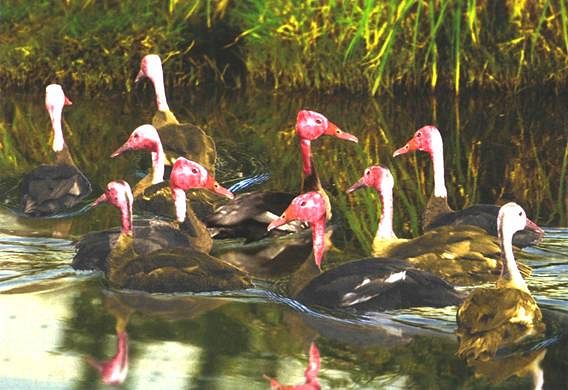
A Paddling of Ducks was written by a man passionate about waterfowl. From a young age he always wanted to have a duck pond of his own- and he did just that, building enclosed ponds and over the years keeping a wide variety of ducks and some geese. He traveled afar with other duck enthusiasts to collect eggs and find specimens- sometimes to try and bring home live ducks, other times to shoot them (enjoying a roast duck dinner) and at other times simply relishing at seeing a certain species in the wild. Most interesting to me was reading about his efforts to raise ducks, and a few anecdotes of duck behavior. I had just read in Sandy that bantam hens make the best foster mothers for baby cranes, and here Ripley advocates the same hen for hatching ducklings, explaining why bantams are better than incubators, or other hen breeds. Unfortunately, I am not really crazy about ducks, just mildly curious about them, so a lot of this book was rather dry reading. There are pages and pages describing the geographic distribution of the many different duck species, their migrating patterns, how they are related to each other, how the plumage of the ducklings varies, and particularly, enthusiastic descriptions of their beautiful colors. The book is graced by many fine black-and-white line drawings by Francis Lee Jaques, but without any titles to the pictures, I often had no idea which duck I was looking at. I wished for some color illustrations, and ended up looking up a few of the more spectacular-sounding or oft-mentioned ducks online, including the author's favorite eider duck, and the presumed-extinct pink-headed duck. If you know someone who loves ducks, this book would be an excellent read. For me, it was just piddling.

I read this book for the TBR Challenge.

Rating: 2/5                          256 pages, 1957

Jun 6, 2009

Life of Pi

by Yann Martel

Pi is the son of a zookeeper in India. When his family emigrates to Canada- taking as many zoo animals along with them as possible- the ship sinks, and Pi finds himself alone in a lifeboat with several animals, including a large bengal tiger. Before long, of course, the tiger has eaten the other animals- and Pi must use all his wits to stay alive in the confined space, on the rocking, endless ocean, with a hungry tiger. I loved all the details of this book- especially about animal behavior. This is a survival story, an animal story, a moral story, all in one. It was a shock to me to reach the end and find out that what I thought had been going on- and taken so much enjoyment in reading about- could have been something totally different. And I was a bit annoyed. For days I wavered back and forth, arguing to myself which way to interpret the story- and I'm still not sure! Life of Pi is one of those books that I found utterly engrossing- and totally frustrating at the end. It is lyrical, funny, and haunting. I can't give away the ending- but if you've read it, you must tell me which premise you believe in- was Richard Parker on the boat, in his beautiful furred coat? or was there some cannibalism going on....?

Rating: 4/5 ........ 326 pages, 2001

More opinions at:
The Curious Reader
Book Chase
Rabbit Reader
Andrew Blackman
You've GOTTA Read This!

Jun 5, 2009

Sandy

The True Story of a Rare Sandhill Crane Who Joined Our Family
by Dayton O. Hyde

I really loved this author's book about coyotes. The crane one, well, it just wasn't as captivating. Bird behavior and biology has never fascinated me quite as much as that of mammals, and so when the book felt lacking in detailed descriptions, my attention started to flag. Sandy is about a rancher's devoted efforts to save the greater sandhill crane, a relatively rare subspecies that at the time he began his studies was not getting much attention or protection. Parts of the book describe his work- rescuing eggs from floods, raising the chicks, trying to discover the whereabouts of his birds when they migrated alone and failed to return (one trio ended up in a zoo, but recognized him when he visited!). Other sections go into lengthy discourses on the importance of wetlands conservation, land management, and wildlife protection- mostly on behalf of the cranes, but also in consideration of other waterfowl and animals. There's several chapters full of reminiscings of the ranch he worked on as a young man, and while the author talks a bit about how he first became enchanted with sandhill cranes back then, it felt like a digression to me and at one point I nearly put the book down, because I wanted it to get back to the cranes! Also, in many cases he described the end result of some studies, but not how he reached them- which details I would have found interesting, but maybe that's just me. Hyde was the first to successfully raise sandhill chicks (with chickens as foster mothers!) and release them into the wild, instead of just ending up in zoos. He also carried out extensive surveys of their population numbers, and after years of work was considering something of an expert on cranes, giving advice on their management to some wildlife conservation organizations. These large, ancient birds (fossil records date back at least two and a half million years) are impressively elegant, I just wished they had graced the pages more fully.

I read this book as part of the 2009 TBR Challenge, hosted by MizB.

Rating: 2/5 ....... 214 pages, 1968

Jun 4, 2009

Meme: Sticky Books

At first when I saw this meme from Booking Through Thursday on so many blogs, I thought it was a "sticky post" about favorite books, but actually it's about books that stick in your mind. "Don’t take too long to think about it. Fifteen books you’ve read that will always stick with you. First fifteen you can recall in no more than 15 minutes." For me these are books I might have read years ago, but they made such a lasting impression on me I could easily tell you all about the characters, the setting, the plot, practically quote lines and conversations right out of the book. Perhaps when I'm not quite so tired I'll come back here and mention something about the less familiar ones...

Roots- Alex Haley
Amy's Eyes - Richard Kennedy
Gentle Gorilla- Susan Green
Ratha's Creature- Clare Bell
Ender's Game- Orson Scott Card
The Poisonwood Bible- Barbara Kingsolver
Watership Down- Richard Adams
Call It Sleep- Henry Roth
The Chosen- Chaim Potok
Dogsbody- Diana Wynne Jones
The Hobbit- J.R.R. Tolkien
Ariel- Steven Boyett
Dragonsbane- Barbara Hambly
An Edge of the Forest- Agnes Smith
The Clan of the Cave Bear- Jean M. Auel