Mar 30, 2015

The Sea and the Jungle

by H.M. Tomlinson

I didn't know what this book was about at first, but I found the cover intriguing- it looks like woodcut panels. (They follow the timeline of the journey in the book, but the two on the back cover are first, chronologically). The first line definitely caught me: Everyone knows that the purpose of a travel book is to make the reader miserably envious of the author. It's a travel book unlike any other I've read. It describes the route of a cargo ship, a steamer that in 1909 carried a load of Welsh coal from Swansea to ParĂ¡, Brazil and then up the Amazon river and a small tributary to a site near the San Antonio Falls where it sat "in port" for a month while inspections were made and cargo unloaded. The return trip went via Barbados, past Jamaica and landed at Tampa, FL from where our narrator caught a train to New York and made his final way home.

I haven't spoken of him. He's actually not much of a figure in the story itself- mostly an observer. It begins rather abruptly when Tomlinson is on his way to work, feeling bitterly oppressed by the daily grind, and stops to have conversation with a sailor on the street. This man invites him to take passage on the cargo steamer (it being short a few hands) and our narrator pretty much ditches his job, family and responsibilities in an instant to go along. (If you read the forward it becomes apparent the sailor was his brother, but still it seems very impulsive!) From there the book is all about the journey. I liked reading it, but the descriptions can be so dense it's hard to keep track of what you're reading about sometimes. The author has interesting insights and musing to share about everything he witnesses. The few momentous events seem to occur to other people, and there are a number of tall tales and travel stories told by other people met along the way. Tomlinson went aboard the ship in role of purser, which I understand means his job was to keep track of accounts, so he doesn't seem to do much but sit around chatting with people and watching everyone else work. It really does give you a vivid sense of place, the pitch and roll of the ocean, smothering heat inside the belly of the ship, characters of the deckhands (most did not speak English), the changes of weather, the sudden wall of greenery of South American jungle, glimpses of native people, birds and astonishingly gorgeous butterflies (never any wildlife larger than a peccary or anaconda), fears of mosquitoes and disease, and a crazy story about this railroad being built deep in the rain forest headed who knows where.

Certain aspects of the book reminded me vividly of The Lord of the Flies, Mister Johnson by Joyce Cary and State of Wonder but it's hard to put my finger on exactly why.

Rating: 3/5     302 pages, 1912

Mar 29, 2015

The Dangerous Book for Dogs

a parody
by Joe Garden, Janet Ginsburg, Chris Pauls, Anita Serwacki, Scott Sherman

Just the kind of light-hearted, amusing read I needed. A book of instructions pitched to dogs themselves, it includes advice on things like how to defend territory from the mailman, drive dinner guests from the house (with great subtlery), select the best shoes for chewing, get out of and destroy stupid costumes and train the owner to feed you when you want. The dogs' viewpoint on sharing a household with cats and the inevitability of bathtime (horrible but still vastly preferrable to visiting the groomer) were hilarious. Also pretty amusing were the doggy advice on how to woo a female in heat and why humans disdain the lovely odors of fresh dead carcasses and feces, but won't share drinks from their toilet bowl. In between the advice and instructions, there are tidbits on famous dogs in history and literature, most of which I found rather inane. But the one about the dog fighting a toaster was pretty funny.

Rating: 3/5         192 pages, 2007

Mar 24, 2015

Gifts of An Eagle

by Kent Durden
The author tells how he and his father raised and trained a golden eagle. At the time eagles were only protected at the state level, so they were able to obtain a permit to trap and keep a golden eagle for educational purposes. They studied the bird as it grew, keeping a record on film. They created short films depicting the eagle's flying skills and intelligence, and later created early nature films for Walt Disney and pieces that were used in the tv show Lassie. That was all pretty interesting, but most I enjoyed reading about the eagle's habits, how they interacted with and trained her, how she adjusted to new situations, how she bonded with the author's father while viewing the son as pretty much a sworn enemy for life. (Because he had to hold the eagle when his father trimmed its talons, and also was the one to trap the eagle when they re-enacted its capture for a film). It was fascinating to read about how the eagle became a foster parent numerous times- when she laid unfertilized eggs during the breeding season (having no mate) they replaced her eggs with fertile ones from other birds to see how she would raise them. Geese, ducks, owlets and last of all some actual golden eagles. So many interesting moments here, told very well. This book was a surprisingly good read. It made me laugh a good number of times.

Rating: 4/5      160 pages, 1972

Mar 22, 2015

The Bird Hospital

by Caroline Crowninshield Bascom

Another old book I picked up at a used sale somewhere, that wasn't quite what I expected. It's the firsthand account of a woman in the early 1900's who kept wild birds in her home, attempting to nurse them back to health. It began when as a young girl she was bedridden for long periods due to illness, and her mother brought in an abandoned baby bird someone had found to amuse her. Soon children in the neighborhood started to bring her birds as well- young ones fallen out of the nest, injured birds caught by cats, etc. Pretty soon she was known locally as the woman with "the bird hospital" and had a steady stream of avian patients.

While she was obviously kind-hearted and well-meaning, tenderly caring for her charges, it was also obvious that she was unfortunately ignorant about what the birds needed. This is my guess, because I'm not an expert myself, but I was surprised to read that she fed many baby birds a steady died of bread or crackers soaked in milk, that she gave birds she assumed had asthma sugar cubes dipped in whiskey, and many other birds got table fare on a regular basis, whatever they seemed to fancy. One bird she didn't know the name of but described in detail (I think it was a starling) became ill after eating some roses, was dosed with alcohol and promptly died. They also met with frequent accidents from swallowing string, or being attacked by her cat (which she constantly let into the room, with stern but unheeded verbal reprimands) and many simply died from unknown causes or escaped out windows the first chance they got.

All in all, it seemed from reading between the lines a dismal success rate, though she never lost her enthusiasm and conviction that she was doing well by them. It is fun to read about the birds' antics, her attempts at training them to sing along to the piano or come when called by their names. But I couldn't help feeling a bit sorry for them all, in spite of her evident fondness for them and desire to help.

Rating: 2/5      190 pages, 1905

Mar 20, 2015

Hummingbirds: My Winter Guests

by Arnette Heidcamp

Lovely little book written by a wildlife rehabber who specializes in the smallest of birds: the hummers. At first she just fed hummingbirds in her yard, then began tending to injured ones in her open sunroom. She became known as the lady who ran "Hummingbird 911" and this book describes a number of hummingbirds she cared for overwinter, so they could be released in spring when they were done healing and recuperating. The birds included a nestling found when a tree was cut down, a bird that was found severely injured after apparently running headlong into a window, one caught by a cat, and several others found wandering off-course when winter began, weakened without the reserves to migrate successfully. In each case the author describes how she fed and tended to the tiny birds- often having to invent new methods to safely handle them, due to their size. For example, one injured bird that could not preen got its feathers individually dried with a sable paintbrush. Another that needed extra protein (hummingbirds eat a surprising number of small insects such as gnats, whitefly and aphids) got fish food crumbled into its nectar solution. I learned a lot from her book about hummingbirds- their needs, biology, behavior and little quirks. I would like to read her other books especially the first one, because she glossed over a lot of details in this one that I bet were explained more thoroughly earlier- such as how she managed to get such sharply detailed photographs.

There was one interesting passage where she talked about the patterns of hummingbird migration, how certain species were being seen outside their usual area, speculating that they were expanding their range. While she couldn't help assisting the lost and injured hummers, she also wondered about the effects of humans intervention- rescuing the unfit birds where nature would have weeded them out, making the species as a whole stronger.

Rating: 3/5     204 pages, 1997

Mar 13, 2015

Gipsy Moth Circles the World

by Sir Francis Chichester

Another tale of a singlehander's voyage that I had on my shelf. It has some similarities, and many differences, to the previous one. In this case, the adventurer was a very experience sailor. He had a yacht custom-built for his trip, where he planned to circumnavigate the world stopping at only one port (Sydney, Australia) which had never been done before, and to do it faster than anyone ever had in a small vessel. Alone. He pointed out how different sailing is with an able crew, than one person solo. I was astonished that he even put to sea knowing all the things that were wrong beforehand- the boat wasn't balanced right, the sail yardage seemed wrong for its size, the keel wasn't big enough, it didn't steer well etc etc. I don't know what all the sailing terms mean, but even so I thought: I would never attempt to cross the oceans in that boat! Plus he had a serious leg injury right before leaving, and refused to see a doctor. Undaunted, he put to sea. And found many more problems along the way- issues with how the boat handled, leaks all over the place, moldy food and so on.

The book is based on his meticulous logs; some of it is about navigation and weather observations, most of it is a retelling of all the things that went awry and how he solved them. Ingenious fix-it-ups when things broke or malfunctioned. I was impressed that he baked his own bread during the voyage, grew cress, bean sprouts, mustard seed and wheatgerm for greens, and even drank seawater (small amounts) when he felt he lacked salt. Also impressed at how arduous it must be to sail alone- constant work to readjust sails and alter the steering whenever the wind and waves changed. Not to mention all the other work! Never any rest. Must be exhausting. I admit I could never face some of the things he did: re-baking moldy bread to eat it anyway, doing dental work on himself when he broke a tooth, going days on end of hard work with fragmented sleep.

And he did all this when he was sixty-five. Breaking several records for fastest-travelling sailing yacht of its size, longest passage without stopping at port, furthest distance travelled by a singlehander, and several others. His trip was followed avidly by newspapers at home, and he was met by adulating crowds and knighted by the Queen when he finally made it back to London (approx 8 months later).

I liked reading about his sightings- he was very interested in the seabirds, mentioned seeing whales or dolphins occasionally, not many fish. In one regard very marked difference with d'Aboville's account of crossing the Pacific in 1991, who remarked upon constantly running into floating plastic trash. Just twenty-five years earlier, Chichester made no mention of finding such pollution. Were the seas so much cleaner then, or perhaps he was too busy to notice it.

Overall, the book gets kind of tedious. It's fascinating to see what the experience was like, but I get lost easy in all the terminology. When he mentions doing this and that adjustment to such-and-such a sail to the boat's response in this way to that kind of wind, I just imagine things being tugged and swung around, but really have no idea. Probably this book is best appreciated by a sailor. It did give me a few great-sounding titles of other famed seafaring ventures, and cleared up some confusion I had when reading Rockbound. (In that book, the characters constantly groused about a seabird colony on the lighthouse island. They called them "the careys" and despised their burrowing habits which ruined the land for crops, and their stink. I couldn't figure out what these birds were. Chichester mentions seeing "Mother Carey's chickens" which he tells me are storm petrels. Ah! That puzzlement cleared up nicely.)

Rating: 3/5        269 pages, 1967

more opinions:
Loud Latin Laughing

Mar 9, 2015

Alone

The Man Who Braved the Vast Pacific- and Won
by Gerard d'Aboville

In 1991, this Frenchman d'Aboville rowed across the Pacific Ocean solo. From Japan to the American coast (his original goal was San Francisco but he landed in the small town of Ilwaco, Washington). It's quite an adventure story. Not the most gripping reading- although he describes his preparations, difficulties, encounters with sea life (few and far between), the overpowering emptiness of the ocean, its mood and weather, what it felt like to be so small tossed on the waves- it still did not compare to the fantastic storytelling that was Kon-Tiki, for example. The biggest question when I read this book was- why? why undertake such an arduous, dangerous exploit? D'Aboville states that a decade earlier, he rowed across the Atlantic- he often compared the two journeys- the Atlantic was calmer, warmer, much more populated with fish and sea traffic, and yet two other men who were attempting to row across at the same time he did, failed to make it. It turns out he just felt compelled to push himself to his limits, to prove he could do it. It definitely sounded like an ordeal. The cold, the wet, the tedious diet (mostly dehydrated meals), the loneliness (even for this is a man who prefers his own company more often than not). He kept accurate notes on his experience, took myriad photographs to document it- even in the midst of a storm or the turmoil that occured when his boat capsized. Which it did many times. It was a twenty-six foot rowboat with storage space fore and cramped sleeping compartment aft under the decks. It was specially designed just for this trip, had an ingenious water-pumping device to allow d'Aboville to right the boat when it capsized (with him trapped inside), solar panels for limited electricity to power his telex, and a radio among other things. The journey across the ocean took him 134 days. Several times he was passed by ships which invited him on board, and he refused- always determined to finish the crossing by himself.

When I first picked up this book on a whim, I thought from the cover image it was about a man who accidentally was adrift to survive the ocean- shipwrecked or something. Not at all- a deliberately planned venture of bravery and stamina. It's funny that one of the amazon listings for this book has a misleading subtitle: The True Story of the Man Who Fought the Sharks, Waves, and Weather of the Pacific and Won. There were no sharks!

It would be nice to read about his first venture crossing the Atlantic, but I couldn't find any evidence that he'd written a book about that.

Rating: 3/5        167 pages, 1992

Mar 7, 2015

Rockbound

by Frank Parker Day

On a remote island off the southern shore of Novia Scotia, young David ventures to claim a piece of land that is his by inheritance. It's difficult at first to make his livelihood and gain acceptance among the islanders. The community is mostly comprised of two families that are in constant friction- they argue over everything from who will marry whom, to whose task it is to fill a pothole in the common road. The harsh conditions and rough work make tough men, who are proud of their strength and skill. David finds his way among them, proving his worth and standing his ground against the "island king", an old man leader of one group of fishermen who makes all the important decisions. It was really intriguing reading not only the details about how fishermen make their living, but also the politics on the island, the gossiping and vying for power, the prevalence of ghost stories and superstitions. I was a bit surprised at how intent some of the men seemed to be on gaining wealth through their fishing enterprise, when they lived so crudely and seemed to just sit on the money. David's friend becomes keeper of the lighthouse on a small, even lonelier island and it was interesting again to read about the work involved in tending the lighthouse and ingeniously fixing it up when things broke and no supply ships could get in because of the weather. There's also a love story, acts of forgiveness and revenge, and a picture of how life on the island evolved over time. Machinery replacing some of the work done by cattle, women eventually getting to vote and choose their husbands instead of always being ruled by the men (even in these cases the men always had to save face in some way!) I even liked the details about managing the land- how the barren rock and thin topsoil was turned into rich gardens by composting with sea wrack- that appealed to the gardener in me!

Through it all there's the admirable character of David. He takes his hard knocks and comes through it. He survives shipwreck and debilitating injury, he doesn't stand in his best friends' way when they desire the same future. I thought it a bit far-stretched that this man could start reading Shakespeare's The Tempest shortly after learning how to read- but it made a nice allegory in the story. I almost didn't get into this book because at first the dialogue written in local slang really threw me off, but before long I was caught up in the narrative. There are some other disjointed parts in the beginning where the author suddenly tells what one character will do years ahead of the present storyline- and then jumps back into the flow- but after that it goes on fairly linear.

The afterword by Gwendolyn Davies is pretty interesting- it tells about the author's life and research, how the book was first published and its initially poor reception. Apparently the author had visited the fishing community on an island called Ironbound, to learn about the local culture. The inhabitants were offended when the book was finally published- though called fictional, they said it portrayed them in a bad light as being ignorant and crude. The book met strong disfavor and was out of print for over forty years, finally being reprinted in 1973.

Rating: 3/5       328 pages, 1928

Mar 4, 2015

The Marvels of Animal Behavior

edited by Thomas B. Allen

This book is from the National Geographic Society, part of their natural science library series. The chapters are written by over 20 different authors and scientists on animal behavior. Most of them from work in the field. A few are broad discussion on things like migration, how animals learn and different social orders among the animal kingdom. The majority have a specific focus: the shift of territorial boundaries between hyena clans, social order of bee colonies, echolocation in bats, how bison bulls vie for dominance, whale songs, penguin colonies, the courtship behaviors of fish. Featured animals also include storks, african lions, mountain gorillas, elephants, ants and wildebeest. Although the book is really outdated (for example, at the time it was written bat sonar and whale songs were new discoveries, nobody knew about elephants' subsonic communication and how birds navigate was still largely a mystery) I still learned many things and enjoyed the reading overall. For the first time I read the words of George Schaller! Another chapter is written by Dian Fossey (the other authors were unknown to me).

I recognized a number of the photographs- especially the ones of an albino gorilla- from my parents' collection of old National Geographic magazines- I used to look through the pictures a lot. Back then I hardly ever read the articles, so I don't know if the chapters in this book are just reprints of selected articles, or were written specifically for this volume. The publication data and acknowledgements are unclear on that. I did notice, if they were originally magazine articles, how focused they are on the science and the animals. Whereas I often feel that current articles I read (because I'm interested to learn about the wildlife) are just as much a travelogue- you get more about the place, its politics and relevant difficulties as information about the science and animals themselves.

Rating: 4/5         422 pages, 1972

Mar 2, 2015

Animalscam

the Beastly Abuse of Human Rights
by Kathleen Marquardt

This book is an opposing voice to animal-rights extremists. Using public quotes from animal-rights activists themselves and revealing machinations behind nonprofit organizations that claim to help animals, the author points out how absurd and harmful to mankind some animal-rights agendas can be, plus how money raised by some big-name organizations doesn't actually do anything to help animals at all. Funds not ending up where you think they should. People purporting to defend animals who use violent methods like bombing buildings and shooting at hunters. How activists stall research efforts that are working to help mankind by advancing medical science (not all research labs are poorly run or treat animals badly). She makes the case that animal-rights people are so for animals that they deliberately do things harmful to people, and that they would ban pet ownership altogether. And so on. Some of the arguments seem poorly put together, I am not sure how much of the quotes to believe- I'm sure they could all be found in public record, but guess that probably a lot are taken out of context to make their viewpoints seem more extreme. It's one of those books you really have to read with a lot of skepticism. A different take on everything. The author's voice comes across as pretty angry and judgmental throughout. This book is out of print. I read it some years ago.

Rating: 3/5        221 pages, 1993

Feb 26, 2015

neverending TBR

Deep Down Dark by Hector Tobar- At Home with Books
Very LeFreak by Rachel Cohn- Caroline Bookbinder
Threatened by Eliot Schrefer- library catalog
Stitches by David Small- Caroline Bookbinder
The Sculptor by Scott McCloud
The Room by Jonas Karlsson- Farm Lane Books Blog
The Brother Gardeners by Andrea Wulf- Puss Reboots
Indian Boyhood by Charles Eastman- Bookfoolery
The Wilder Life by Wendy McClure- Shelf Love
Some Luck by Jane Smiley- Caroline Bookbinder
Decoding Gardening Advice by Jeff Gillman and Meleah Maynard- Garden Rant

Green Grass, Running Water by Thomas King- Shelf Love
Into the Forest by Louis Nowra- Farm Lane Books Blog
The Vet's Daughter by Barbara Comyns- Shelf Love
Man v. Nature by Diane Cook- Shelf Love
The Brendan Voyage by Tim Severin- mentioned in Dance to a Dolphin's Song
Twenty Years A-Growing by Maurice O'Sullivan- ditto
The Virago Book of Women Travellers edited by Mary Morris and Larry O'Conner- Read Warbler

Feb 24, 2015

Dance to a Dolphin's Song

by Horace Dobbs

Dobbs was a scientist who studied dolphins. In the 1970's, several wild dolphins were observed off the coast of Wales and Ireland, which would curiously approach humans in small boats. Dobbs noticed the strong emotional impact that contact with a wild dolphin had upon people, and began to wonder if it could help individuals overcome depression. He invited "depressives" to come out and meet the wild dolphins, under his supervision and the eye of a film team. He wanted to find out as objectively as possible if contact with dolphins really helped people, so he filmed the encounters as a record (and made a documentary out of it all that appeared on british television). After two years of frequent interaction with one particular wild dolphin near a fishing village in Pembrokeshire, Wales the dolphin broke contact (which was always completely voluntary) and never reappeared. Dobbs and his team heard of another dolphin in Dingle Bay, Ireland that also approached boats, so they went there to continue the experiments. They not only tried different methods of attracting the dolphin's attention and enticing it to stay, but also approaches to filming underwater. The book is just as much about the filming effort as it is about the dolphin-human interaction, and the descriptions of underwater scenery and the ocean environment are riveting. It's amazing the trust and deep emotional pull people felt towards the dolphins- many of those who traveled from afar to have a dolphin encounter had never been in the sea before, some didn't even know how to swim. Others were so eager to jump in with the dolphins they didn't even wait to put everything on. Dobbs describes four individuals in particular who came several times to see the dolphins, and how they responded. One woman became part of his film project and the dolphin in Wales (called Simo) took a particular liking to her. He would tow her far out to sea, miles from the boat, to keep her attention to himself it seemed. I have to wonder at the animals' motives; reading between the line, the crew did not really seem to know much about dolphin behavior. It appears these were juvenile animals- were they out looking for adventure before settling down to adult life? ostracized from their pod? or just happened to be curious individuals, lacking normal fear of humans? Who knows.

What does seem certain is that close contact with the wild dolphins had a profound effect upon people (although there were a few individuals whom the dolphin ignored or spurned, and they felt the trip was a waste of time and money!) Many called it a life-changing event, most felt lifted out of their depression by it. Dobbs capitalized on this, founding an organization to bring people to the dolphins, producing various books and films about the encounters and creating recordings of dolphin sounds mixed with Australian aboriginal music. He asked people to listen to the tape and record their responses to see if that, too, could lift moods. The last few chapters of the book aren't about meeting the dolphins, but about the author's speculations on what contact with them can do for people. He briefly describes travelling to other locales around the world where close connections with wild dolphins were reported, and mentions other things like midwives who not only assisted women giving birth underwater, but in the sea with dolphins, and therapy groups that brought autistic children to meet dolphins as well. Pretty interesting stuff overall.

Note added 2/26/15 I forgot to mention this curious line on the publication page: Horace Dobbs has asserted his right to be identified as the author of this work What does that mean? was the authorship in dispute? I'm curious, but doubt I'll ever find out.

Rating: 3/5     192 pages, 1990

A Ring of Endless Light

by Madeleine L'Engle

Vicky and her family are spending the summer on an island with her grandfather, who is dying from leukemia. The story is about her search for a sense of identity and stability, while facing her grandfather's approaching end, and the unexpected deaths of several other people around her. At the same time she's juggling the attentions of three very different boys- a solid friend who wants to be more, a reckless spoiled rich guy who has obvious history with her family (they don't like him, and I don't blame them although I missed the backstory, not realizing at first this is the fourth book about the Austins) and a friend of her brother's who works in a marine biology lab. She gets involved in his dolphin study and through him meets some wild dolphins. Her natural ability to communicate with them grounds her through all sorts of difficulties. She's always got the wisdom of her grandfather to fall back on, her older brother and the shoulders of her friends, but she often feels alone and confused as well. The summer is full of new experiences for her. She's apparently used to being overshadowed by her pretty younger sister, but now is growing into her own.

I am pretty sure this book wound up on my shelf from a library sale or secondhand shop. I picked it up just because it was an unfamiliar L'Engle to me, with a girl riding a dolphin on the cover! It's the first beyond the Wrinkle in Time quartet that I've read. I think I would have loved this book as a teen, but unfortunately reading it first as an adult, I wasn't so impressed. And that saddens me, because so many other readers mention this is their favorite of the Austin family books. It's got a lot going for it- young teen longings, cute and mysterious boys, exciting moments with the dolphins, a very bookish and wise family. I think the main reason I couldn't really get into the story was, surprisingly, the amount of deep, serious conversations everyone had. About life, death, humans wrecking the environment, animal communication, cryonics, suicide, poetry, science, discoveries in outer space and so on. It was interesting reading and has some wonderfully quotable lines, but I don't know many people who actually talk like this to each other- always sounding so profound. It stretched my ability to believe in the characters. I really felt for Vicky though. There's so much death in this book, so much grief. They handle it very well. The part about the dolphins and their telepathic communication was almost too much. If the book had been more mystical maybe I would have gone along with it easier. It did make me curious to read An Arm of the Starfish, though.

I should hand this one to my ten-year-old and see what she makes of it!

Rating: 3/5       324 pages, 1980

Feb 23, 2015

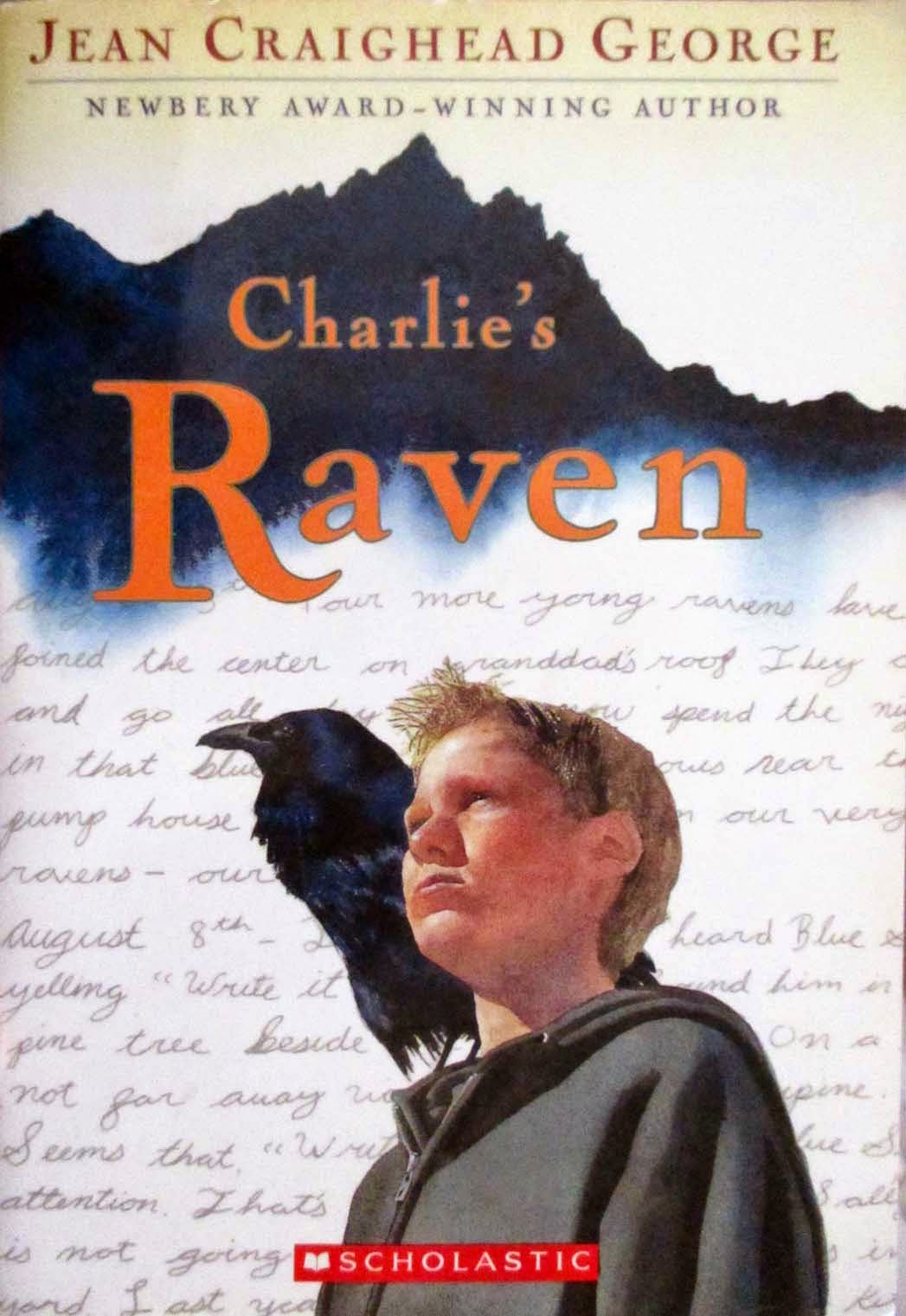
Charlie's Raven

by Jean Craighhead George

Charlie is visiting his grandparents for the summer, who lives in a small cabin near Yellowstone National Park. Charlie's beloved grandfather is suffering from a long-term illness. His friend from the local Sioux tribe, Singing Bird, is studying to be a storyteller among her people. She tells him of a legend that the presence of ravens can heal people. So Charlie steals a baby raven from a nest, and brings it home. His grandparents chastise him, but Grandfather (a retired naturalist) lets him keep the bird if he will make it part of a scientific study. So Charlie begins keeping notes, caring for the bird and closely observing its behavior as it grows.

Charlie is confronted with opposing opinions about ravens by those around him. Singing Bird says they are good luck. His grandfather admires their intelligence. And a new neighbor claims they are omens of evil, wants to drive them off his land. Charlie determines to find out for himself if ravens are "good" or "bad" by tallying up incidents in his notebook. Along the way he learns a lot about raven behavior and communication. He ends up with a mystery to solve too, when the raven comes of age and nobody knows where it goes (this continues part of a study his grandfather had given up on years ago). There's also a puzzle of why his grandfather's health seems to improve only on days the raven visits him in the mornings, and a problem to resolve with their neighbor who wants to shoot the ravens. It's a decent story, and I learned some things about ravens myself (the book even gives nod to Bernd Heinrich!) Some of the resolutions are a bit too convenient, but I liked it regardless. (It reminded me a lot of Coyote for Keeps, even though I haven't read that book in ages).

Rating: 3/5       190 pages, 2004

Feb 22, 2015

Marley

A Dog Like No Other
by John Grogan

I was right in my initial guess about this book. This is a middle-grade version of the book Marley and Me, simplified for younger readers. For what it is, it was pretty well done. Even though it doesn't really have any new material and all the main incidents and jokes were familiar to me.  I read it in one sitting, laughing all over again. It's been long enough since I read the first book that I had to stop and think to remember what portions had been left out. I still prefer the original, but this one is pretty good too. And has less of the serious moments, the adult issues and dealings with raising kids. It's mostly just about the family dog.

Rating: 3/5   196 pages, 2007

more opinions:
A Year of Reading

Feb 21, 2015

All Moms Go to Heaven

by Dean Hughes

I'm not sure where I picked up this book, I probably thought it looked cute. I didn't realize at first that it was written by a promient LDS member who has penned a lot of popular LDS historical fiction and children's books. Well. It started out pretty good, the author describing a summer he spent at home caring for his children while his wife worked on her degree. The chaos, funny moments and realizations about how difficult it can be spending all day with small children were familiar. He seemed to feel he'd earned his badge as stand-in "mom" and refreshingly, admitted to his own mistakes in parenting as well. But there's not much depth (even for a book that's so short) and the amusing conversations with his children are nothing compared to a favorite of mine, Conversations with Adam and Natasha. And before you get halfway through, the book starts to go downhill. It's still nice enough. Full of stories about mothering skills and incidents surrounding the children and women in his extended family- his grandchildren, his own wife as a mother and grandmother. There was too much of him being careful to name every person mentioned, give them credit, and excuse where he might sound critical, than actual storytelling. In the end, it reads more like an essay or a written "talk" than a proper book.

Rating: 2/5        95 pages, 2005

Feb 19, 2015

How to Speak Dog

by Stanley Coren

I've read many books before that describe the communication methods used by dogs, and how people can successfully interact with them. But none with this level of depth, detail and comprehension. Coren very systematically looks at the "language" of dogs- how well they understand spoken human words and human gestures, or can be trained to do so. What the wide variety of sounds they make specifically mean, plus all the different uses of body language, and the combinations thereof- which can vary meaning and nuance more than I had realized. How cross-communication works, why cats and dogs are classic enemies (many of their basic body signals mean opposite things). How dogs communicate with scent (hilarious story in here about a man who tried urinating around his wife's flower bed to deter neighborhood dogs from digging in it). He uses scientific studies, personal observations and carefully examined anecdotes to demonstrate the discussed communications (or miscommunications, as it were). Even points out why some methods used by humans to dominate their dogs, or teach them who's "leader of the pack" such as flipping a dog forcefully on its back or biting it on the nose (!) are misguided and won't get the result you want. Through it all there are interesting passages on the evolution of dogs, comparison of dogs to wolves, comparison of dog intelligence to that of children (about equal to a two-year-old's, although their concerns with social status and the doings of other dogs are more adult in nature), descriptions of studies on animal intelligence and communication with other species (many familiar names here- Clever Hans, Washoe and Koko, but also new insights and other individuals I had never heard of before).

To sum it all up- yes, dogs have their own form of language. They understand a lot, and can read incredibly subtle body language. When confronted with a fearful or aggressive dog, you can mimic canine gestures to give a dog confidence, or appease a possible attacker. You can use dog langauge to let your dog know you're definitely the boss in the house, but that he's accepted and loved. I was surprised at how many kinds of dog expression are often misunderstood by humans (for example, a dog who leans his body against you is trying to assert dominance- if you move aside, giving way, you've confirmed his higher status. Same with a dog who sleeps on your bed, or demands food from the table, etc). Fascinating stuff. A book I think every dog owner should read.

Rating: 5/5        274 pages, 2000

Feb 15, 2015

Woman's Best Friend

edited by Megan McMorris

From a collection of women writers, short stories and reflections about their dogs. The search for the right dog, the connection and depth of bond with an animal- whether it comes quick and easily, or slow and unexpected, sometimes reluctantly. A few amusing moments, but more of them are thoughtful, perceptive, precise in detail and pinpointing emotion and meaning. There are first dogs, training efforts, animals whose companionship helps women through tough times (more than one story about loss, divorce and the search for new connections). There are stories about finding an animal, and stories about loosing one. Nearly all of them resonated with me in one way or another. Very good reading.

I was at first dismayed that I only recognized two of the authors' names, until I read the short bios in the back and learned that most of them usually write for periodicals- thus I am unfamiliar with their names. I liked their words here.

Rating: 4/5       305 pages, 2006

Feb 8, 2015

Tails from the Bark Side

True Stories from the Family Dog Files
by Brian Kilcommons and Sarah Wilson

I've been busy lately. With work, with my kids, and trying to get my aquarium healthy. Not much reading time, and that in bits and pieces. Which this book was perfect for- a collection of brief stories from the lives of two renowned dog trainers. Mostly about experiences in training dogs and teaching people how to properly handle their dogs. These are wealthy clientele, as the authors lived and worked in New York. They also had a training center or kennel in a rural area of New York state, and there are a few stories from early days in vet school as well. (The stories are not arranged chronologically and sometimes I was left confused at the setting or context- a bit more could have been explained). In spite of their brevity, the anecdotes were all fairly interesting and informative. Some funny, others sad. I was honestly stunned at the story of a bodyguard who wanted a protection dog trained. Very upsetting. Most of all what shines through these stories is the authors' skill in working with dogs, and their patience with foolish, ignorant or cruel owners- they always try to help and educate people when it would often be easy to express anger or ridicule. I also liked reading about what it was like running a kennel in the middle of a big city- I could relate to some of that, having briefly worked in a kennel once myself, but many aspects of it were very different!

Do you ever find unexpected connections between the books you read? I'm always tickled when they reference each other. Turns out these authors have worked with Roger Caras (they named one of their dogs after him) an animal expert and author I read widely in my teen years. Caras is just mentioned briefly here (perhaps he didn't want stories about himself in someone else's book.) They have also worked with Barbara Woodhouse while using dogs in films for television- and it was really interesting to see through someone else's eyes this woman's methods and personality. (I knew it was her before they even gave a name, because the first sentence of that chapter mentioned a woman who rode her own cows and trained horses in Argentina for the army!)

Rating: 3/5       233 pages, 1977

Jan 26, 2015

From Baghdad, with Love

by Lt. Col. Jay Kopelman
and Melinda Roth

In 2004, a military unit stationed in Iraq finds an abandoned puppy and starts feeding and caring for it in their quarters. It's strictly against the rules for Marines to feed stray animals or keep pets, but their colonel becomes so attached to the puppy he becomes determined to get it out of the country and home to America. So the story isn't really about the dog. It's about all the events that surround the dog- the secrecy, emails and letters and pulling strings and getting support of big-name pet product companies and volunteer groups back home, to do whatever it takes to get the puppy out. Then the smuggling operation to move the puppy across boarders and home on a plane. It's also about military life, local politics and conditions in Iraq- the stress and fear and confusion. Most of all, Kopelman doesn't want the little dog to die, as so many strays do there on the streets (shot to control disease and keep them from eating dead bodies). He succeeds in rescuing the puppy- but unfortunately I lost interesting in all the technical details of how. I really wanted to like this book- it's such an inspiring story and apparently had a lot of media coverage, but unfortunately it's not very well-written and couldn't hold my attention. The chapters are really too short to be called such, there's very little depth and too much casual slang (it's written the way someone talks) and in the end, even the font started to annoy me. If you like military stories, you might appreciate this one, and if you like animal stories it's good to know the dog doesn't die- but for me this wasn't it.

Abandoned      196 pages, 2006

more opinions:
Bookslut
anyone else?

Jan 23, 2015

Doctor in Love

by Richard Gordon

In this installment of the Doctor series, young Gordon is still pretty fresh out of medical school. He's given up hopes of passing the exams to become a surgeon and establishes himself in a general practice instead. Far from being resigned and resentful at giving up his dreams of surgery, he pitches himself into the practice with eagerness to do his best- I admire that attitude. When the residing doctor goes on extended leave for his own medical problems, Gordon has to run the practice with all its upheavals- an irritatingly irresponsible partner, lack of staff and so on. There's also stories about the various lodging houses and odd flatmates (as before) and a new development when he falls in love with a new partner (surprised that this doctor is a woman), sets his sights on marriage and goes house-hunting. All good tales, and it still got a few chuckles out of me, but somehow I wasn't quite as entertained this time around. I think because there simply weren't as many medical stories, no case studies. It wasn't as much about how he practiced medicine, as his dealings with co-workers, prospective employees, annoying roommates, his new love interest and the like. It was interesting to see the different mindsets from the fifties- still a lot of stereotypes about women, although feminism was a newfangled idea here- and also the National Health system seemed to be new as well. There were a lot of complaints about it, from doctors and patients alike, and comparisons to the "old way" of doing things. So it's a bit of a historical read, as well. Light fun, but one I'm not going to keep. I had to make myself finish it.

Rating: 2/5       188 pages, 1957

Jan 22, 2015

Stellaluna

by Janell Cannon

Stellaluna is an adorable young fruit bat. She is accidentally separated from her mother, and adopted by a family of birds- but only if she can follow mother bird's rules of conduct. So Stellaluna tries to adjust and learn to live like the birds- although some things make her miserable (eating bugs) and she's particularly awkward at landing upright. When Stellaluna learns to fly she is discovered by other fruit bats and learns her true identity. Then she wants to introduce her bird friends to her bat family- only to discover that they find bat manners just as strange!

This is a lovely picture book. It's a wonderful story about friendship and acceptance, teaching children about the biology of bats and birds at the same time. The end of the book has some facts on bats as well, for those who want to learn more. I have to share some of my favorite pictures with you:
especially this one

Rating: 4/5       48 pages, 1993

more opinions:
The Well-Read Child
The Reading Tub

Jan 20, 2015

The Secret Life of Squirrels

by Nancy Rose

Mr. Peanuts is not an ordinary squirrel. He has quite the refined life- playing the piano, baking cakes, reading from his tiny library. He mails a letter inviting his cousin to come visit, and is shown making preparations- tidying the bedroom, doing laundry and so on. When cousin squirrel arrives, the two enjoy visiting an ice-cream parlor, going on a picnic, and playing chess among other things. Mr. Peanuts is sad to see his cousin go when the visit is over- having discovered that your favorite activities are more fun when you have a friend to share them with!

The pictures in this book are just delightful- showing real life squirrels among miniature furniture and sets. I thought at first these must be tame squirrels, but it turns out they are wild animals that visit the author's backyard. She describes in the back of the book her process for taking the photographs (creating tiny sets, baiting them with peanuts, waiting for the curious squirrels to arrive and taking dozens of photographs to capture just the right pose). My kids really enjoyed this book- the youngest loved seeing a squirrel doing "people things" and her older sister spent a long time looking at the pictures, to guess how the author made all the miniature items. The author has a website too. There's an article about her work here, with more pictures.

Rating: 4/5          32  pages, 2014

more opinions:
Indextrious Reader

Jan 18, 2015

Doctor at Large

by Richard Gordon

This third installment of Ostlere's Doctor series (I don't have the second volume) follows young Dr. Gordon soon after qualifying. Searching hopelessly for a good job. Filling in as assistant for different general practices- varying widely in quality and all which turn out to be intolerable circumstances. Or just don't last. So he ends up back at St. Swithin's hospital, working as assistant to the house surgeon, trying to polish his skills and keeping an eye out for a better position. There's flirtations with nurses, dealings with unscrupulous hiring agencies, to-and-fro with his friends and rivals. Lots of laugh-out-loud moments. Some puzzlement from this reader at bygone practices- I don't quite know enough to be sure, but every time the young doctor groaned that a practice didn't have the most up-to-date instruments and equipment, I felt sure that the items he mentioned would nowadays be found in a museum! And I did wonder at how many surgeries involved removing the stomach. It seemed to be a certain surgeon's favorite procedure. Did that really cure the ailments they were hoping to? All in all, a good fun read.

Rating: 3/5      208 pages, 1955

more opinions:
Retrospace

Jan 14, 2015

I, Freddy

by Dietlof Reiche

Cute book about a golden hamster with high ambitions. Freddy is born in a crowded pet shop cage. He doesn't like tussling with the other hamsters (contests of strength) and questions the matriarch's tales of a promised land of Assyria (where golden hamsters originated). He wants to get out of the cage and find a better life, so is thrilled to finally be bought as a pet for a little girl. The move into a new home is stressful for Freddy, but he soon overcomes his fears and starts observing. From watching the little girl do homework he learns to read (quickly surpassing her skills) and he also figures out how to open his cage and roam the house. This is not without danger. The Mom (presented as a really negative character) turns out to be allergic to hamsters, so Freddy ends up in a different household where he must confront a very self-assured cat and two nutty guinea pigs who like to crack jokes at his expense. Freddy despises them, but must enlist their help if he is to follow his dreams- to improve his reading skills, and learn to write. He wants to communicate with his human captors, although the cat warns against this. It's a fun look at things from a hamster's perspective (sensitive to smells, passionate about mealworms, proud of his clean and tidy habits) with an engaging story that actually surprised me a few times.

Rating: 3/5        203 pages, 1998

Jan 13, 2015

Doctor in the House

by Richard Gordon

From the fifties, the retelling of a young man's forays through medical school at an imaginary teaching hospital in London called St. Swithin's. As the author was a surgeon himself, I'm pretty sure he was drawing on his own experiences (probably with embellishments) and gather that the picture of medical practice in that bygone era is more or less accurate. It's full of humorous incidents and very lighthearted. My knowledge is very general from a layman's perspective, but I was still horrified at some of the ways patients were treated- surgery was used to cure all manner of ills that seemed entirely unrelated, for one thing. Most of it though, is about life as a student- dealing with roommates, inscrutable professors, cramming for exams, ineffectively trying to date nurses and so on. The shock of being presented with his first cadaver to dissect. How quickly the students got used to such things. The chapter where he was sent out on midwifery rounds, on a rickety bicycle through damp streets to dirty tenement houses, reminded me so much of The Midwife. I felt sorry for the patients the medical students had to practice on, but they often seemed proud of the attention their ailments garnered! It's an amusing read and the writing even reminds me a bit of James Herriot.

I picked this book (and two of its sequels) at random from a secondhand sale once. Never heard of them before. I've found out that they were very popular in the sixties, the author (whose real name is Gordon Ostlere) wrote thirty-seven books in the series, and there was a television show made. Apparently the first handful of Doctor books are semi-autobiographical, after that they (according to wikipedia) get fictional, including a lot more "sexual innuendo and farce." I have a hunch I'll prefer the early novels. Not to go searching for, but if I come across more on book-hunts I'll probably pick them up.

Rating: 3/5       190 pages, 1952

Jan 11, 2015

The Alley Cat

by Yves Beauchemin

Florent has a dull job as salesman for a record company in Quebec. He's always wanted to own a restaurant. One day an act of kindness to a stranger on the street attracts the attention of an elderly wealthy man, who puts him on the path to buy a local restaurant. Florent is thrilled but baffled at his benefactor's intentions. As the restaurant changes hands and Florent with his young wife and several friends work to get things running smoothly, strange incidents begin to occur. Several of which threaten to ruin their budding restaurant business. Eventually it throws them into poverty, and Florent must search out other means to make a living. He tries his hand at various business ventures, but every time the old man crops up again, seems to have his hands behind everything. It gets very convoluted and distressing. Florent starts finding connections between all kinds of disparate people in his life, and just when things start to look up again and they think the strange benefactor has disappeared, the creepy old man shows up yet again. Eventually Florent does manage to establish his own restaurant again, and his conflict with the old man reaches a drastic conclusion.

There are all sorts of interesting things going on- descriptions of the restaurant business, antiques dealing, overseeing a building restoration, and even a venture which never becomes actualized but sounded interesting- making beauty products with grapefruit leaves. By far the most interesting character is a beastly little boy whose mother practically ignores him- he's discovered alcohol and buys or steals it whenever he can, dragging around his pet alley cat. He behaves hideously, but firmly attaches himself to Florent and his little family, somehow winning their affections and getting himself mixed up in all kinds of stuff. I was also intrigued by a character who was pretty much disparaged or pitied by all the others- a priest who had a passion for books, neglecting his duties and boring everyone with his quotations- it was obvious that reading was considered by the others an irresponsibly escapist pastime! Also the constant raging of a certain chef against American concoctions that he claimed were ruining culinary interests all over the world amused me.

This is a strange book. I almost put it down several times, but the story kept taking interesting turns, even though I couldn't always follow the intrigue. As events progressed it got more laughs out of me, and a lot of puzzlement as well. It's one of those books I might read again, just to see if I can figure it all out. The more I think about it, the more I actually like it.

The Alley Cat was originally published in French, it's been translated to English by Sheila Fischman.

Rating: 3/5         450 pages, 1981

Jan 8, 2015

another TBR list

for the new year- catching up on a backlog of book titles I have noted in the past weeks, but not listed out or looked up (source) until now:
The Sixth Extinction by Elizabeth Kolbert- Shelf Love
Rules of Summer by Shaun Tan - Stuff as Dreams Are Made On
Dirty Chick by Antonia Murphy- So Many Books
Burma Chronicles by Guy Delisle- Ardent Reader
Cooked by Michael Pollan- Farm Lane Books Blog
As You Wish by Cary Elwes- It's All About Books
Eating Animals- Jonathan Safran Foer- Stuff As Dreams Are Made On
What We See When We Read by Peter Mendelsund- Indextrious Reader
Feral by George Monbiot- Shelf Love
Proust and the Squid by Maryanne Wolf - Indextrious Reader
The Sleeper and the Spindle by Neil Gaiman- Iris on Books
Between Gods by Alison Pick- Indextrious Reader
While You're Reading by Gerard Unger- Indextrious Reader

Dec 31, 2014

2014 book numbers

Not that I obsess about stats- I don't even think about it most of the year, and this time didn't keep a tally sheet- so it's a bit tedious to count up the numbers. But it's still nice to see how things ebb and flow, how my reading habits change over the years. I'm following same pattern as 2013 and 2012 (in terms of what I count/look at) here. Please note- numbers don't always match up to the total because some books are in more than one category, and that's just how it is.

Total books read- 105

Fiction- 36
Non-fiction- 69

non-fiction breakdown
Art- 8
Gardening- 5
J Non-fiction- 6
Memoirs- 15
Nature- 5
Animals- 55
Other- 10

fiction breakdown
YA- 7
Historical Fiction- 15
Fantasy- 3
J Fiction- 8
Picture books- 28 
Animals in Fic- 23
Baby books- 6

other formats
Short stories- 2
Graphic novels- 1
Ebooks- 6

sources
Owned- 59
Library- 69
Review copies- 3
Borrowed from a friend- 2

other numbers
Abandoned books- 13
Re-reads- 1

This year I didn't include picture books in the general tally (that feels more honest). And I read far more of them to my kid than the mere 28 I blogged about. So of course the numbers aren't perfect, but you get a general idea.

Places I visited in books this year: various South American and African countries (notably the Amazon jungle, Zululand and Somalia), rural Italy, Northumberland, several remote mountain peaks including Everest, Afghanistan, Holland, Poland and the South Pacific.

Great books? It seems none of the fiction really stood out for me this year (I'm still leaning heavy into non-fiction reading). The best all-around fish book (lots of those!) was The Simple Guide to Freshwater Fishkeeping, the most stunning art/photography book was The Life and Love of Cats and my favorite picture books were Extra Yarn, The Curious Garden and The Squirrel Wife (I'd add all those to my kids' collection if I find them).

Yeah, not so exciting I know. How was your reading year?

Dec 30, 2014

The Cat

by Edeet Ravel

This story is not really about a cat. It is about navigating grief. A lonely mother, isolated from friends and family, is devastated by the loss of her only -and very much cherished- son when he is accidentally hit by a car. On the roadside in front of her house, no less. She locks herself up, refusing visitors, turning off her phone and closing email, in effort to deaden the pain. She wants to end her own life, but realizes (with horror at first) that she cannot abandon the cat her son loved- she must stay to take care of it. The story follows her thoughts and memories through numbness, pain, anger, resentment, guilt and finally to an outlook of possible hope and recovery. It took a little while for me to realize she was not only avoiding people because of her pain and anger- her whole life had been spent feeling mostly alone, shamed by the birthmark on her face. Through the pages you learn about a painful childhood, an only friend lost long ago, a few college lovers whom she felt betrayed by, a complicated mix of family she mostly avoids. But finally she reconnects to a few people and realizes they still do care for her, after all the years apart. For a relatively short book, it's very intense.

Rating: 3/5       221 pages, 2012

more opinions:
Book Chase
The Indextrious Reader
Bibliophile by the Sea
the 3 Rs Blog

Dec 29, 2014

October Light

by John Gardner

Okay, so has anyone out there read this book and can tell me more about it? Because I'm really wondering if it has any merit to continue on, or should I just throw it down as I feel wont to do. I looked at some reviews online to get a better feel of this book- seems people either love it as being a great work, or find it awful and tedious (as I did). This is as far as I got: it's a turn-of-the-century novel about two elderly siblings in a farmhouse and the man hates his sister and locks her in a bedroom where she reads a crappy novel that's also interspersed in this novel. And they plot against each other. And the old man is bitter and scornful of everything around him. I was intrigued by one aspect: how the elderly people felt proud of their skills and knowledge and looked down on newfangled inventions that made life easier. One scene in particular was vivid: the old man smirking at another on the roadside whose car (new invention) had stalled from the cold, while he sat up high on a sleigh pulled by two strong horses- warm living flesh that would always function, not rendered inert by cold like the machine. The description of him baffled me, though. I picked this book up because I remember liking Grendel (same author) in high school, but this one I don't seem to be able to read. The long-winded descriptions loose my attention and the characters confound me- I don't understand them, and I don't like them so I don't care to try more.

Abandoned     440 pages, 1976

Dec 24, 2014

Animal Talk

by Karen Gravelle and Anne Squire

This book is all about how animals communicate, with each other and with us. It's written for young readers (I would say age group eight to twelve) but is very informative and I even learned a few things (that ducklings coordinate their hatching time by responding to the mother's calls through the shell, and that rattlesnakes can't hear the sound they produce with their own tails!) While none of the topics are discussed in a lot of depth, they are all clearly presented. Each section is headed with a short descriptive passage of an animal interacting with others, and then the following chapter explains how this is possible. Not only the different methods animals use to communicate- sound, scent, touch, body posture and so on- but also why their communication abilities differ (animals that live underground or are nocturnal don't use many visual signals, for example). Animals featured in the book include honeybees, rattlesnakes, prairie dogs, housecats, chimpanzees, songbirds, elephants, seals, deer, frogs, sheep and even certain fish (which pulse electric signals to each other)! The final chapters discuss why dogs are so good at communicating with people (we share many similar types of signals) and how humans have taught signals and rudimentary language to dolphins, chimpanzees and gorillas. I was familiar with the apes briefly presented here- Lucy, Washoe and Koko. Even though this book is written for kids, it was a satisfying quick read for me.

Rating: 3/5        114 pages, 1988

Dec 23, 2014

Talking to Animals

by Barbara Woodhouse

An old book I picked up at a secondhand shop once. The author is an adamant animal-lover, and she tells of her life with various animals, how she raised and trained many, her methods and affinity with them. She can be stern but mostly comes across in this book as training animals with encouragement and praise. The book opens with her childhood around horses and dogs, and she tells of attending an agricultural college when few women were allowed to. She then went to visit friends at a cattle range in Argentina and ended up staying on and working for them, stepping in wherever needed- as much as they would allow! Women weren't supposed to break horses, so it took some cleverness on her part to be allowed the chance, and once the men saw she could train a horse in a few days with gentle methods, she got the job to break and train horses continually. Returning to England she faced hard times during war years, had to sell her horses but started keeping dairy cows to sell milk in the neighborhood- so there's a lot about her work with cows- not only how she kept them and got extra yield, but also how she let her children ride the cows and eventually was called up anytime someone wanted a cow to use in a film! because hers were known for being docile and that she could "do anything with them." When the war ended her household moved, and she began buying and selling cattle, but eventually got back into training horses again, and then tried to get her favorite dog- a great dane- acting in films as well. She found it difficult and tiresome to deal with film companies, but became known as a dog trainer and took up running dog obedience classes as well. This was not a woman to ever take no for an answer- often she got around regulations for her dairy cattle, she made and produced her own film on dog training and self-published a book about her great dane. There are a lot more stories in here, all wrapped around the animals, her love for them, and her claims that upon initially earning an animal's trust, she could teach it to do anything she wanted.

I found particularly interesting the description of her time spent in South America, the different customs there and methods they used to manage livestock and train their horses. She also tells of becoming diabetic while she lived there, and nearly died of the condition until she took a local remedy from a tree which she claims completely cured her.

Also a curious passage which made me wonder about the origins of the nursery ryhme/song "Rock a Bye Baby". She tells of a native custom where if a baby died, the people did not want to put the body underground but instead would tie the small coffin up in a tree. And a storm blew it down. And they collected the remains and tied it up again. She doesn't say how long they would leave the coffin in the tree- indefinitely?

Rating: 3/5        208 pages, 1974

Dec 20, 2014

The Devious Book for Cats

a parody
by Joe Garden, Janet Ginsburg, Chris Pauls, Anita Serwacki, Scott Sherman

Funny book about why cats do what they do, written as if it's one cat giving instructions to another. From how to wake your human, napping styles, methods to employ in a cat fight, planning secret missions (against humans in the household of course) to the horrors of the crazy cat lady, waging war against the vacuum cleaner and more. Dogs are absolutely dismissed. There's also, interestingly, notes on how to handle the indignity of being declawed (an enterprising cat can still disembowel an armchair to launch a sneak attack). And notes on what kinds of dead prey make the best gifts to a human provider. Also some kitty viewpoints on famous cats in history, wild feline relatives, cats from comic strips and online personas. If this book had been published some years later, I'm sure it would have featured Maru, Grumpy Cat or (one of my favorites) Simon's Cat. As is, I learned about the origins of the lucky Japanese Maneki Neko cat figurines. It's an amusing book, and pretty true to the character of cats, but not one I'll actually keep on my shelf. Because I've seen it done better, in a book called The Silent Meow- which this one only made me want to go read all over again.

Rating: 3/5       213 pages, 2008