Jan 1, 2017

Love: the Lion

by Federico Bertolucci

Life of a lion. This one follows the doings of a solitary male, distinguished by his dark mane. There's a lot of iconic african wildlife scenarios in here- wildebeest and zebra crossing a river getting ambushed by crocodiles in the water and lions waiting on the other side, lions and hyenas battling over a carcass, vultures coming in for the remains. Male lions shown hogging the food, but also using their prowess to bring down prey solo. The storyline of this one is a bit confusing as it shows the clash of two different lion prides, and sometimes it's hard to tell exactly what is going on. There's a lot of bloody encounters- between predator and prey as well as rival lions. And the ending is actually quite sad- unlike the other two novels, this one shows the individual lion's memories -depicted in sepia tones- which adds some emotion to the story.

Unfortunately, I was more annoyed with inaccuracies in this book than in the previous two. Some are petty criticisms, but they bother me because the artist is obviously so good at drawing form and proportion I am disappointed with things like this. Young wildebeest don't have the same coloring as their parents. The stripes go a different way down the spine of a zebra, than shown from above here. And while the cheetah cubs here seem to sport their silver mantles (I wish there were more cheetahs in this book, they were beautifully illustrated) why do none of the lion cubs have spots? What really jolted me out of enjoying the story though, was again the portrayal of animals in the wrong habitats: lions and hyenas in jungle-like scenery, fighting over what appears to be the carcass of an okapi. I know it's fiction so the author can take some liberties, but a few too many and it ruins my ability to really immerse myself in the story.

This graphic novel by Frédéric Brrémaud with artwork by Bertolucci is the last one my library has, although I see there's another in the series which features a dinosaur. I am sure I will be able to enjoy that one without much complaint, as I don't know enough particular facts about dinosaurs to recognize any flaws!

Rating: 3/5      82 pages, 2015

More reviews:
Snips and Snails and Puppy Dog Tales

Love: the Fox

by Frederico Bertolucci

Another graphic novel by Brrémaud and Bertolucci, with fantastic artwork and dramatic scenery. This one is about a fox that lives on an island, apparently near arctic regions. It's way more dramatic than the Tiger book, because a volcano erupts on the island and the animals scramble through the ensuing chaos trying to survive. While the thread follows the fox as it bolts through the harrowing landscape of fire and ice, it also diverts to show what other animals are doing- in a way reminiscent of Sally Carrighar's One Day at Teton Marsh, depicting the intersecting lives of many different species. There is a scene involving a whale and her calf fending off a pack of orcas, who lurk just offshore waiting to prey on sea lions and other animals. There is an encounter between a polar bear and an alaskan brown bear. I'm a little confused at the representation of species because the book shows musk ox in forested areas, and mouflon leaping around rocky peaks- but I don't think those two animals live in the same regions. And while the artist's sketches of foxes in the rear of the book are lovely, the one featured in the book is a bit too cute for my taste- with a very fat plume of a tail always carried high even when situations would probably make it hold the tail low in fear or caution. (There's a fox briefly shown in the Tiger book, and I much prefer how that one was drawn). I also have a kind of pet peeve with people who don't know that baby animals have slightly different proportions or markings than their parents- case in point, young foxes don't have a full bushy tail, but a narrow one. Even a yearling fox won't have a full brush yet. Oh well.

The illustrations showing underwater scenes and marine life are really captivating. The drawings of gannets are wonderful. It's the kind of book I want to hold onto for several days to look at again and again (my little criticisms aside).

Rating: 3/5        82 pages, 2015

More opinions:
Snips and Snails and Puppy Dog Tales

Dec 31, 2016

Love: the Tiger

by Federico Bertolucci

I saw this book mentioned on another blog somewhere (was it you?) and while it didn't land on my actual TBR list, when I wanted a light read this week I picked it up along with several other graphic novels at the library. It is authored by Frédéric Brrémaud although there are no words, the pages are all full of gorgeous artwork by Bertolucci.

It depicts the life of a tiger in the jungle. Most of the pages are taken up by images of the tiger prowling through the undergrowth and stalking prey. He has an awful lot of near misses. Gets harassed by monkeys, bitten by ants, a near encounter with a crocodile and fights some rival black panthers. Tries again to catch a meal- usually seems to be after a tapir (who has unusually large ears). Life as a tiger seems difficult. In the end the tiger does get his meal, an unexpected one.

Really the pictures are breathtaking. So much atmosphere, detail, fierceness and beauty. I had not heard of this artist before but he is amazingly good at drawing animals. Especially birds- and they're not the main focus. I really liked the final few pages that show some original sketches and studies done by the artist, and you can see a lot more samples online. Beautiful work.

Rating: 3/5    82 pages, 2011

More opinions:
Snips and Snails and Puppy Dog Tales

Dec 30, 2016

Mr. Sponge's Sporting Tour

by Robert Surtees

This book from the mid 1800's is about a man of limited means who acquires three rented horses, puts on airs and basically invites himself to the homes of various folk in the countryside so he can attend fox hunts (which he also invites himself to). He banks on the fact that nobody knows him, to be able to get away with things- people pretend they know of him to avoid looking ignorant, and he lets them make assumptions about his social position etc, takes advantage of free room and board until he seriously wears out his welcome, and they make efforts to throw him out. Then he moves on, finding someone else who had extended (in mere politeness) an invitation, which he takes them up on suddenly. Eventually enough people in the district hear of him that he finds himself staying with people who aren't so well-to-do, and he is thoroughly dissatisfied. He tries to get himself invited back to one of the other households, and starts to wonder at his predicament- no money, no income, and apparently no more invitations forthcoming.

All this time he is involved in some kind of horse-dealing scams- showing off his horses (hiding their faults of course) and selling them, but then making the buyer so discomfited they pay him to take the horse back (once pressured by empty threat of a lawsuit). So he makes money off these horses that aren't even his. He doesn't seem too skilled at foxhunting although more into it than some of the other characters- lots of them apparently participate just to make a show of themselves- and has a curious obsession with studying a book of 'bus schedules and fares that he carries around. A lot of the book isn't about Mr. Sponge at all (most of the names pointedly emphasize something about each character) there are entire chapters just describing the people who will be his next set of hosts. Lots of curious folk with different quirks and habits. I think the one that amused me most was a man who went foxhunting so he could look for likely trees to cut sticks from- his hobby was carving an entire series of walking-sticks with the heads of famous people.

In the end Sponge, who had often had female attentions pressed on him when staying at various households, met a lady who liked to ride with the hounds, and he very suddenly fell in love and married. Of course he still had no means to make a living, but adroitly (or by sheer luck) won a steeplechase and found something to invest his winnings in. It was a rather abrupt conclusion.

I was interested in reading the descriptions of the hunts, the various ways in which they were conducted and the parts about the horses. Most of this seems to be character studies and obviously intended as humor, although I sometimes missed the point. I did like it just for the fact that it described a way of life long gone by, so very different in many ways (it went easier when I started glossing over the descriptions of people's clothing). More than for enjoyment of the story or an expectation to read it again, I feel I ought to keep this book just for what it is as a physical object- one of the oldest books in my library. My edition was printed in 1860, and even though it is faded, yellowed and stained in places, the binding has held up remarkably well, the paper has a fine texture (although print somewhat faded) and the ink illustrations are very clever- depicting the various characters with a lot of humor.

Rating: 3/5       408 pages, 1853

Dec 22, 2016

Jayber Crow

by Wendell Berry

This is a thoughtful book, and slow. It is the story of a small town, told through the eyes of a man who lives above the barbershop, makes his modest living giving haircuts, and listens to all the talk of the town. It has many threads- some of this man's life- his childhood on an aunt's farm, his religious education, the moment he realized he didn't want to be a priest and wandered back home where he settled down as the town barber. Then it is a very long and slow story of the small-town life, the people he observed, the folk he liked or disliked. I admit I liked the beginning and end of the novel better, the middle part at times felt very dull and hard to stick with. The latter end, where Jayber falls in love with another man's wife and admires her from afar for years, while internally criticizing how that man uses and abuses the land, was far more interesting to me. It is one big long soliloquy on the dismay of small farms folding under pressure and how big agriculture ruins the land. With bits of storylines of the townsfolk holding on or moving out, woven around to make a whole. As the small town quietly crumbles under pressure of change, Jayber himself moves to live in a small cabin on the riverbank. Lots of writing describing nature then, it makes you think of Walden, and then the ending is very sad.

I am curious to read another one of his novels, as I've heard they each tell the story of this town through the eyes of a different inhabitant. Also intend to read some of his nonfiction and essays. But I don't know if he'll ever be a favorite of mine. Just a bit too- deliberate and meandering sometimes for my taste. However it's entirely possible I just need to approach it again at a different time of my own life, with a different mindset to appreciate it properly.

Rating: 3/5      363, 2000

Dec 18, 2016

Pyewacket

by Rosemary Weir

When I picked up this book up secondhand, it was because I thought I'd read the name of the main character before- a cat named Pyewacket in another book, called after this Pyewacket whom I didn't know of before...

Not sure which book it was that mentioned it, but now I know who the original Pyewacket is. A tough, scarred, one-eyed cat that lives at the end of a rundown lane. There is a cat in each house- a young foolish kitten, an older gentle cat who lives with two ladies, a rather snobby Siamese, a standoffish Manx, two other toms- variety of types. The cats are sitting around complaining about how their humans mistreat or neglect them when the old tom Pyewacket announces a plan: get rid of the humans and have the lane to themselves. He makes a deal with the local rats to enlist their help in scaring away the people, but something else much bigger than Pyewacket's plan is going on. Quicker than they had expected, the people start to leave and the cats (who manage to avoid being taken along when their owners move out) are left to their own devices- but not in easy possession of their homes as they had assumed. The entire street is being torn down for a factory to be built. The cats start to get cold and hungry (loosing their edge against the rats) and then their leader is injured and carried off to the animal hospital. What will become of the cats now?

It has a good ending- rather predictable, but with a few nice turns. I liked the inked illustrations by Charles Pickard.

Rating: 3/5       123 pages, 197

Nov 29, 2016

How Green Was My Valley

by Richard Llewellyn

I can't remember the last time it took me a month to read one book. I have simply been busy- all the regular stuff plus a basement remodel, guests for the holidays and a very large project at work that has gone way past the deadline, have eaten up all my free hours. I'm still trying to wrap up stuff at work, often too tired at the end of the day to focus on more than a magazine article before sleep...

Well, this is a book that sat a very long time on my shelf- for over eight years. I can't recall what prompted me to first pick it up at the Book Thing, except perhaps the title caught my eye. Reading it at once I was reminded of Germinal, because of the similar theme. How Green Was My Valley is set in a coal-mining village on a mountaintop in Wales. It is told from the viewpoint of a younger son in a large family, Huw Morgan. Most of this bildungsroman is about family centeredness- the strong moral code, the younger son learning skills from his father and older brother. There is an incident in his childhood which leaves him weakened and bedridden for several years, so he studies a lot and becomes well-versed in classical literature. It is baffling later on when he is sent to receive formal schooling, but the school is run by the English and they look down on him and think he is ignorant, just because he is Welsh. Huw learns carpentry from the local preacher and boxing from a group of prizefighters- and there are lots of ins and outs in the story about love- his brothers wooing different women and getting married, the unrest some of these pairings cause in the family, his long infatuation with his brother's wife, his curiosity about 'the facts of life' and final realization with a girl from the next valley over- this part of the story was actually quite funny, as he didn't like the girl at first but she weaseled her way into his company. For some reason I never really connected with the main character- nothing about him really stood out to me, except that he had a strong sense of right and wrong, curiosity about how the world works, and didn't hesitate to question the actions of those around him when they seemed senseless.

The parts about mining and its effect on the valley loom in the background- slag heaps piling up to nearly topple over the houses, grime slowly covering everything, the meadows of flowers suffocating, the streams devoid of fish- but it all occurs so gradually people don't notice until it seems too late. Most of their concern was keeping their livelihood- Huw's brothers are involved in creating a union and there is a lot of unrest, times of suffering and famine. The ending, when Huw's father goes down into the mine to find one of their men who didn't come back after going down to see why the tunnels are flooding- well, it ends in tragedy as you might expect. All the fighting and suffering and despoiling of the mountain, to end in loss and sorrow.

The language is beautiful. Throughout the entire book there is a unique pattern of phrasing that comes from the Welsh language- it took me a while to get used to it, and then I loved the way the descriptions would put images in my mind. Huw's thoughts on the nature of the land and the depth of relationships in people around him are quite eloquent. It is for this I might keep the book on hand to read again, or look for others by this author- although from reviews I glanced at, the sequels to How Green Was My Valley aren't as good.

Rating: 4/5         497 pages, 1940

Oct 30, 2016

Educating Esmé

Diary of a Teacher's First Year
by Esmé Raji Codell

I found this book at a secondhand shop, and was interested because I have a friend who is in her first year as a teacher. It's the author's diary about her fifth-grade classroom in a Chicago school- one that had just been built. She tells how she earns the students' respect, helps them deal with problems (or leave them at the door) and how she galvanizes learning- especially when it comes to literature. About her plans and projects, how they work out or don't. She's full of creativity and energy, but comes up against reluctant volunteers, unenthusiastic co-workers, and a serious clash with her principal who mostly picks a fight because she wants her students to call her "Madame Esmé" which he insists isn't proper. The kids often give her a hard time. Some of them are dealing with abuse (it happens right in front of her a few times), homelessness, recent immigration... She isn't afraid to speak up to other adults or even the children- this could come across as rude but I admired her for speaking her mind. It's a funny, heartwarming, sometimes surprising account. But it was a really quick read. Half the book is made up of the foreward, an afterward, an epilogue, and Esmé's own tips for new teachers- which is certainly thorough and looks very informative. She taught two years at the Chicago school and then went to a different school where she became a librarian (and loves it). Her current space: The Planet Esmé Plan, where I might just get some recommendations myself.

Rating: 3/5       262 pages, 2009

more opinions:
A Worn Path

Oct 29, 2016

the Dragon of Og

by Rumer Godden
illustrated by Pauline Baynes

This charming little story is set in Scotland, medieval times. A young dragon lives in a pool near a Lord's manor. Every so often the dragon eats one of the Lord's cattle, otherwise he leaves the people in peace. The people see him as a symbol of luck and protection, so they don't bother the dragon. Then power changes hands. The new Lady of the manor brings newfangled ways that upset a lot of folk- she wants to have basic cleanliness and order. The new Lord is upset when he finds out the dragon eats his cattle. He demands that the practice be stopped, and when they can't find a way to prevent the dragon from taking what he sees as his due, the Lord demands that a knight be found to kill the dragon. Meanwhile, the Lady herself has met the dragon on its own terms, and she has befriended the beast. So she is out to thwart her husband's plans.

Quite cleverly, I thought. There's a point in the story when it looks like this will be a tragedy, but it all turns out well in the end. A bit reminiscent of The Reluctant Dragon. And I have to say, the illustrations by Pauline Baynes are a perfect match with Rumer Godden.

Rating: 4/5      60 pages, 1981

Oct 25, 2016

Whatever You Do, Don't Run

True Tales of a Botswana Safari Guide
by Peter Allison

Peter Allison always loved wildlife. He waffled around trying to figure out what to do for a living in his early twenties, went on a vacation backpacking in Africa, and never wanted to leave again. When he found out he could make a living as a safari guide he was ecstatic. It was a dream job he'd never imagined existed- spending his time driving around looking for animals and showing them off to tourists. Apparently he worked in various locations for several different safari outfits, even was a camp manager once (but didn't like it, as he wasn't out in the bush observing wildlife) but this book describes his time in Botswana. When I looked for more titles I found he's written quite a few books about his safari experiences, and now I want to read them all. The way the book covers are designed and his goofy shocked expressions give the impression the books are all humor- but that's not true with this one, at least.

While there are plenty of self-deprecating jokes and Allison has no qualms about describing his clumsiness and mistakes that often get him into troublesome situations (drowning several vehicles when he tries to cross rivers, or finding himself too close -on foot- to an upset mother lion or elephant for example) you can tell he really loves the wildlife, and the book is just as much about appreciating the animals. There's also a lot about what goes on behind the scenes in running a safari camp, the ups and downs of the daily grind it becomes, the relationships with his co-workers, the visiting tourists who are often difficult or demanding. And there are some quite serious moments when people fall ill, have accidents, run into dangerous snakes. Or when a kill they are excitedly homing in on to show the tourists some action- lions and hyenas fighting over something- turns out to be the death of an animal they had come to know from long association- so instead it is something quite sad.

I liked this book. It was engaging, funny, heartwarming, interesting by turns and made me want to go look up more by this author. Still a 3- which is a good read in my little system, but this is a 3 that I will keep, whereas the previous book was a 3 I don't mind letting go (it's already swapped in the mail).

Rating: 3/5        246 pages, 2008

more opinions:
At Home with Books

Oct 21, 2016

Monkeys on the Interstate

by Jack Hanna
with John Sravinsky

This book is by the zoo director of the Columbus Zoo. He tells about his childhood interest in animals, his early attempt to run a pet shop, first few jobs working for a veterinarian and in some older zoos, and then how he got the position of director at Columbus. The book goes up to the time he started appearing on the Letterman Show in the late 80's, but I think there is a sequel or two, I saw another title online where he looks older on the dust jacket, called Jungle Jack (also posed holding animals, of course).

There are a lot of animal stories in here- tigers, camels, gorillas, you name it. Even pet cockroaches. Hanna describes lots of amusing or interesting incidents, including times the public called him in desperation to take care of situations- an alligator in someone's backyard, an apartment full of venomous snakes. The zoo was small and in some disrepair when he started as director, and a lot of people didn't even know it was there. Hanna definitely put it on the map- rebuilt better enclosures, boosted employee morale, acquired more land, and especially worked hard on publicity. Including television appearances. In fact, a lot of the book is about that, and his work managing the zoo, not actual animal stories.

So for me it was an amusing light read, but nothing great (which I should have guessed when I saw it was co-authored). Quite a few other readers really liked it, though- it has five-star marks on amzn and LibraryThing.

Rating: 3/5        301 pages, 1989

Oct 15, 2016

Squirrel Seeks Chipmunk

by David Sedaris

I didn't like this book much. And it's not just because I had forgotten how crude Sedaris can be. Despite it's small, compact size and the cute cover illustration, these stories are not for children. It's a bunch of short stories, 'modern fables' Sedaris wrote, with animal characters that act and talk a lot like people. They're dark. Unpleasant, wry and snarky. I didn't laugh out loud once. Several times I was left scratching my head- expecting just a bit more to wrap up a tale. Especially the last one about the hippo and the owl- I really wanted to know what that exploring gerbil found. The story about the lamb and the crow was disturbing, the one about a mouse with a pet snake overly predictable, the storks arguing about what nonsense to tell their children about where babies come from, kinda lame. There's a dying rat in a lab, an Irish setter dog whose mate wonders if he's cheating when his owners take him to be bred to other females, a brutal rabbit who wants to safeguard his part of the forest with a ridiculous gate. Makes his point well. It was mildly amusing in an uncomfortable way, but I probably won't read this book again. The animals act too much like dissatisfied people, and too many of the stories leave me hanging.

Rating: 2/5       159 pages, 2010

more opinions:
She Treads Softly
Boston Bibliophile
a good stopping point
Bermudaonion's Weblog

Oct 14, 2016

Trash Mountain

by Jane Yolen

This is a brief story about a young red squirrel who struggles to survive when gray squirrels kill his family (his siblings die of squirrel pox, and his parents are killed outright in an attack). Includes lots of facts about squirrels and other wildlife- some woven into the story, others presented at the chapter headings. The red squirrel is pushed out of his parents' territory and runs away- to the dump. There he meets some rough characters- rats and gulls- and finds out they're not as stupid as his parents always told him (they called those scavenging species "lowlifes"). Our red squirrel has to figure out how to keep himself fed and safe among the territories staked out in the dump, and thwart the gray squirrels who come looking for him. He makes it in the end, and I thought the part about the defunct appliances in the trash heap being used to save the day was clever.

However, I wasn't quite able to get into the story or enjoy it. Some things were odd- the squirrels are ignorant about lots of things beyond the farm area they occupy- and they give descriptive names to things they don't really understand- for example cars are 'People Carriers'. Yet the red squirrel knows what trolls are from overhearing a family telling stories on their porch, and his mother keeps a photo of the Queen of England on her den wall- how could they not know what cars are, and yet recognize and revere the Queen, whom they've never even seen?? It didn't seem consistent.

Also, for a story written at a middle-grade level, there is a lot violence (although it isn't described in too much detail). The red squirrel's parents get killed, the gray squirrels try to kill him, and owl takes one of them, the squirrels and rats fight viciously, there's a lot of death. Which is to be expected in an animal story about survival, it just seemed a bit much for a book aimed at a young audience. I felt like it should have been toned down a little, or the story written with more detail for older kids.

Found browsing at the public library.

Rating: 2/5        176 pages, 2014

Oct 13, 2016

The Nature of Jade

by Deb Caletti

High-school senior Jade has a lot going on in her life. She has a heavy courseload at school. Her friends are being pulled in different directions as the school year draws to a close. Her parents are at odds, especially when her mothers' excessive involvement in organizing school activities leads to a flirtation with the school librarian. Through it all, she keeps calm via thorough talks with her therapist, repetitively counting up the words in sentences on her fingers, knocking on doorframes and watching elephants from the nearby local zoo on a webcam. Her therapist encourages her to reach out and do more than just watch the elephants. She becomes interested in a young man she sees repeatedly on the webcam- and feels they have a connection because he also seems interested in elephants. She wonders why he always has a young child with him. Her attempts to meet the boy flounder, but she starts to volunteer at the zoo, working with the elephants, and gets a second chance. Their brief meeting gradually evolves into a relationship, one she hides from her parents and friends: because Sebastian is a teenage father. With a secret. That threatens to undermine all Jade is hoping for.

I liked this book. The voice of its young protagonist is insightful and lively. It's not about a teen working through problems or facing the world on her own- her family and the rocky relationship with her mother, her simultaneous annoyance at and tenderness towards her younger brother- are very much a part of the story. People in this book aren't perfect- Jade's new love interest, for all his positive traits, has flaws as well as anyone else. Jade struggles to make the right choice when she finally learns what is really going on. I'm glad the book has a positive yet realistic ending- it's not all wrapped up super tidy, but satisfying enough for the reader.

And the setting was a nice touch. It's in Seattle and there was just enough atmosphere to remind me of where I grew up. The author is from the area, which helps a lot in getting the details accurate!

Borrowed from the public library.

Rating: 3/5       288 pages, 2007

more opinions:
Becky's Book Reviews
The Compulsive Reader
Bookworm 4 Life
Write Meg!

Oct 5, 2016

The Fox

by D.H. Lawrence

Two women live alone on a small farm, in near-poverty just after the war. They are raising chickens but not making much success of it. A fox is constantly stealing the chickens. After some time a young man shows up on the farm, expecting to find his grandfather who used to live there. He is constantly described in terms that link him to the fox- sly, conniving, smoothy flattering to fit his needs. He invegiles his way into staying at the farm, even though it is considered highly improper. Finds ways of making himself useful, but his end goal is obviously to get one of the women, March, to marry him. He fixates on her from the very beginning. Even though he is much younger than her (also considered very improper).

There were some parts of this story that intrigued me, and other parts that seemed a bit off. I found that I really like how Lawrence writes characters. The way the three people interact, their little gestures and bits of conversation, feel quite vivid and significant. Descriptions of the landscape and the fox are strong, too. But I found it odd how constantly the women were portrayed as being less, being weak- they were referred to as 'girls', they were always identified by their last names, it was pointedly noted that March would loose her independence if she married the young man, that she wasn't a complete person yet, and so on. The man saw her as a mere object of desire and stopped at nothing to obtain her- he felt he needed to own her. The end of the story really felt heavy-handed with its constant reiterations -from both characters- on how miserable they were going to be in their new relationship. Not a happy ending. And the fox is dead at this point.

I was puzzled at a few points in the story that seemed inconsistent- I thought at first that the man wanted to gain the farm, by getting the woman's hand- but later he plans to return immediately to Canada. I failed to note when that intention changed. I also thought he had run away from the service, but he readily talks of having steady work back in Canada, and when he does return there on his own, there is no mention of difficultly in re-joining his camp- he's just suddenly described sitting there, "cleaning his kit". Wouldn't there have at least been some reprimand? Oh well, I suppose it's not important. Although the foreward by Doris Lessing was interesting and insightful, I wish I hadn't read it first. It gave away a major event that happens at the end of the story, so there was no surprise waiting for me there. It was pretty heavily foreshadowed though, I might have guessed what was coming anyway.

Funny thing, I had completely forgotten where I first heard of this novella. It was noted in my TBR list without a source. After writing I found two other blogs that mentioned this book- and I had commented my interest in the story on Bibliographing, over seven years ago! That's how long this title was on my TBR. I'm glad I finally read it. I might look for a few more D.H. Lawrence, now... any recommendations?

Borrowed this one from the public library.

Rating: 3/5      89 pages, 1921

more opinions:
Bibliographing
The Reading Life

Oct 1, 2016

Under the Sea-Wind

by Rachel Carson

I have a few of Rachel Carson's early works, books about oceanic life in all its minutiae. The other one come to mind now is The Edge of the Sea, which describes the creatures that live on the margins of sea and land. If I remember correctly, that book is kind of a list of descriptions. This one is more narrative in style. It details the life cycle of several animals that live in or near the ocean. First a shorebird called the skimmer, and alongside the story of his migrations and search for food are the lives of other birds and animals he encounters, but the landscape is really a key feature here. The rolling hills and seagrass, the wind and the tides and the sand flats. Crabs that scuttle along the shoreline. Creatures that shelter in the seaweed.

The second section is about the life of a mackerel fish, from egg to spawning adult. This is more focused on the one fish, although it still describes the movements and habits of other creatures that share the environment. The life of the fish is one of chance- he narrowly escapes being eaten many many many times before growing large enough to maneuver and avoid dangers and seek safe areas. Descriptions of how fishing nets are set and the activities of the fishing boats- it sounds destructive, how many fish are caught and how many thrown out and how many small lives blindly destroyed, but really I think it is nothing compared to the waste that happens in later decades.

Last of all is the life of an eel- from its origins in the ocean, travels upstream to a creek, development and growth into an adult eel, and then the journey back to the sea decades later. I think I liked this narrative, and that of the fish, the best. Reminded me a lot of Eels in its descriptions of where eels go and how they live. But there are so many other creatures in this book: starfish and octopus and tuna and dolphins and lobsters and barnacles and sand fleas and on and on. The movement of water, the pressure of tides, changes in salinity or light or temperature and how the fish and other animals respond to that, how they feel it. There were some things Carson could not explain that I know a little more about- what fish use their lateral line for, is one example- but this book really does not feel dated. It is impressive how clearly she describes the interwoven lives and activities of so many different animals in the ocean. It encompasses so much. In some ways very like Watchers at the Pond, or Sally Carrighar's books One Day on Beetle Rock, One Day at Teton Marsh, Icebound Summer...

Rating: 3/5      314 pages, 1941

Sep 27, 2016

Silver Boy

The Gray Fox of Topanga
by Vance Joseph Hoyt

This book came into my collection over the weekend (a library sale find) and went into the swap box just as quickly. Which is kind of sad. I have a fondness for animal stories in older books and out-of-print junior fiction. Some of them I enjoy for the storytelling, even if the events are improbable. But in other cases- like this one- it seems the author was trying hard to write an authentic nature story, but got some key details so wrong that it totally lost me.

The story is about an avid naturalist in California (near Los Angeles) who so admires a wild gray fox he plans to trap it and keep it as a pet. Supposedly the author himself once had a pet fox and based a lot of his story on first-hand observations of wildlife. He describes trapping the fox and slowly gaining its trust so he can let it roam his cabin, and can hold and pet it (although the fox doesn't seem to enjoy this). Then the fox kills a rattlesnake that found its way into the cabin, and the man is so grateful he feels guilty for keeping the animal captive. He lets the fox go and continues to observe it in the wild, knowing where the den is.

His next venture is to trap a wild condor, in order to send it to a zoo. The strange thing is that the condor was described as a "modern roc" terrorizing all the small animals of the canyon. While the physical description of it was accurate, the bird's behavior was not. In the story it would stoop to catch prey like a falcon, and chase it actively like a hawk, using its talons like "grappling irons". Um, no. Condors are vultures, they eat carrion, already-dead animals. They don't actively hunt the way this story describes. Unfortunately that inaccuracy was so ludicrous, it killed my interest in reading any more of the book.

Abandoned       265 pages, 1929

Sep 26, 2016

The Tigris Expedition

by Thor Heyerdahl

Once again Heyerdahl set out to prove that ancient peoples could have used reed ships to travel the seas. This time, he started on the Tigris river and built a boat from the local reeds (different from the Egyptian papyrus). The book has the same pattern as the other two I've read: an explanation of his theories about contact between ancient cultures (in this case Egypt, Mesopotamia and the Indus Valley), his efforts to research and find people who could built him a ship of local materials, the building process, and the journey. It was interesting to read about how the reeds were used and tested, how locals reacted to seeing the reed ship built, and how it was launched across the Persian Gulf. A large part of the journey is about navigational difficulties- they had to avoid a lot of shipping traffic until got free of the Gulf, and it was not easy to steer the ship in tight quarters. Reeds under sail (which float excellently- he kept describing it as riding high on the water like a rubber duck) respond differently to wind and maneuvers than wood hulls powered by engine. So a lot of the narrative is about narrow misses with other boats, tricky maneuvering and encounters with locals along the way- in many places they were told certain areas were hostile- they did run into extortioners- and so could not always land when needed. The boat rode out storms with ease- although it could not always be steered in bad weather, there was no fear of sinking or capsizing.

The part where they cross the Arabian Sea was more to my taste- the going became easy and the writing was more about oceanic life they encountered- particularly the movements of fish that sheltered near their hull and small creatures that lived off the sea grass and shellfish that started to grow there. I really liked reading about that micro-environment that developed under their boat and the various fishes and sharks they observed. More distressing is to read about the pollution encountered. By the time they reached the tip of Africa- making final port in Djubouti- the waters on all sides were banned from travel due to warfare and hostilities, so although they had been five months at sea and the boat was still in great condition, they ended the expedition, setting fire to their reed boat in protest against the war.

Throughout the narrative there is a lot of history interspersed, in particular about ancient Sumerians. And about ancient building sites they visited, and stonework Heyerdahl was interested in. These parts weren't as engaging, and I started skimming quite a lot before I got to the end where the marine life is described when they finally cross the ocean. I'm sure I would have learned a lot from it, but my mind wandered when the history got more and more detailed, so I actually skipped reading about a third of the book.

You can read a little more about the expedition here.

Rating: 2/5      349 pages, 1984

Sep 18, 2016

The Ra Expeditions

by Thor Heyerdahl

This book was a re-read for me. Seven years ago I was kind of floored when I read about Heyerdahl's trips across the Atlantic in handmade boats, to test his theories about how ancient peoples might have travelled the oceans, in particular going from Egypt to the American continent. For some reason I had this book on my TBR shelf next to The Tigris Expedition and decided to read one before the other (chronologically). I was only a few chapters in before incidents and descriptions began to feel familiar, and I realized I'd read it before. It was still pretty darn interesting, and is sticking around in my collection (this time properly shelved).

In Kon-Tiki Heyerdahl crossed the ocean on a balsa wood raft, in this case he built papyrus reed boats. He travelled the world to find men who still built reed boats on various lakes, and with their expertise handling the materials, followed the design of reed boats depicted in Egyptian tombs- he was convinced by their shape they must have been seaworthy. However he didn't know the purpose of certain parts of the design, so although they copied the images faithfully, once at sea they made some mistakes which caused the boat to start falling apart. They made it most of the way across- just a few hundred miles short of their goal before being rescued by a ship. The bulk of the book details the research, how the boat was constructed and the first trip- how the men settled their differences on board (being from seven different nations), how they learned to steer the reed boat, sightings of whales, porpoises, sharks, jellyfish and other oceanic life, difficulties with the weather and all things you'd expect to read about an ocean voyage. Mostly it's about how the structure of the boat held up (or didn't) to the rigors of wave and wind, and how their provisions held out- they took only foods that ancient Egyptians might have had, and packed them the same way- clay jars and baskets. It all worked out surprisingly well.

Thor Heyerdahl launched a second trip not long after, to prove they could make it all the way with the boat built and loaded properly. This time they didn't have nearly as many difficulties, and the second trip is told in a mere one chapter. It wasn't as exciting because not so much went wrong- the boat still took on water and they broke steering oars, but it didn't fall apart like the first one.

While I liked reading this again, I did notice it got really repetitive telling about all the historical similarities between ancient cultures Heyerdahl was trying to prove. There's an entire chapter or two in the middle of the book where he just reiterates all the arguments he brought up at the beginning of the book, fleshed out from some reading the crew did while on board to while away calm moments. Then he rehashes it all again at the end. I didn't really want to read a bunch of history, I wanted to read about the adventure- I could have done with all that just told once and summarized again...

Rating: 3/5        341 pages, 1971

My earlier review is here.

Sep 12, 2016

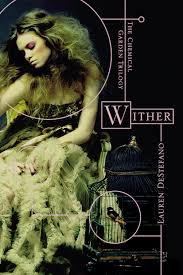
Wither

by Lauren DeStefano

In the not-so-far future, every continent apart from North America has been annihilated by nuclear warfare.  For a time afterwards America was like a utopia- cancer and other diseases erradicated, only  perfectly healthy babies born due to genetic manipulation. Then the dark reality sets in- those born in the next generation die in their early twenties. All of them.

What this means for the story is that our main character finds herself kidnapped at age sixteen, taken to a mansion and coerced, along with three other girls, to marry a wealthy man who is among the desperate- they want to breed as many children as possible in hopes of finding a cure before humanity dies out. The main character is one of these girls kidnapped to be a bride. She is suddenly jerked from being in poverty and uncertainty to living in luxury and being well-cared for. But she isn't free, she's not happy, and she knows when she's going to die...

It's an interesting idea, but this one didn't work for me. The characters were uninteresting. I never got a sense of them as real people. And I didn't quite buy the premise. If everyone was suddenly dying young, would the reaction of wealthy men really be to kidnap young girls and marry them in order the get lots of progeny? To me it was an odd idea. Another issue I had was that the story is told a lot in flashbacks, so the background events are revealed in pieces. I prefer my narrative to be linear. I think if I'd had chapters describing the chaos, the sudden flux of orphans when people started dying, the struggles the main character faced before suddenly being shoved into this mansion... it would have made more of an impact for me.

But again, I'm not the target audience for this book. It's the kind of thing my near-twelve-year-old might gobble up. Except when I started to tell her about the premise (to see if she wanted to read it before I return it to the library) she said "wait, so all these girls are getting raped by a rich guy?" Well... they got married to him, but against their will, so yeah, rape. The whole idea of it is pretty distasteful once you start seeing past the descriptions of opulence hand-in-hand with oppression. However, as far as I read in the book, I didn't come across any sex scenes at all. The girls discuss consummation, who spent the night when with their husband, one of them gets pregnant, that's it. I can't be sure though- I started to feel distracted around thirty pages in, and just skimmed a bunch after that before ditching this one.

Abandoned         374 pages, 2011

more opinions:
Presenting Lenore
Rhapsody in Books
Dear Author
There's a Book