Aug 7, 2012

The Kindly Ones

Sandman Vol 9
by Neil Gaiman

As usual, reading a Sandman volume has been a rather uneven experience for me. I could see very well that the storyline was pulling in loose threads from previous volumes, and characters reappeared that I hadn't seen since the beginning. But unfortunately since I have been borrowing these from the library I don't have the earlier volumes on hand so couldn't check back to refresh my memory of those storylines and characters that started resurfacing. So there was quite a bit that went over my head, but the main arc managed to hold my attention: Dream's realm is facing possible destruction. Wronged woman from his past comes with revenge on her mind. That creepy Corinthian guy with the teeth in his eyes goes searching for Morpheus' son (the younger one, that lives in the waking world) and the intriguingly flighty Delirium is looking for the dog she adopted from Destruction.... lots of other stuff happens, but mostly it is about this revenge being enacted, and the Dream King resigning himself to his fate- out of duty? I thought the bit about Nuala, the fairy who preferred her plain face, most touching.

One of the things I really enjoy about these volumes, strange to say, is their forwards and the after-pages that introduce the author and illustrators. The forwards are always written so eloquently and gushing with praise I'm always just a tad disappointed when I read the bulk of the pages. And the parts at the end with all the contributors are just funny. They're always uniquely bizzare and curious. This time those final pages had old-looking black and white snapshots of children with one-liner descriptions. (Another volume had hand-drawn crazily expressive portraits for each, and I can't remember the others now but they were equally amusing). I also enjoy seeing how the artwork changes with each volume- different artists depicting the now-familiar characters in their own style, but still making them quite recognizable even to me, who has trouble following who's who sometimes.

Moving on to the tenth soon.

Rating: 3/5 ........ 352 pages, 1993

more opinions:
Graphic Novels Challenge

Aug 6, 2012

in the bookshelf

I have a small bookshelf in the living room that is just for the little one's board books. She seems to enjoy pulling them all off the shelf just as much as turn the pages or bring one to me to read.
Today she took this activity to a new level and climbed into the shelf herself once it was emptied.
Then tried to pull the books back in with her- and got stuck, of course.
Silly girl!

Aug 5, 2012

Kitten's Winter

by Eugenie Fernandes

The final book in a little quartet that depicts a kitten exploring the seasons. In the opening scene we see the farm blanketed by winter: the fields covered with snow, the little pond iced over, trees bare of leaves, a snowman in the yard. As Kitten hurries to get home through a mild snowstorm, the reader gets to see how wildlife experiences the winter world. We meet some birds that stay at home: a blue jay and cardinal perched in evergreens, a chickadee on a shrub with some red berries, woodpecker rapping on a tree. We see which animals sleep through the winter: the beaver in its house, raccoon in a tree, turtle burrowed under the ground, chipmunk in its nest, bear in a den. Other animals are out and about searching for food: rabbit, fox, squirrel, even an otter catching a fish. A skunk huddles in a hollow log, a mouse scurries through his tunnel. There are even fish depicted beneath the ice! (Torpid from the cold?) The kitten scampers through the background, sometimes just barely visible as a patch of russet fur, making it fun for kids to try and find him on each page. On the last spread before he gets back home, just his pawprints are seen in the snow. As Kitten enters the house he finds mittens, hats and snow boots on the floor, children's drawings of the animals, books and a mug on the table- nice winter activities I agree! And already there is a hint of spring: some flower bulbs blooming in a pot. The textured illustrations made of sculpted clay, cut paper and paint are just wonderful, something you must see. I'm keeping my eyes out for more Fernandes books now. (And I haven't yet read Kitten's Summer but it's on my request list).

Borrowed from the public library.

rating: 4/5 ........ 24 pages, 2011

Aug 4, 2012

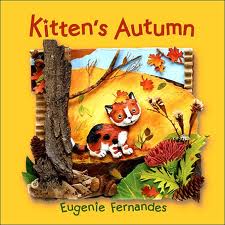
Kitten's Autumn

by Eugenie Fernandes

This little book is just as charming as the first. In the opening farm scene we see the pumpkins in the field that was green leaves before, tilled bare earth in the flowerbed, a rake leaning against the house, leaves falling, an empty nest in the tree. As Kitten explores his surroundings he meets birds and caterpillars, finds pinecones and nuts on the ground, sees squirrels busy gathering food for winter. There's a porcupine chewing on a shoe, a bear getting into a stump for honey, a big fish eating a smaller one. Raccoons are after the corn, a skunk slurps worms, a chickadee picks seeds from a sunflower. When the kitten comes back inside, stuff just inside the door indicate what people have been doing: gathering apples and pears, baking pies. Lovely book that shows all kinds of indications of the season, how animals live and find food in nature, with beautiful textures and the Kitten himself hiding throughout the scenery. The illustrations, as I noted before, are made with clay modeling, paint and cut paper- a wonderful combination of colors and textures.

rating: 4/5 ....... 24 pages, 2010

more opinions:
Kiss the Book
Jean Little Library
Puss Reboots

winner

Cipriano has won the watery bookmarks. Congrats!

Aug 3, 2012

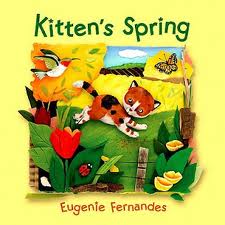
Kitten's Spring

by Eugenie Fernandes

I saw one of these little picture books on display and was intrigued by the charming illustrations so then I searched out the entire set. The concept is very simply; a kitten wanders through the woods near his home seeing what other animals are doing during different seasons of the year. At the end of the book Kitten returns home where a warm meal or cozy bed is always waiting for him. The text is just two-word rhyming phrases, it is the pictures that make this book. They are so rich in detail I sat looking through the book several times just to take it all in.

As the kitten wanders through the forest we see birds singing and nesting, insects crawling about, frogs near the water, a ducking hatching and a new baby calf, a lamb gamboling and a horse running in a meadow, as well as many other things. I like that the book doesn't tidy up nature; the owl is shown feeding her baby something obviously fuzzy and limp (dead mouse?), the piglet is nursing as his mother lies in a mud wallow. But the pictures are so charming that I don't think these details would bother anyone on the contrary they would encourage children to learn about those kinds of realities. The pictures are just amazing. They're made from a combination of modeled clay, cut paper and cloth, painted backgrounds (looks like watercolor to me but might by acrylic washes.) The cow's tail is yarn threads. It's just lovely and wonderfully engaging to look at. As a plus, each book begins by showing the farm scene and you can look at them altogether to observe how the garden, pond, flowerbed, etc change with the seasons. As the kitten enters the house at the end of each story, there are things scattered about evident of what people have been doing at that time of year; in this spring book there are seed packets and seedlings in trays, bulbs flowering in pots. For most of the pages the kitten is in the background or peeking through leaves, so it can turn into a find-the-kitty exercise too, which is always fun for kids.

rating: 4/5 ........ 24 pages, 2010

more opinions:
BookAndAGarden
Young Readers
Kiss the Book

The Good Luck Cat

by Joy Harjo
illustrated by Paul Lee

I'm anticipating the time when my fourteen-month old will sit still long enough to read real picture books. I do like good children's books and now sometimes when we're in the children's section at the library, she's pushing chairs around and playing with the few toys they have there; I'm idly looking at titles and covers on display and sometimes I bring a few home to read myself, or share with my older child.

The seven-year-old is into Ramona books right now, so she declines whenever I offer a picture book. Last week she read the episode where Ramona's elderly cat dies, and started talking to me about how cats have nine lives. I saw this kitty title on the picture-book shelf and when I saw the beautiful rich paintings and that it was about a cat with nine lives, I had to bring it home.

The Good Luck Cat features a Native American family and their beloved tabby cat Woogie. A young girl narrates the story, telling how her aunt said Woogie brought them good luck, and explaining how cats have nine lives. She recounts how Woogie lost each of his extra lives, in narrow escapes from the neighbor's dog, a car in the street, falling out of a tree etc. The best picture is when he momentarily gets shut in the clothes drier and tumbles around yowling before someone rescues him! (This part of the story could be distressing to younger readers, as the cat also gets threatened by boys with BB guns) Then Woogie disappears and the girl worries that he's lost his ninth life and will never come back. She puts out food on the porch for him and worries anxiously until he returns, missing part of his ear but apparently a happy cat, and certainly glad to be back home.

This could be any family with their pet cat. The identity of them as being Native American isn't really prominent, apart from the mention of the family gathering at a powwow, they really look like any other kids. The little girl is mischievous and irresponsible at times; she shuts her cat in a box and hides it under other things in the trunk to try and sneak him into a party, for example. But when he goes missing she anxiously posts lost-cat signs and frets about his safety. It's a tender, well-told story that appealed to my older kid who was intrigued with the nine-lives concept, as well as the younger one who just loved the cat's faces. And did I mention the illustrations are just lovely?

rating: 4/5 ....... 32 pages, 2000

more opinions:
Book Talks
Reading and Responding to Children's Literature

Aug 2, 2012

Tess of D'Urbervilles

by Thomas Hardy

I don't know how or when Tess of D'Urbervilles first got on my reading list, and I really had no idea what it was about before reading it this week. I've been fitfully participating in our public library's summer reading program (yes, they let adults play too) which this year is mostly about familiarizing yourself with the library's many resources- so for the first time I've browsed their DVD selections, and used some of the online databases- interesting stuff! One of the requirements however is to read a classic you've always wanted to and I picked Tess.

This is one of those cases where I don't quite know how to write about a book without possibly giving spoilers, so you've been warned!

It's been a long time since I read a classic and I've never read Hardy before- let me tell you, it was a rich experience! I was drawn in immediately by the descriptions of rural lifestyle and the character of Tess herself. She lives in Dorset, 19th century. Her family the Durbeyfields is poor but her shiftless father discovers one day that they are supposedly connected to an ancient aristocracy named D'Urberville and he immediately starts putting on airs, gets so drunk he can't function the next day so Tess is sent on an early-morning errand. She falls asleep on the road and gets into an accident which kills their family's only horse. They are now facing ruin but the mother urges Tess to visit a well-to-do lady in the next valley who is also supposedly of the D'Urberville line, and ask for help. Tess reluctantly agrees because she feels guilty about the death of the horse. When she arrives at the estate she immediately catches the eye of a certain young man. He's not really related to her- his family assumed the D'Urberville name for their own reasons- so he has no qualms about flirting with her, then practically stalking her, then well- things go badly for Tess- who disliked him from the start- and she ends up back at home with an illegitimate child. Things are miserable for a while but Tess eventually moves on, vowing to never marry.

She takes work as a dairymaid in another part of the country where people don't know her history, and then falls in love with a man who has rejected his family's standing as clergymen to become a farmer himself. This Clare sees Tess as a beautiful unspoiled country girl, even though she repeated tries to tell him of her sullied past he refuses to listen. Tess wants to marry him, but feels unworthy and is afraid of his finding her out. And then- of course- the man who ruined her life in the first place makes a repeat appearance- and things just get worse and worse. I've probably said too much already so I'll stop now. But it has a sad ending. Rather melodramatic, I thought. I mean- really- Stonehenge? I can't imagine anyone sleeping on a slab there, when today you can't even step inside the circle to take photos, it's so roped off (or so I've gathered, never having been there myself)

But regardless, what a story. I really felt bad for Tess. She was a good person at heart, smarter than her family, had her pride, did what she thought best. Some seem to think she deserved her lot and put herself in harm's way with her so-called "cousin" but that guy gave me the creeps from the start. Ugh, what an awful man. What I really enjoyed about the book was all the details about how people lived in rural communities more than a century ago. The tasks of threshing wheat, preparing straw to thatch roofs, digging turnips in the fields, and particularly how work was done on the prosperous dairy farm- all so different from today's operations. The dialect of the people being particular not only to the time and locale- many words out of use- but also to the family's being poor it was often hard to understand what exactly they meant but I was usually able to gather it from the context- I like that kind of reading challenge- and only after finishing the book did I realize there was a glossary in the back.

It's not as long as it looks. The edition I read (borrowed from the library) had appendixes, maps, several different forwards and afterwords written by different people for various other editions, excerpts that had been edited out of early editions (which shocked contemporary readers) and copious notes on the text. It's the first time I've ever read a book which had a note at the head of the forward warning of spoilers! so of course I didn't read that until later, glad I did as it gave away some of the crucial twists in the plot. I didn't read all the extra material, but did find interesting an included article all about the artists who illustrated early editions of Tess (which was first published as a kind of magazine serial). I definitely want to read more Hardy now.

That was rather rambling, apologies. It's late but I wanted to jot something down before sleep while it's all still turning in my head. I could say a lot more but will rest now.

rating: 4/5 ........ 518 pages, 1891

more opinions:
Tell Me A Story 
Valeehill
bookreviewsbycharles 
Book Puddle

Jul 26, 2012

giveaway

win a free pair of bookmarks! with a watery theme
all you have to do is leave a comment
be sure there's an email where I can reach you
winner drawn at random a week from now
I guess these caught my eye because I've been spending lots of time with the kids at the pool, in the hot hot weather. The smaller one has a man diving into the blue on one side, a sailboat on the ocean al reverse. The larger bookmark has the line on the bottom of a pool lane, and ripples on the water on its opposite side. I think they're quite attractive! Laminated, handmade from magazine scraps, by yours truly.

click on either image to view larger

Jul 25, 2012

Let's Count

by Mike Dunning

For a counting book, this one is fairly simple. Each page just pictures the objects and numbers in order: one puppy, three cupcakes, four lizards, up to ten toy soldiers. But it's got some subtle things going on, as well. Most of the pictures have elements that match the numbers as well. For example, on the cupcake page, each cupcake has three decorative elements in the frosting. Each lizard on the 4 page has four feet. The starfish on the 5 page all have five arms (some can have up to forty or fifty, you know), the bugs on the 6 page all have six legs, and spiders demonstrate the number 8. It's a nice little touch. Another thing that makes this book a bit different is that the page margins have tabs that stick out with the numbers running down the side, so when you close the book you see all the numbers vertically on the right margin. It makes the page edges change shape, which I imagine might help keep interest when little minds wander... (currently my baby won't sit still through four or five pages, even if she brings you the book repeatedly!)

rating: 4/5 ....... 10 pages, 1995

Jul 22, 2012

more titles

added to my TBR list this past week or so, thanks to you wonderful bloggers!
The Bond by Wayne Pacelle- Bookfoolery and Babble
Girlchild by Tupelo Hassman
Euphemania by Ralph Keyes- At Home with Books 
Wildlives by Monique Proulx - The Indextrious Reader
The Cove by Ron Rash- Bermudaonion's Weblog
Seraphina by Rachel Hartman- The Lost Entwife
The Woman Reader by Belinda Jack- Things Mean a Lot
Keep Holding On by Susane Colasante - Melody's Reading Corner
Me, Who Dove into the Heart of the World by Sabina Berman - At Home with Books

Jul 21, 2012

Lightfoot the Deer

by Thornton W. Burgess

Love and conflict seem to be the main themes of this book. Well, when it opens we really just get treated to a little lesson about how deer grow and shed their antlers, as Lightfoot explains it to the ever-curious Peter Rabbit. In the next part of the story, Lightfoot is pursued by a hunter and uses all his skills and cunning to stay out of the hunter's sight. Finally he is exhausted by the stress of constantly being followed in fear of his life, and escapes across the river where he finds a safe haven. He stays hidden until the hunting season is over. At home the other animals worry that Lightfoot has finally met his end, but then he returns. He is welcomed home, and quite relieved that the hunting season is over. Then Lightfoot discovers another deer has come into his forest; he follows a female about then meets a rival male, has a fight, and wins his wife. The story ends rather abruptly with Lightfoot showing off to his new companion, then suddenly makes mention of Blacky the Crow needing his story told. Not quite as smooth as the stories usually end. I also found it curious that all the animals seem to love Lightfoot the deer, it was often said the forest would never be the same if he were gone, and yet I've hardly met him at all before in the pages of Burgess' stories.

Read this one on my kindle.

rating: 3/5 ........ 72 pages, 1921

Jul 20, 2012

The Adventures of Old Granny Fox

by Thornton W. Burgess

More than any other Burgess book I've read, this one is about relationships. Old Granny Fox and the young Reddy are having a tough time finding food in the winter. Reddy Fox is quite the know-it-all and even mocks the older fox when he doesn't understand what she's doing but Granny is remarkably patient and shows him that he still has a lot to learn. Reddy despairs that they can't find any food in the snow. Granny shows him how to perform for ducks and take the farm dog's dinner, but when they've exhausted every other means of getting food they resort to stealing hens. She makes quite a point out of the fact that the foxes only take the hens because they're starving so that's okay even though it's stealing; the humans have plenty of food so they can spare a few chickens. The raid on the chicken coop is a big event in the book; even here Reddy is overeager and Granny Fox must teach him to be patient, to wait until it's perfectly safe, to stay away afterwards so they have a chance to get hens again at a later date. However most of the story seemed to be about lessons on respecting your elders and having a willingness to learn. It even seems that things have finally sunk in for Reddy Fox; at one point he finds a fish to eat and even though he's starving he thinks of Granny Fox waiting at home, unable to hunt for herself and he takes the food back to her. It was a wonderful change of heart for him, this feisty little fox who usually only thinks of himself.

Rating: 3/5 ........ 202 pages, 1920

Jul 16, 2012

The Adventures of Jimmy Skunk

by Thornton W. Burgess

Jimmy Skunk is one of those animals in the forest who doesn't have many worries, as everyone is afraid of his terrible smell and goes out of their way to avoid bothering him. When Peter Rabbit finds the skunk sleeping in an old barrel, he thinks he's found a perfect opportunity to play a prank on Jimmy without anyone knowing who did it. Peter contrives to get the skunk in trouble with Reddy Fox, but finds the aftermath of his prank puts himself in a very uncomfortable situation. So he learns his lesson. And Jimmy makes a point of coming back to chastise Peter for instigating the trouble between him and the fox, when he finds out who was really responsible. The second half of the book tells of Jimmy Skunk and Unc' Billy Possum getting themselves into the farmer's henhouse where they are annoyed to discover the eggs have already been gathered. So they end up squabbling with each other, and are caught when the farmer's boy comes in the morning to feed the chickens. Jimmy Skunk has no fear of the farmer's boy and just marches out of the henhouse when he opens the door; the possum plays his trick of being dead but the boy isn't fooled. The boy has been particularly good-natured towards the animals in these last few stories; here he simply lets the possum go after showing it off to both his hound dog and his mother.

Rating: 3/5 ........ 87 pages, 1918

Jul 15, 2012

The Adventures of Bobby Raccoon

by Thornton W. Burgess 

Another little Burgess book, which tells about some hard times for a raccoon. Bobby Coon is snoozing in his hole in a tree one day when disaster strikes and his home is destroyed. Not only that, but he gets injured and is terrified when the farmer's boy catches him and ties him down. The boy means no harm and is only treating his injuries but Bobby doesn't know that. He pines away while confined and is relieved to be released at last. Now homeless, he wanders around in search of a place to rest. He tries several times to appropriate other animals' homes, but of course is pushed out and must move on. Then he finds a hollow stump to sleep in, but his rest is rudely interrupted by some noisy crows and a visit from Buster Bear. Finally he finds a place that seems both dry, safe and unoccupied. He's dismayed at who his new neighbors are, though! What stood out in the book this time wasn't the little lessons on being fair and so forth, but the very nature of Bobby Coon. Whenever cornered or feeling threatened, he would growl and snarl and try his best to look fierce. I could just picture a real coon acting like that!

 Rating: 3/5 ........76 pages, 1918

Jul 14, 2012

From the Ground Up

by Amy Stewart

I think this is the first time ever that I've read a book immediately upon receiving it. I got a copy of this through Paperback Swap, and when it arrived starting thumbing through it curiously to see what it was like. But then instead of putting it on my TBR shelf where most books sit for weeks, months, even years, I set aside my current read to immerse myself in this one.

It was delightful. Amy Stewart tells about living in a small beachside town and growing her first garden, with all the discoveries that entails. Parts are about the weather, the neighbors, the summer influx of tourists. But mostly it's about the garden: how she learned to feed her soil, how she moved from just growing pretty flowers into vegetables, how she picked up ideas from touring estates with beautiful manicured gardens. I appreciate that gardeners seem unashamed of writing and telling the world about their mistakes, and really you can learn a lot from that. I've made many of the same ones she has, like not testing my soil (still guilty of that). She discusses composting (both the traditional kind and also with worms), design, battles with bugs, the contoversy of cats in the garden. Growing tomatoes, oranges and basil. The thrills of saving your own seed, and collecting seed from others. Her disinterest in houseplants until she discovered orchids. The satisfaction of eating your homegrown produce, and finally the delightful problem of having surplus vegetables on your hands when the garden is finally in full swing.

It was a wonderful read that made me feel guilty for not being fully invested in my garden this year- mine's rather shabby as I'm kept busy with a toddler just learning to walk. I just can't quite focus as much but Stewart reminded me of so much I want to do better with next year.

Rating: 4/5 ........ 261 pages, 2001

more opinions:
Stay At Home Bookworm
Who Needs Gauge
Life on Two Acres

Jul 13, 2012

Hyenas

by Gloria G. Schlaepfer

This juvenile non-fiction book about hyenas is a lot more detailed and fact-filled than the previous one. It doesn't create a narrative, but is just as easy to read. Geared towards older kids, I'd say. The book not only discusses hyenas' roles as scavengers, but also their social structure, how they raise their young, and threats to their survival (mostly due to people unreasonably fearing or hating them). In actuality, the book informs young readers, most hyenas hunt for themselves and only the smaller less abundant brown and striped hyenas are mainly scavengers. The aardwolf eats termites. I haven't seen many books that talk about the aardwolf; I don't think I was even aware they belong to the hyena family before. It was nice to see a very informative book that includes the less well-known species.

Rating: 4/5 ........ 48 pages, 2011

Jul 12, 2012

The Adventures of Jerry Muskrat

by Thornton W. Burgess

It completely escaped my attention that I hadn't written about this book, which I read some weeks if not months ago, until I searched for my post to link to from Paddy the Beaver, and couldn't find it! So I'm amending that omission now.

This little book has two main storylines, both featuring Jerry Muskrat. In the first part, Jerry gets his tail pinched in a trap the farmer's boy left near the pond. His mother had warned him about traps, but he was careless. Soon the animals discover many traps and Grandfather Frog teaches them how to find the traps and avoid or spring them so they can stay safe (which greatly puzzles the farmer's boy). They are all duly warned not to take food they find lying around where it usually isn't, especially very delicious food, as it is often a trap. Some of them have to get hurt before they really learn to be cautious.

In the second half of the book, the animals discover that the pool of water that makes their home is shrinking. Alarmed, several of them set off on a journey upstream to find out what the trouble is. Among them is Spotty the Turtle, and here the tale echoes the old Aesop's fable of the tortise and the hare. The other animals get distracted along the journey and stop for one reason or another, but Spotty just keeps plodding along so even though he's the slowest, he is the first to reach the source of trouble and find out what it is.

Now the animals meet Paddy the Beaver and they are all intimidated his great size and the massive dam he's built. They want Jerry Muskrat to talk to Paddy about the problems he's causing; they figure the beaver might listen to Jerry since he's Paddy's little cousin. Jerry is nervous at first, but he gets his courage up to approach Paddy and finds that the beaver is a nice guy after all. A solution to the problem is found, but it's quite different to the one presented in another book about Paddy the Beaver!

Rating: 3/5 ........ 90 pages, 1914

The Adventures of Paddy the Beaver

by Thornton W. Burgess

Paddy the Beaver, whom I've met in another Burgess storybook, The Adventures of Jerry Muskrat, is a newcomer to the forest who keeps to himself. But all the other creatures soon know he's there and come to see him, as his activities influence them all. The first thing he does upon deciding to live in their forest is, of course, build a dam. Which reduces the spring to a trickle and the pond to a puddle and the other animals are understandably upset. Paddy assures the others that once his dam is finished, the stream and pond will fill with water again. And they do: when the pond is at the depth he wants, the water flows over it and runs down the brook again. The other creatures are satisfied and come to visit Paddy. Some are quite critical of his apparent destruction in cutting down trees; others of his building methods, until they see the finished product and are properly impressed. Paddy is a nice fellow. He keeps his opinions to himself, is always pleasant to others and even flatters the annoying blue jay who then proves himself to be a staunch friend instead of a pest like he is to most critters.

What took me aback was how the story differs from the scenario presented in Jerry Muskrat. In that story the stream had also died to a trickle, several animals traveled to its source to find the problem, and discovered Paddy building a dam. They complained about how he was ruining their homes downstream and so the beaver reconsidered, tore out his dam and moved somewhere else. As Burgess frequently makes mention of previous storylines in his books, linking them all together, again I'm not quite sure why this one is different. Did he want to change the beaver story, give it an alternate possibility? did he simply forget that the scenario was a little different before? Hm.

Like with all his other nature books for children, Burgess has infused this one with some good lessons. Here he makes a case for the merits of hard work, good planning, not making quick judgements on first impressions, trusting one's friends, teamwork and the wisdom of often keeping your opinions to yourself.

Rating: 3/5 ........ 180 pages, 1917 

Jul 11, 2012

The Quest for the Tree Kangaroo

by Sy Montgomery

A kangaroo that lives in trees? That's what I thought when I saw this book on display. I like the author as well, so of course I had to pick it up. Sy Montgomery was part of a team that accompanied researcher Lisa Dabek into the remote cloud forests of Papa New Guinea to study these arboreal marsupials. There are ten species of tree kangaroo, which do hop but are excellent climbers with long curved claws and thick prehensile tails. They are pretty muich unknown to science. Lisa's team was the first to safely capture some tree kangaroos (the local people used to eat them), radio-collar them and study their movements. The book describes in detail how the team was organized and all the hard (and often dirty) work they did that led up to the wondrous moment of locating their first kangaroo. The gorgeous photographs and descriptive text wonderfully evoke a very distinct place on earth (Papa New Guinea has about 400 bird species, 60 mammals and 6,000 kinds of plants found nowhere else on Earth- and new ones are still being discovered!)

Not only is this book a good adventure story about a faraway, incredibly unique place, and the discovery of an amazing animal, but it's also a great introduction for kids about the work that field science actually entails.

Borrowed from the public library. Now I'm looking for Sy Montgomery's book about the pink river dolphins!

Rating: 4/5 ........ 79 pages, 2006

more opinions:
 Jean Little Library
brooke dycus
Children's Literature Reviewed by Kathy Yale