Aug 17, 2017

Life Everlasting

the Animal Way of Death
by Bernd Heinrich

Nature recycles the nutrients of dead animals and plants into new life; that's what this book is about. The author carries out his own studies, making observations on his own land in Maine and Vermont- he deliberately set out mouse carcasses to see what burying beetles do when they find them. He dragged deer or cow carcasses into the woods and then watched to see which animals arrived when, what parts of the body they disposed of, and so on. He always hoped for a large gathering of vultures, but never got one. Also in a few different places in Africa he observed various kinds of dung-collecting beetles. There are beetles that bury mice, and others that consume bones. Subject jumps around somewhat- one chapter speculates on how early man must have been a hunter and tyranosaurus rex a scavenger; another on what exactly happens to a whale carcass when it sinks in the ocean, another ruminates on how salmon are "committing suicide" when they swim upstream to spawn. There's an entire chapter about how bark beetles, fungi and other organisms break down a tree. Of course seeing the author's lifelong fascination with corvids, there's a lot about ravens and crows throughout many chapters. I expected a bit more about coyotes, but there's not much beyond the mention that they open a carcass, making it available to crows and other scavenging birds (even large vultures can't break the skin by themselves).

He kind of lost me on the last few chapters- the idea that insects undergoing a complete transformation from larval stage into adult are actually two separate species that merged their genetic code long ago? wow, a new one for me. The final chapter that waxes philosophic on ideas of the afterlife- dipping briefly into several ancient cultures and then considering what are the options if you don't want to be buried in a casket or cremated (which adds lots of toxins to the atmosphere)- kind of lost my interest. But at that point, the book was done. It wasn't nearly as engaging as some of his other books I've read. I kept loosing interest and then coming back, so it took me a while to get through.

Borrowed from the public library.

Rating: 2/5            236 pages, 2012

Aug 14, 2017

Yotsuba&!

Vols 5 and 6
by Kiyohiko Azuma

Yotsuba is kinda crazy with the reactions. Her eagerness and innocent misunderstandings get her into some funny situations too. In volume 5 Yotsuba meets a life-size robot at Ena's house. Miura likes to trick Yotsuba, and Asagi is still a tease, but the one who really gets to Yotsuba is an acquaintance of Koiwai's who shows up- he really messes with her. Yotsuba and the girls nextdoor go stargazing with her dad and Jumbo. There's a very mundane but still amusing episode where Yotsuba and her dad walk in the rain to the DVD-rental place. Yotsuba mishears something her dad says and invites all the neighbors to go with them to the beach- when he hadn't planned to go at all. But they do. Fun in the waves, Yotsuba searches for shells with the girls, finds a hermit crab and pokes a jellyfish.

Volume 6 opens with Yotsuba experimenting with recycling. She collects unwanted objects from family and neighbors- and makes something! Her dad buys her a bicycle and she is super enthusiastic about it, but has trouble remembering to follow the rules. Like: don't go anywhere alone! She wants to do errands, and goes on a bike ride with Asagi and her friend. When she does take off by herself, it was for a good cause- she wanted to share something special with Fuuka, so followed her to the school. Grounded. (Except she calls it "dirted" in one scene which really made me laugh). In the last episode here, she helps Daddy and Jumbo make a bookshelf. Ha, I liked that part.

Borrowed from the public library.

Rating: 3/5             208 pages each, 2006

Aug 13, 2017

Wild Sex

The Science Behind Mating in the Animal Kingdom
by Dr. Carin Bondar

Brief segments dense on information about the wide variety of ways in which animals find partners, mate, and care for their young. I knew there was a lot of different stuff going on among animals- but not quite how much. Especially with invertebrates, wow some crazy things sure glad not to be a female insect. All the things we humans think of as degraded or unnatural sexual behaviors are actually fairly common among animals, according to this author. A few really interesting facts stuck with me: did you know that female birds can control what type of nutrients and hormones their eggs receive? It depends on the species- for some, they put more nutrients into an egg if they mate with a preferred, healthy male. If the male is of lower quality, they lay smaller eggs- not putting as much into them. For other birds whose chicks must face varying competition (a later hatchling, or a brood parasite in the nest) the mother can control how much testosterone each egg receives, to prepare her chick if needed.  The section of the book that I found most interesting- that about how the animals vary in their parenting styles- was the shortest. Also I found it kind of odd that while the source notes and glossary are extensive, there is no index. The book is based on a web series and you can tell- it reads similar to a book sourced from a blog.

I gave this one a 2 because while it was interesting, some of the information was just too much (I did not want to know about frustrated male sea lions taking advantage of penguins for example) and there were a few parts I skimmed over. Had to read it in pieces over several weeks (interspersed with Yotsuba) This book was originally published with the title: The Nature of Sex: the Ins and Outs of Mating in the Animal Kingdom. Personally, I like the original title better.

Borrowed from the public library.

Rating: 2/5      366 pages, 2015

Aug 11, 2017

Yotsuba&!

Volume 4
by Kiyohiko Azuma

More fun seeing everyday events through the eyes of five-year-old Yotsuba. She is eager to play games with her Daddy- but gets upset because he always wins- even when she changes the rules. Jumbo takes the girls fishing. You'd be surprised which one was squeamish when it came to cleaning the fish. Yotsuba goes shopping with her dad for a special dinner- and when he finds he left his wallet at home, she steps right in to solve the problem- to his embarassment! Yotsuba discovers Fuka is very glum because she felt rejected by a boy she likes- and tries to console her. Then blabs Fuka's secret to the entire family when she decides to be a news reporter and has to think of some real event to announce. She does group exercises in the park with other kids. She wants to be a milkman and 'makes' milk out of water and paint- then gives it to her unsuspecting dad. And misunderstanding the onomatopoeic word for a cicada that also sounds like a word for a pointy hat- whom everyone says signals the end of summer- she dresses up in a triangular outfit and dances around like a fairy to magic the change of the seasons. That part was a bit hard to get sometimes, but the translator's notes help. It's hard to explain why the book is so charming and funny- you'd have to read it!

Rating: 3/5                 192 pages, 2005

Aug 8, 2017

Yotsuba&!

Volume 3
by Kiyohiko Azuma

More daily fun through the life of Yotsuba, this odd little five-year-old who tackles everything with enthusiasm. Part of the fun of Yotsubato is seeing how the ordinary things amaze this little girl, the summer is all one big eye-opening adventure for her. There's a hint at the very end that Yotsuba and her dad recently moved from somewhere more rural (they call this 'the big city' and one of the other kids protests: "it's not that big!").

Yotsuba experiences fireworks for the first time- initially doing some on the street with her neighbors, later attending a festival and seeing a fireworks show. She goes to the zoo with her dad- that was pretty funny- the things Yotsuba noticed about the animals as well as her dad's made-up facts. (Oh, and she punches a goat). Yotsuba tries to learn to play badminton. She hops on a city bus by herself- freaking out Fuka who had taken her along on errands. She meets a police officer, and finds out that Jumbo is a florist (who in a fit of pique fills her house with discarded flowers from the shop). The father of the three girls next door makes an appearance- he's not separated or deceased as they seemed to be joking/hinting at, but apparently just absent due to working all the time.

Looks like my library has the first twelve volumes; I am plowing through them with enjoyment.

Rating: 3/5                  176 pages, 2004

Yotsuba&!

Volume 2
by Kiyohiko Azuma

Cute, spunky kid. She doesn't get some ordinary things, puzzles at the meaning of big words. Eager for fun every day. There's an episode in here where she goes off with the older girls from next door to draw at the park. I liked that. There was an oh-so-familiar incident where Yotsuba insists the other girls tell her if her drawing is good- because of course her dad always says so. One of them is bluntly honest and says no, it's bad. The other girl of course doesn't want to hurt Yotsuba's feelings - so then Yotsuba is convinced one of them is lying! Because her art can't be both good and bad, can it? Yotsuba tries to draw a picture of Jumbo but it runs off the paper onto the table. So to make it properly big she draws out on the street.

She insists on having cake with the neighbors. She is left to her own devices when her dad is sleeping off an all-nighter. Ends up drawing on his face with marker, and then is terrified at the possible repercussions. There's almost just as much in here about the neighbor family as there is about Yotsuba- I'm starting to wonder what the story is behind the always-absent father, I suppose the backstory will be revealed eventually... They all go to the pool, and find out that neither Jumbo, Koiwai (Yotsuba's dad) or Fuka can swim. Yotsuba endeavors to teach them- hilarious. Turns out Jumbo really likes Asagi- the oldest girl next door- who is rather a tease (to her siblings).

Yotsuba tries to catch frogs and Miura (friend of the youngest neighbor) objects. We find out that Yotsuba is terrified of a bull's-eye thing that is in someone's yard (it looks like a target to me, but it's used to frighten away birds). Miura uses this against her in what turns into a uproarious fight- a teddy bear is the main casualty.

Slightly-disturbing episode in here where Yotsuba watches a gangster movie on tv with her dad and Jumbo. Then she immediately grabs her water pistol and goes off on a 'mission of revenge' in the neighborhood. The girls next door play along- to some extent. You could see this as a suggestion that violence on tv causes the same in kids' behavior, or just showing her having some good old pretend fun. This episode was in the beginning of the book, and on the last page Asagi comes home from a trip, finding Yotsuba's drawing of Jumbo on the pavement outside- which if you don't know the origins, looks rather like the outline of a murdered body. She stares. I couldn't help it, I laughed out loud.

I still don't quite know why Yotsuba's hair is green- but found out that her name includes the word 'four' and her hair is always tied into two short pigtails- reminiscent of a four-leaf clover. There's a brief part in here about something in the past between Asagi and her mom over four-leaf clovers. I'm delighted to find there are some twenty volumes of Yotsuba&! Must look up how many are actually in my library system.

Rating: 3/5                 192 pages, 2004

Aug 6, 2017

Yotsuba&!

Volume 1
by Kiyohiko Azuma

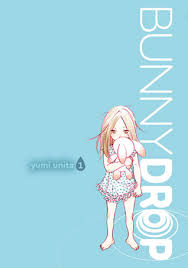
I can see right away why people compared this manga to Bunny Drop. Both are about a girl being raised by a young man who's not her father. This story is a lot more casual and fun. It really made me laugh in some parts. Starts out with Yotsuba moving with her adopted dad to a new house- we meet the little girl just as abruptly as her new neighbors do. She's energetic, crazily enthusiastic about nearly everything, and oddly surprised at everyday objects like - swings in the park, air conditioner unit in her neighbor's house, items on the shelf in the store. You get the idea there's some strange story to her past. At the end there's a small revelation- basically the dad found her while travelling abroad, admired her spunky optimism and brought her home.

He's quirky himself. Obviously a guy who never grew up- but in a completely different way from the father-figure in Bunny Drop. The banter between him, Jumbo (a friend who's really tall) and Yotsbua makes you realize these guys know each other well... In this volume Yotsuba meets lots of new people, wanders the neighborhood into a park (her dad doesn't seem alarmed when she just goes off on her own), learns about global warming (and thus for a brief period thinks a/c is evil), gets locked in the bathroom, goes shopping with her dad- usual kid stuff, right? But then they all go on a cicada hunt. Yotsuba wants to catch the biggest one. This was my favorite chapter. So fun.

Rating: 3/5       208 pages, 2003

more opinions:
Puss Reboots
Musings on YA Libraries and madness

Aug 4, 2017

A Starter Garden

by Cheryl Merser

This is the kind of gardening book I enjoy right now: more or less someone writing about their own garden, offering instruction using real-life examples. Outlining the pitfalls as well as the joys. Merser describes two gardens she started on new properties that didn't have much going for them at first. She talks a lot about plant selection- how to gauge what plant will do well in what spot, how to give the garden form and anchors using shrubbery, what works nicely (in her case) for groundcovers, accents, shady spots etc. She has a whole chapter about roses, another about water features. It's all a mixture of casual advice and very practical know-how. Her voice reminds me a bit of Thalassa Cruso. I had to laugh at some of her ingenuity, too. I grew scrawny seedlings for years in windowsills before building my first makeshift coldframe; she just puts hers in the trunk of a hatchback and lets the car heat them up! And for nighttime she moves them into a steamy bathroom. Clever. I share her hatred for japanese beetles, but not quite her enthusiasm for decorating with found objects. She discusses herbs but is mostly about flowers and shrubs and interesting plants to make the outdoor space beautiful and alive. Which is great inspiration, I need to work on that part of my yard too. I have a long list of plants to look up now- because the only thing the book really lacks is decent pictures. There's a nice glossary in the back that details every plant mentioned in the book, its scientific and common names, growing habits, light/moisture requirements, peculiarities and attractiveness, etc. One to read again.

Rating: 3/5                 254 pages, 1994

Jul 31, 2017

Bunny Drop

Volume 10
by Yumi Unita

This compilation of little shorts fills in some gaps from the main series. There are several cute stories from Rin's gradeschool and middle school years; I liked those the best. Showing how she and Kouki grew up together under Daikichi's struggles to figure out parenthood. Story behind the scar on Kouki's forehead. Some of the episodes explain things regarding other characters- there's one that goes into how Masako met her assistant who would become her husband. Nice to see a bit more about her conflicted, driven character. Another has details from the time when Kouki was considered a delinquent. And the last two chapters explore a bit of how both Rin and some of her friends have moved on in their relationships since the ending of book 9. True to pattern I enjoyed most the stories about Rin's childhood and Daikichi's awkward but heartfelt attempts to be a good dad. I found the few parts set in the teen years rather uninteresting, and the final chapter where Rin is settled into married life with Daikichi irritatingly distasteful, even though nothing bad happens. I just don't like it. Hm.

Rating: 3/5                     208 pages, 2012

Jul 30, 2017

Bunny Drop

Volume 9
by Yumi Unita

I don't think I can help it there will be SPOILERS below.

So- this final volume wraps up the storyline with Rin finding her own way of defining a family and staying where her heart is set. I didn't like it though. For several reasons. The conclusions and reasons for making this scenario work out felt too rushed. We find out that Rin really loves Daikichi -something I don't think would ever happen among two people who had been in a father/child situation for over a decade. Daikichi to his credit is appalled at the idea and protests. So are a few of Rin's friends, although others at this point don't know and it would be rich to see what the reaction of Daikichi's own family- parents and siblings- is. The only way I can figure it is that the author wanted to show how such a relationship could be possible and could be acceptable- the point is made that Rin always saw Daikichi's grandfather as her dad, so she never felt Daikichi was in that role but I don't buy that. He acted like her father, he raised her, end of story. (Supposedly research across several cultures shows that children raised closely together when they are under five years old will never develop romantic attachments to each other- they are naturally repulsed by the idea when older. After six, this isn't always the case. So maybe that's why this story has Rin go from her grandfather's to live with Daikichi when she's already six... I still don't think it could work out that way though)

Regardless of the possible rationales, it still doesn't sit well with me. Then there's the sudden revelation that she and Daikichi aren't related at all- the grandfather never was her dad to begin with- this is found out in a sudden outburst when Rin in distress visits her mother again and Daikichi follows her- and Masako reacts by practically yelling this information at Rin - there, go be happy now! in effect- and shoving her out into the hallway to figure it out with Daikichi. There's also a two-year timeskip so that Daikichi can wait and allow Rin to reach adulthood, giving her time to see if any guy her own age will catch her eye in college. Nope. The story doesn't even show a hint of this happening. She feels nothing for anyone else, and delightedly gives her guardian a big hug when she hits that legal age- happy at last to find her peace in being allowed to marry him.

Um, ewwww? I have to say the author fit this narrative together very cleverly to make these characters so endearing to the reader, and throw in all these little twists to make their living situation and romance (barely existent, only in Rin's professions of love, nothing shown) acceptable. But it's not. Not for me. It just all feels rushed and uncomfortable in the end, even though I'd prefer to like where they end up, I can't.

So overall: books one through five were great. Six was rather boring, just because I don't relate well to all the highschool drama. Book eight started to feel weird with the hints at what was coming, and nine was a dissatisfying shocker. However there is volume ten, which fills in some of the story from the ten-year skip when Rin was in middle school, so I'll see how I like that.

Rating: 2/5                       224 pages, 2011

Jul 29, 2017

Bunny Drop

Volume 8
by Yumi Unita

Warning: there are SPOILERS in the second paragraph.

Rin continues to navigate highschool- making curriculum choices, looking at future career options; she seems to want to stick close to home. Her friend Reina bounces between boyfriends, while Rin still doesn't have one- there's a guy who likes her but she doesn't return his interest, and Kouki of course is still pining for her- constantly rejected. Rin meets with her mother Masako again- who is now married and has a second child (there was an odd scene where it looked like the baby was nursing but then Masako said "it's time for her milk" and gave it a bottle- so I guess it was just snuggled against her near-naked bosom?) Rin seems to have accepted who her mother is, and is delighted to be a big sister.

Now the final direction of this whole storyline becomes clear, and it doesn't make any sense. Rin can never accept Kouki's attentions because having grown up alongside him, it just feels weird- she knows him too well, can't see him as boyfriend material. Yet she appears to be developing feelings for Daikichi. Ugh no no no no no. He's been her guardian, as a father to her all these years. This isn't possible. Surely someone in that circumstance would have the same complete lack of romantic attraction to their father-figure as she does to the childhood friend who was so close they 'felt like siblings' (a phrase Rin uses frequently when referring to Kouki). So while I continue reading, really liking these people as characters, I don't at all buy the premise anymore. It just would not occur. Not to mention being distasteful and shocking.

Rating: 3/5                 208 pages, 2010

Bunny Drop

Volume 7
by Yumi Unita

This one was better again. The focus is on Rin and Daikichi, more than the high school drama stuff. Rin notices the mothering tendencies of women around her and starts to wonder about her own mother. She becomes determined to seek her out although Daikichi, having met Masako himself (and disliking her), is afraid that she will just get hurt. Then Daikichi sustains a back injury and has to depend on family and friends to tend to his needs. His brief time as an invalid makes him really wonder about the future: what will it be like when he really gets old? Who will be there to care for him? Because of course he expects the best for Rin- a good college, marriage.... and Nitani has made it clear she's not interested in a relationship. He fears he will be a bachelor again into old age.

More serious stuff, and I started enjoying the series again. I particularly liked that despite Daikichi's negative impression of Masako, when she and Rin finally meet although it is awkward, Rin's natural politeness and friendly manner smoothed things over. Having no expectations of what her mother was like, Rin didn't perceive her as an unpleasant person at all. It's refreshing to see how good some of these characters are, what decent people.

Rating: 3/5                224 pages, 2010

Jul 26, 2017

Bunny Drop

Volume 6
by Yumi Unita

I don't get the highschool stuff. Drama, girls vying for attention of a certain guy. Rin seems levelheaded, but has to face off with a manipulative girl who pulls a dirty trick on her friend Kouki. This volume was mostly about the kids' relationships, very little about Daikichi and Nitani, nothing at all about other adults or relatives....

And I spoiled the rest of the series for myself. Looking at some other online reviews, found out how it all ends. Haven't even got there but totally understand why a lot of people hate the ending. Wondering if I want to continue and see how it reaches that point- will I be disgusted and angry too? Curious how it fits with the idea in my head of Rin's mother, and if it's just something more acceptable in Japanese society... if I keep reading there will probably be spoilers in future posts, but I will give warning.

Rating: 2/5         224 pages, 2009

Jul 25, 2017

Bunny Drop

Volume 5
by Yumi Unita

The story jumped. It skips ten years; Rin is now starting highschool. Which is fine, but it's the not the same slice-of-life story I was enjoying about Rin as a child being raised by Daikichi a guy who himself had never quite grown up. There are a few flashbacks showing incidents from middle school; I think I would have liked an entire volume about that! Rin is mostly dealing with her studies, Kouki's crush on her (which she can't take seriously) and her plans for the future. It's more about her social life and a lot less about Daikichi's efforts in becoming a father figure. Which isn't nearly as interesting. Daikichi finally makes his feelings known towards Nitani- Kouki's mother- but that's about the most interesting thing that happens among the adults. There wasn't anything about Rin's mom. I was on the verge of giving this one a 2...

Rating: 3/5               224 pages, 2009

Jul 24, 2017

Bunny Drop

Volume 4
by Yumi Unita

I'm really liking this series so far. It continues to be pretty interesting, full of realistic characters who struggle with everyday problems- and some not-so. Daikichi has a sudden problem arrive on his very doorstep when his cousin takes her kid and leaves her husband. Daikichi can't comprehend her reasons, and there's some very awkward moments between him and Kouki's mother when Kouki assumes the cousin is in a relationship with Daikichi. The kids all get along fine, the adults sometimes have issues. For the first time Dakichi has to deal with Rin getting sick. He continues to have moments of confusion seeing how other parents around him deal with things- coming to it so late in the game, as it were. Some really amusing episodes in this book were the jump-roping competition among the schoolchildren- and the parents all got involved, too, on pretext of helping their kids practice. Also the part where Rin looses her first tooth was pretty funny- another contrast between cultures. Daikichi tells Rin of an older tradition where baby teeth are thrown on the roof, but is taken aback when a fellow parent tells him nowadays kids get cute little boxes made especially for saving baby teeth in as keepsakes. He wants to go with the current trend so scrambles to find where those tooth cases are sold before Rin looses another. Then one of her school friends pipes up with the information that when she looses a tooth the "money fairy" leaves fifty yen under her pillow (about forty-five cents)! The other parents are all hoping this American custom will not become the new fad. Haha.

I have to say, Daikichi's character is really growing on me. Even though he's a typical guy through and through he's also really kind-hearted and compassionate, cares a lot about doing what's right for Rin. It comes across in spurts of anger at how other people treat or perceive her sometimes. He's not terribly attractive (judging by the drawings- another dad he meets used to be a model for clothing catalogs) and a bit awkward, but such a decent person, someone you'd really want as a friend.

Rating: 3/5       224 pages, 2008

Jul 23, 2017

Bunny Drop

Volume 3
by Yumi Unita

Rin is now in elementary school, which brings new challenges. She has new friendships to navigate. So does her caregiver Daikichi- who has to deal with a bunch of new part-time coworkers, one of whom is determined to flirt with him (which behavior he finds baffling). He discovers that some of his male coworkers are also parents, so there is more companionship there. There are more glimpses of his family- visits to his parents, his sister who wants to stay single and carefree... and also some of Rin's mother. While I don't like the choices this young woman had made, I do find her character intriguing (she's an artist), and I know there's more backstory to be revealed. There's some amusingly awkward moments when Rin invites her friend Kouki over- or he invites himself- and the parents are a bit uncomfortable with the suddenness of it. I like learning little glimpses of Japanese culture via the story- such as how some children have a "commemorative tree" planted on the day of their birth- so they grow up together. In Rin's case, Daikichi wants to buy her a young tree to memorialize the day she began school. She wants to plant a seed instead, even though it will take longer to grow. Endearing.

Rating: 3/5       224 pages, 2007

Bunny Drop

Volume 2
by Yumi Unita

Daikichi continues to navigate life as a new parent- of a preschooler. Just as he's getting settled into the preschool routine, it's suddenly time to make preparations for elementary school- which throws him off base. Other parents are confused and sometimes angered at his lack of understanding what's expected of him- but a single mother he slowly befriends because their kids hang out together, she gets it. She points out to him that everyone assumes he is Rin's father and has raised her since birth, as they have such an obvious rapport and Rin totally trusts him. Daikichi teaches Rin some cooking skills and struggles with things like managing to do her hair up in pigtails for her. Meanwhile he's also dealing with issues at work, getting to know coworkers in his new department (a step down), and on a completely different note, following up some clues to figure out the identity of Rin's birth mother. When he actually meets her, it is a total shock- for this reader as well! Seeing Rin's mother face-to-face clears up a few questions, and raises many more.

Rating: 3/5       208 pages, 2007

Jul 20, 2017

Unlikely Loves

by Jennifer S. Holland

Sometimes when life is so busy you need a light, comforting read that's easy to dip in and out of. This book was perfect for that, cute and heartwarming. It's a collection of brief accounts featuring various animals that formed a bond with another species. A goat and a dog, great dane and a fawn, rhino and warthog, donkey and sheep, horse and dog, mother dog adopts kittens and so on. There are orphaned animals tucked into another litter- a piglet among rottweilers, for example. And others more unusual: a turtle who like to hang out with puppies. A miniature pony who befriended a capybara. A dog who liked his owner's snake. Some of the ones I found really endearing were the dalmatian who was attached to a spotted lamb, a hen who took it upon herself to babysit puppies, an otter who was rehabilitated among badger cubs, a disabled macaque who was given a rabbit and guinea pig for companions. But a few of the stories include humans- a boy who visited a field of marmots and they were friendly to him, a guy who flew a lightweight aircraft with his golden eagle, a young woman who helped nurse a moose calf, which never forgot her. And there's one about two lionesses- doesn't really fit with the theme. Overall, nice little stories. Most of which you can find online if you look- I'd seen the one of the cat and the owl before, and I looked up the one about a disfigured dolphin that appeared to be living with sperm whales.

The title is rather familiar- I think once before I picked up the precursor Unlikely Friendships but didn't find it interesting enough to really read. And I was a bit surprised to find another title in this now-apparent series with a focus on dogs, that had a tiny trademark-circled R after the title. Really? I don't know why but that irritates me.

Borrowed from the public library.

Rating: 3/5       224 pages, 2013

Jul 12, 2017

The Narrow Edge

A Tiny Bird, an Ancient Crab and an Epic Journey
by Deborah Cramer

It's about a small shorebird, the red knot. Mostly this bird feeds on small clams, but during its migration it makes a stopover on one particular beach in Delaware Bay to feed on the eggs of spawning horseshoe crabs. The author saw the birds and horseshoe crabs on a beach near her home and became intrigued by this close interaction of two species. The knots are dependent on the crab eggs to make it to their summer home and breed. Cramer undertook a project to follow the knots on their entire annual migration. She started in southern Chile and made stops all along two continents to observe the birds on their journey, all the way up into the Arctic. Met a wide variety of people who work with conservation efforts to save the red knots and other shorebirds, and found a vast difference in environmental conditions in each location. Like many other birds, knots are facing population decline, mostly caused by people of course. Lots of varying factors for this, most of which the general public seems unaware. After all the birds are small, and seldom seen in large, impressive numbers anymore.

Well, I really wanted to like this book. It has a lot of information, the kind I usually particularly enjoy. But something about the constant introduction of new names, places, details, scientific terms- I kept loosing attention. I think it's just me, this time. I want to come back to this one someday when I have better focus.

Borrowed from the public library.

Abandoned          293 pages, 2015

Jul 2, 2017

Harvest

An Adventure into the Heart of America's Family Farms
by Richard Horan

This guy travelled around the country visiting small family farms to help with the harvesting of crops, and then wrote a book about it. I really liked the concept, and I appreciated learning a little about what goes into the production of certain crops, but overall the book left me feeling dissatisfied and a little irritated, and I skimmed some sections, especially getting near the end. The author worked with these crops in the following states: turkey red wheat in Kansas; green beans, potatoes and squash in Michigan; blueberries in New York, tomatoes and sundry in Massachusetts, raspberries and Brussels sprouts in Ohio, wild rice in Michigan, cranberries at a bog in Massachusetts, potatoes in Maine, walnuts in California. He also visited a winery in California, but didn't actually pick grapes. In each chapter, for each locale, he describes his experience, the people he met, how the operations are run, and a bit about the philosophy or history of the farm (however much the owner and/or their family would share).

I liked reading about the farms and the food they grow, but the author shares a bit too much about his personal politics and even though for the most part I agree with his stance, I didn't like it. He kept quoting books and authors and mentioning stuff in little footnotes but the way they were included here felt awkward. The chapter about visiting San Francisco was entirely unnecessary and felt uncomfortable. The way he talks about people sometimes confused me- if I was that person, I might be embarrassed let's say. There's just too much stuff on an unnecessarily personal level, or him poking fun at things and making jokes I don't find amusing at all, it just makes me want to skip the page. Disappointingly, the one chapter I was most curious to read, about harvesting wild rice, was the most unintelligible. Most of it was in an entirely different voice, as if imitating the style of a Native American storyteller, with so many Chippewa words interspersed it kept jarring me out of the narrative entirely. I didn't get it. On the whole it all felt a little bit off.

Rating: 2/5         300 pages, 2012

Jul 1, 2017

Bunny Drop

Volume 1
by Yumi Unita

I admit I picked this one up to make sure my twelve-year-old wasn't reading anything too objectionable, as I've noticed that manga can sometimes have very mature or explicit content, let's say. And flipping through this one I saw one illustration showing a young girl in the bath with a grown man, so I wondered and sat down to read it myself.

Turns out it was innocent, and the story is an interesting and sensitive look at the kind of unusual family structure that can easily lead to misunderstandings or judgement from others. The man in that scene is Daikichi, a thirty-year-old bachelor who works hard, enjoys his beer and considers children and women to be "the enemy" - avoid interaction at all costs kind of thing. The six-year-old girl Rin is his aunt. Daikichi finds out when he attends his grandfather's funeral that the old man had a secret love affair with a younger woman, and Rin is his child. The family is all shocked and no-one wants to take in the illegitimate child. They're going to put her in an institution but Daikichi finds himself angered at how casually and judgemental the relatives talk about her and in a fit of compassion he decides to give her a home himself.

This is a huge adjustment. Obviously Daikichi has no idea how to be a parent- what kids will eat, what she needs in everything from comfort to clothing; finding a daycare provider is such a difficult issue he even realizes he may have to reconsider his career path. He comes up with all kinds of questions and goes through internet searches, then starts to make new acquaintances just on behalf of the child. They have to deal with bedwetting and Rin's silent little deceits (he's shocked to find out she lies to him in the simple manner of avoidance all kids use I bet). Daikichi notices that Rin isn't dimwitted or shy as most adults assume when they meet her, but struggling with emotions she can't express. He realizes that no one ever helped her cope with or comprehend what happened when her father (whom she called 'grandpa') died and he has no idea what her past was like. He determines to find out more about her mother, a completely absent figure whom no one in the family has ever met.

The author hooked me pretty effectively with this unlikely pair. And now I want to read more, to see where this story is going and what happens with this child. Happily the manga series has at least ten volumes. Borrowed from the public library. There was one thing that took some getting used to- following the original style of printing in Japanese, the book reads not only back-to-front but right-to-left, which was confusing at first. You get used to it fairly quickly, though.

Rating 3/5                      208 pages, 2006

One Trick Pony

by Nathan Hale

Graphic novels are fun. The more of them I read, the more I like them. This one I picked up on a whim, browsing shelves. It's a post-apocalyptic tale, neatly told in a steady reveal through the interactions of the characters. So fair warning: there may be spoilers, especially if you want to understand the story gradually as I did, on the first read.

The world is gone to ruin, any kind of technology snatched away by dangerous aliens that have invaded and turned most of Earth into a wasteland. The survivors live in small bands, reverted to a stone-age lifestyle. Except for one group that lives in a traveling caravan, attempting to find any remnants of technology (computers, robots, films, even small things like watches) before the aliens do and saving it in a vast hoarde of precious knowledge. Which is highly risky of course, as the tech stuff attracts the aliens. Out on a scavenging trip, a group of teens finds a robot pony- something none of them have ever seen before. The girl Strata is so intrigued by the pony, she's determined to take it back with them. Which of course attracts the aliens, and lands them in a fast-paced adventure that leads to a greater understanding of what the aliens actually are and why they are there.

It was great. The worldbuilding (very well done in such a brief book), the banter between the characters, the pony especially and how its limited specialized functions (as a robot) led so very neatly to its final role in the story. I liked the artwork, although there were a few illustrations where the legs look weird (upper leg above the elbow too long).

Borrowed from the public library.

Rating: 4/5                   128 pages, 2017

Jun 30, 2017

Silence of the Songbirds

by Bridget Stutchbury

The author is an avid bird watcher and researcher. Becoming concerned about the gradual decline in songbird numbers across North America, she took a closer look at possible causes, including traveling herself to South American countries where many of our songbirds spend the winter. Her findings present a bleak picture. Most people don't notice if there are fewer birds from year to year, but when the numbers are counted up and compared across a decade or more, the loss is real, and very alarming.

Birds face dangers in their wintering grounds from widespread pesticide use in many countries which have loose regulations or none at all. We're talking hundreds of dead hawks and songbirds found in or near fields of crops right after spraying was done to kill pests like locusts, for example. (And guess what, the birds were there to feed on the insects and they do a pretty good job of control, for no cost at all). Habitat loss is another big one. Here in North America where the birds come to breed, they face difficulties also caused by habitat loss or fragmentation, disorientation during nighttime migration caused by city light pollution, collision with towers or power lines, predation by housecats and the parasitism of cowbirds.

While examining all these issues in depth, the author describes lots of interesting details about things like how exactly birds use different habitats (why small, fragmented pieces of forest are not favorable), how their diet changes when they live in different areas, interactions with other bird species in mixed flocks, mating behaviors, what happens to them on the migration route, what makes cowbirds more or less likely to affect a population and more and more. Just the kind of book I really enjoy, even if the end message is rather dismal. Hopeful though, as it points out why buying organic or local produce and shade-grown or sustainable coffee can make a huge difference for the little songbirds. Also their importance in the overall ecosystem- although they are not as well-know for pollination as bees, they do a surprising lot of it, also spreading seed of certain kinds of plants, and vast amounts of insect control. Not to mention they are beautiful.

The chapter headings are illustrated by none other than Julie Zickefoose. Borrowed this one from the public library.

Rating: 4/5           255 pages, 2007

Jun 25, 2017

The Thing with Feathers

the Surprising Lives of Birds and What They Reveal About Being Human
by Noah Strycker

Another book about bird behavior, and this one was both fascinating and engaging. A field researcher with a focus on birds, Strycker's musings and hypothesis are based both on his personal observations and the work of other scientists (notes in the appendix are pretty thorough, adding to my list of want-to-reads). He delves into the lives of many species, including starlings, wrens, mockingbirds, penguins, hummingbirds, snowy owls, parrots, bower birds, albatrosses, pigeons, chickens and turkey vultures. The subjects covered in detail include birds' abilities with spatial memory, long-distance navigation, flocking behavior, social orders, habitat dispersion, courtship displays, self-recognition, musical acuity, aggression, pair-bonding and altruism.

I learned a surprising amount of new stuff. Lots of detail about why hummingbirds are so vicious to each other, and how huge flocks of starlings stay cohesive. I had never heard of the Boids program before, and viewing some demos of that was really cool. I didn't know that turkey vultures have a highly developed sense of smell- I though no birds did- but apparently the erroneous notion that they don't was originally based on another vulture species that lacks that sense. I didn't know that penguins fear the dark. Or that bower birds create optical illusions with their structures- while keeping in mind the viewpoint of the female who will judge them! Really intriguing stuff, with a lot of side notes and looks at relevant human behavior as well. Definitely going to look for more books by this author.

Borrowed from the public library.

Rating: 3/5          288 pages, 2014

Jun 24, 2017

Welcome to Subirdia

by John M. Marzluff

This book is about how bird populations change when forestland is converted into suburbs. Cities proper tend to have five ubiquitous bird species living in them, no matter where you are in the world: European starlings, Canada geese, house sparrows, rock pigeons and mallard ducks. But to the author's surprise, suburbs tend to have a much larger variety of bird species living in them than the original forest ever did. He conducted a lot of detailed studies to find out exactly which species were present where, how their territories shifted as developments were built, and what contributed to their success. The results show that a surprising number of birds can adapt to and tolerate living in man-made environments, others outright exploiting the human resources. Many more, with a little consideration from people, will do just fine.

You'd think I would really like this book. I found the premise of it really interesting, but for some reason it was dull reading. I couldn't pinpoint just why the writing style came across as stiff and dry to me, but after three times trying to get through a chapter and instead feeling bored, I gave up. It's going back to the library.

Abandoned               303 pages, 2014

Jun 23, 2017

Arctic Fox

Life at the Top of the World
by Garry Hamilton

This oversized, beautiful book is all about arctic foxes. Their evolution, distribution, history of encounters with mankind and most of all, how they manage to survive in one of the most hostile environments on earth. They are amazingly adaptable, switching modes from hunter to forager to scavenger depending on the opportunities for food. Well-known for shadowing polar bears for scraps, but some even even hunt seal pups on their own. They can thrive near human settlement- taking shelter in idle construction equipment and feeding at dumps - or in the farthest off-shore reaches of the polar ice, where there appears to be no other life around. Some stay in a closely-defined territory, others roam vast distances. They even have flexible family groups- any combination you can imagine, from a single pair with pups to communal living or even, in one case, a pair that split up (litters can be large in boom times), the male raising half the pups at one den and the female the rest of the young at another. I had no idea that arctic foxes use the same dens year after year, gradually expanding them. Some have over a hundred entrances, extend over more area than a football field, and are judged to be centuries old (reminds me of European badges in that sense). The book relates a lot about other wildlife the foxes interact with or depend on- geese and seabirds, seals, bears, caribou, hares and of course the lemmings. Also much about the landscape and how it changes.

You might think, like me, that the foxes are endearingly cute, but what I came away with most from this book is that they are incredibly tough. Appear to be completely impervious to the cold. The results of a study done by some scientists to test mammals' ability to endure cold still boggles my mind when I read the details. As a base for comparison, they tested a number of animals to see at what point they would begin to shiver, using extra energy to maintain body temperature. One of the hardiest tropical mammals, the coati, shivers at 68 degrees. Among arctic animals, lemmings reach this point at 53 degrees and polar bear cubs at 32 degrees. The arctic fox? It didn't shiver until the temperature was dropped to -94 degrees and even then only after a full hour of exposure! I am not kidding, that's what the book says. At an incredible low of -112 degrees the fox continued to endure, shivering continually, but still maintained its body temperature for a full hour. I think the scientists decided not to push it further. Amazing animals.

Great book. And the photographs by Norbert Rosing are fantastic. Borrowed this one from the public library

Rating: 4/5          231 pages, 2008

Jun 21, 2017

The Bluebird Effect

Uncommon Bonds with Common Birds
by Julie Zickefoose

A lifelong bird-watcher and rehabilitator, Zickefoose shares some of her intimate experiences with various feathered species. There are backyard birds she feeds and sees up close, and quite a few injured or orphaned songbirds she cared for: chickadees, starlings, Carolina wrens, scarlet tanagers, hummingbirds, titmice, phoebes, sparrows, cardinals, and of course bluebirds. There are heartwarming stories of healed, released birds- some of which seemed to revisit her yard and recognize her much later. There are stories that end sadly, as well. Two sobering tales of wild birds who were unreleasable yet seemed to bear captivity well, so she kept and cared for them into old age- a savannah sparrow for fourteen years, an orchard oriole for seventeen. There are observations of large, wilder birds- an injured turkey vulture found roadside, an osprey nest studied through a season, a ruffed grouse that would follow her on walks in the woods, wild hawks that prey on the very songbirds she feeds; least terns and piping plovers whose nesting sites she worked to protect. There are her eloquent longings for the hope of (anyone) ever sighting an ivory-billed woodpecker,  and her look at the conflicting views over hunting lisences issued for mourning doves and sandhill cranes. She also discusses how feeding birds in the winter months affects their populations. And last of all the most intimate is a chapter about her lifelong commitment to a pet chestnut-fronted macaw.

Through all the varied essays, the close and thoughtful observations come through with both skillful writings and a beautiful artist's touch. I love looking at her detailed sketches and paintings of birds just as much as reading her words. She knows birds so well, and is always seemingly ready to learn more, and share it with those of us who, like me, absorb from the sidelines.

Written before her compilation of the studies on infant bird development, this book contains some of the same material - I instantly recognized the paintings and a few passages - but with broader focus and more circumstantial details, about the people who brought her orphans, for example. It didn't feel like repeated material, but added richness.

Rating: 4/5       355 pages, 2012

Jun 20, 2017

The Moon and Sixpence

by W. Somerset Maugham

 * * * warning there are spoilers here * * *

It is a highly fictionalized account of the life of Paul Gauguin; in this novel the character of the artist is named Charles Strickland. It is told through the eyes of a bystander, a man who happens to meet Strickland's wife at a dinner party and later becomes curious about the man's character and becomes a close acquaintance. I wouldn't say friend, as he never liked the man, who had a blatant lack of regard for other people's feelings. In this story, Strickland suddenly leaves his wife and moves to France in order to pursue his art undistracted. The narrator encounters him again through the friendship of another artist- a simple, trusting man who admires Strickland's then-unrecognized genius. When Strickland, often destitute, falls seriously ill, this other artist takes him in; things happen and the poor man's marriage is destroyed. Strickland leaves- and our narrator (willingly) looses track of him for a while. Later he conveniently happens to meet other men who have had later acquaintance with the artist, and finds out that Strickland went to live in Tahiti, where he lived among the natives, seeking out a primitive idyll. He lived with a young woman who was his unofficial wife, and died in isolation and great suffering from leprosy. All the while, to the very last trying to paint and express some ideal vision from his soul.

While the book has a rather pessimistic view of human nature- at least, as far as the character of Strickland is concerned- it is so well-written I did enjoy it. Being told as a second-hand account, it has a lot of other characters and little side-stories. The writing style and descriptions of life in Paris, reminded me somewhat of George Orwell's work, Down and Out in London and Paris.

It did spur me to look up more about Gauguin, so I learned how many liberties this story actually takes. While a lot of it is roughly true to case, he didn't, for example, leave his wife in the way described. He did have quite a number of sales during his artistic career, had a dealer, didn't die in complete obscurity - nor of leprosy- and lived on a few south sea islands in succession, not just Tahiti. He had a different, young "wife" at each tropical locale- quite arguably the man was a pedophile. One of the scenes in the book which I found most moving, where he painted the entire walls of his house in a mural considered a masterpiece, and then his young wife burned it to the ground at his request after his death, was completely fabricated. I did wish more of the story covered his life in the tropics- that was such a short segment at the end of the novel.

The idea of a man driven to express something, having no desire for anything but to paint, and forsaking everything in his comfortable life to pick this up at age forty, facing the ridicule of those in polite society around him- well, there is something admirable in that. I know what it is like to be enthralled by the act of creation with your hands, even if the resulting product is not so great- to want to keep doing it just because you feel so alive when you do.

Does anyone know what the title refers to? I could not quite figure that out. I'm now curious to read a travelouge Gauguin himself wrote, about his time in Tahiti, called Noa Noa, and perhaps another fiction loosely based on his life by Mario Vargas Llosa, The Way to Paradise.

Borrowed from a family member.

Rating: 4/5                   264 pages, 1919

More opinions: Living 2 Read
anyone else?

Jun 17, 2017

What Are They Thinking?!

the Straight Facts about the Risk-Taking, Social-Networking, Still-Developing Teen Brain
by Aaron M. White and Scott Swartzwelder

I got this book because of a concerned email from the public school administration (two months ago) sent to make parents aware of the new film Thirteen Reasons Why which was probably going to be popular among curious teens, and why it was so alarming. I haven't read the book or seen the film (nor do I want to), but I've heard about it. I don't think my pre-teen has any interest in it either, but I'm sure she will be exposed to the ideas of peers who have, and it's always best to arm yourself with knowledge. I don't often read self-help or parenting type books, but I went to the library looking for something about how to talk with teenagers about suicide. (My daughter is not suicidal. But I'm sure she will hear other kids talking about it in regards to this film).

The book didn't really give me that, but it was very informative in a different way. It's about how the brains of adolescents are still developing, in ways that make them eager to show off and take risks, short-sighted when it comes to planning, often unable to control strong emotional reactions, easily stressed, and quick to learn new habits which can be lifelong. It goes into a lot of detail about the actual structure of the brain and how connections are being made and how certain behaviors, food intake, sleep patterns and substance use affects the brain during this developmental stage. Alcohol and drug use are particularly scary. In a nutshell, the book discusses: mental health issues, sugar and caffeine, eating disorders, sleep habits (our local school system starts high school latest of all, and now I know why), driving (how the brain learns and manages that multitasking skill, how easily it is distracted, exactly what aspects of teens driving are risky), influences of digital media on the brain, sexuality, exposure to violence and drugs.

That's a lot to take in. The authors are a biological psychologist and a neuropsychologist. They quote a lot of research and studies, but keep it brief and easy to understand. There is not a lot in the way of what-to-do when your kid acts a certain way, or how to talk with them about things- it's more about understanding how their still-developing mind affects their emotional reactions, thought processes, how they learn and make choices- so you get an idea of what's going on and are not taken unawares. It does point out a lot of warning signs: when to recognize your teen is just being a teen going through normal ups and downs, and when they are showing signs of something you need to address (ie a mental health disorder or substance abuse).

On a kind of side note, one little tidbit I found really interesting: in one state the brain goes through while in process of falling asleep, "some people experience hypnagogic hallucinations during this stage, seeing imaginary objects or people in the room." It is common in young children and diminishes with age. So when your kid is frightened at seeing a monster in the corner or thinking of ghosts in the closet- they may actually be experiencing a minor hallucination when on the verge of falling asleep! On another note, I was kind of surprised at how abruptly the chapter on drugs ended. It discussed a lot of substances in succinct detail- telling what they physically do to the brain, how addictive they are, and how dangerous. The part about cocaine didn't mention anything about actual damaging affects to the body. Which I was expecting, because it was included in all the other sections.

Borrowed from the public library.

Rating: 3/5         288 pages, 2013

Jun 5, 2017

Baby Birds

An Artist Looks Into the Nest
by Julie Zickefoose

This is a beautiful, beautiful book. I borrowed it from the library same day as Bird Brain, and have spent all this time reading it (with several renewals), very leisurely to absorb and enjoy as much as possible. The author is a very capable artist, who also happens to be licensed to rehabilitate wild birds. She spends a good amount of time raising orphaned songbirds, and thus had the handling skills to undertake this project.

She decided it would be interesting, and perhaps reveal new knowledge, to paint daily life-sized studies of young birds from hatching through fledging. She accomplished this with seventeen different species, presented in this book- and mentioned in the afterward that she was starting on another, so the project continues! Most of the birds were nesting on her own property, close enough to the house she could view them frequently, or in nesting boxes she monitors closely. Others were nesting near the homes of friends or colleagues, who obligingly took daily photographs for her to use. A few birds were orphans she raised, and in several cases she began studying a nest only to find it empty after a few days- the infant birds killed by parasites, or a predator, or the cold- but fortuitously she received orphans of the same species at about the same growth stage as when she'd left off with the first nest, so could continue the record.

The revelations of these delicate, detailed watercolor and gouache paintings is amazing. I never thought how differently the chicks of various species grow, and I never realized how fast their growth rate is. Some go from helpless, ugly naked hatchling to a bird able to hop and flap among the branches in just ten or twelve days. There are two main reasons for this: getting out of the nest makes the young birds far less vulnerable to predation, and with the quick growth rate, the parents can often raise two or three broods in a season- advantageous when not many make it to adulthood.

I learned so much from this book. Seeing how the babies grow was eye-opening: some develop the feet first, or the wings, depending on what particular skills they need. Some hatch with fluffy down, others completely naked and sprout real feathers sooner. Most are fed high-protein diet of insects by the parents, but some finches eat a purely vegetarian diet (which foils nest parasites whose babies can't live on that- cowbirds, cuckoos) and the mourning dove feeds its young babies crop milk. A few times the author helped the babies out by cleaning the nest when it had mites - they feed on the nestling's blood and it can kill them. But she found that one bird places spider egg cases in its nest- and when the spiders hatch, they eat the mites.

The birds she studied include: carolina wren, eastern bluebird, tree swallow, ruby-throated hummingbird, chimney swift, house sparrow, eastern phoebe, carolina chickadee, european starling, northern cardinal, prothonotary warbler, tufted titmouse, indigo bunting, mourning dove, house finch, house wren and yellow-billed cuckoo. Lovely to read of the daily observations, the growing awareness of the infant birds to their surroundings, the little incidents with raising orphans. There is so much- I can't in any way share all the details- you'd have to read the book! I remember some time ago reading another book that focused on nests of birds, by Joan Dunning, and now I want to borrow that one again so I can compare what I learned from the two.

Rating: 5/5        336 pages, 2016

May 16, 2017

Bird Brain

An Exploration of Avian Intelligence
by Nathan Emery

The term "bird brain" is a complete misnomer, according to this author. Many birds are highly intelligent, having thinking abilities on par with apes in some cases, and using skills and faculties beyond our own, in others. The book is divided into sections exploring how avian intelligence may have evolved, their abilities to navigate long distances and utilize spatial memory, their communication skills, social intelligence, tool use and tool-making, perception of self and more. A lot of the studies in the book were done with birds renowned for their smarts- parrots in some cases, rooks, jays and crows in most. Other studies used chickens and pigeons. The difference in learning things by mimicry rather than trial and error or deduction is pointed out. I was impressed with the aptitude that rooks have for solving problems- usually presented with a task to retrieve food by choosing a correct tool, making a tool or using cooperation. Most surprising (to me) was to find that when presented with the same problems to solve as the rooks, children under five usually failed the test, even up to twelve-year-olds didn't always solve it as quickly. So these birds really are smart. The ways in which scientists studies how well birds can plan for the future was really ingenious. And unlike other books I've read on animal intelligence, this one actually shows maps of the brain, comparing the connections between different brain regions (and their relative sizes) with how similar connections function in humans and other animals.

While the book impressed me with its fascinating information, I was disappointed in the presentation. The chosen photographs and executed illustrations are good quality, but the font type for the main body text is lightweight and a tad small, so it takes some focus; I often found myself physically tired of reading and put the book down to return to later. Also noticed many typos, which became really irritating the further I read. But in all, an impressive volume that overturns ideas of birds as being dim-witted or simple in nature.

Borrowed from the public library.

Rating: 3/5         192 pages, 2016

May 8, 2017

A Lion Among Men

by Gregory Maguire

It's been a long time since I first read Wicked, I picked this one up for something different. It didn't work well for me. It's very- dull. Interesting to see the perspective of how Brr the Cowardly Lion grew up an abandoned lion cub in the wilderness (although that part is way too brief) and how his indecisiveness and misfortune at being in the wrong place at the wrong time earns him the label of a coward. Also there's a subtle examination of the difference between Animals (talking) and animals (mute) and human intelligence- this wasn't in-depth enough for me either. What philosophizing there was often went over my head or seemed to stray far from the point. The characters talk in circles. Far too much of the book consists of this interview between the Lion and Yackle, a elderly crone of a seer who admits to being a quack- it goes back and forth between the two of them telling their past histories, steeped in the politics of Oz as Maguire has imagined it, and the story never really goes anywhere. At least, I couldn't see where. Quit halfway. The details are admirable, the storytelling is too slow. I did like the part with the bears, that was amusing, and with the ghosts- that was interesting (and I usually don't like ghost stories). But the rest, really made my mind wander.

Abandoned      312 pages, 2008

May 5, 2017

In the Herd

A Photographic Journey with the Chincoteague Ponies and Assateague Horses
by Jayne M. Silberman

This gorgeous book about the wild ponies that live on Assateague Island fills in all the gaps I felt with the earlier read. It tells in more detail how the ponies live on the island, their social structure and daily activities. The author, an excellent photographer, followed the ponies into more remote areas of the island and shows them in private moments- napping on the sand, grooming each other- as well as more active images of them running through the surf, stallions fighting, and of course the famous pony penning day. There are more details about that, too- which answered a few questions I had. Mostly I loved looking at the pictures. They are simply beautiful. While the focus in on the horses, there are also some pictures of other wildlife that shares the island habitat, plant life and scenery. Some images are just about texture- pony hair blowing in the wind. It's a real celebration of the beauty of a wild place.

Borrowed from the public library.

Rating: 4/5       162 pages, 2012

May 4, 2017

Chincoteague Ponies

Untold Tails
by Lois Szymanski and Pam Emge

This book caught my eye browsing at the public library a few weeks ago, and I finally got around to enjoying it. It's about the Chincoteague ponies, mostly spotlighting individual ponies and the stories behind their names. Some small incidents or characteristic behaviors that are related give it a bit more storytelling, but really after the brief introduction about where the ponies came from, how they survive on the island and how their population numbers are managed, it's mostly just photographs (and paintings) showing the ponies and pointing out their names and heritage. Very nice to look through.

Side note: for the first time ever I understand why cowbirds leave their eggs in others' nests. The birds followed herds of cattle or migratory bison, feeding on insects stirred up by their hooves. They did not stay in one place long enough to brood the eggs, so somehow evolved the behavior of leaving their eggs for other birds to raise.

Borrowed this book from the public library.

Rating: 3/5      144 pages, 2012

Fish Decks

Seafarers of the North Atlantic
by William McCloskey

This book is about fishermen. Not casual sportsmen but those who ply the ocean for their daily living. It's also partly about the economics of the industry, the history of various regions and how fisheries are managed. Mostly a close, personal look at the men who catch fish for consumers, and what their daily labor is like. It sounds like throughout history, the lot of fishermen has been a hard one, although modern machinery and conveniences have improved a lot of things, they also have a detrimental side...

McCloskey himself really enjoys being on the ocean. He was able to write such detailed, personal depictions of fishermen because he volunteered to go along, pitching his weight with the crew and working alongside them. Thus learning something of the various skills involved (often refrained from, or denied, doing particular tasks aboard that required certain dexterity and practice to avoid spoiling the catch) and earning the respect of the men, who would share stories and explain things to him. He shows the hardships they endure and the freedom they enjoy, and also a bit of local culture, some of which remains unchanged through centuries (in one region the men looked askance at him for eating the skin of his potatoes at meals!)

The areas he visited included New Bedford, Gloucester, the Newfoundland Grand Banks, the coast of Labrador, Chesapeake Bay and Norway. In each region he spent time both among permanent residents of fishing communities (often very isolated) and also transient folk, who were only there during the main season. He went aboard big ocean trawlers that fished in international waters and smaller boats that stayed closer to shore. He helped place seine nets, longlines and dredging equipment. He went tonging for oysters and even accompanied some men on a sealing hunt- one of the few places where the locals met him with deep suspicion- their livelihood seriously threatened by "save the seals" environmentalists who protest the clubbing of seals as being cruel. But McCloskey shows how efficient their methods were, and also the long-reaching impact when sealing was outlawed in many areas- the resulting population boom of seals then impacted fishermen- starving seals tangled their nets far more often than the fish they wanted to catch. There are other parts of the book that show how regulations made by lawmakers often don't work out the way they're supposed to, how fishing methods can be vilified, how the issues of overfishing pressure on the oceans isn't as simple as it seems...

And probably a lot of this has changed in the decades since the book was written. It felt insightful to read it, though. The author writes well, describing places and people vividly, often breaking a laugh from my reading demeanor. Some parts about the fishing rights and international treaties and how catches are measured and so on can be a bit dry, but overall a good read.

Rating: 3/5           307 pages, 1900