May 15, 2016

A Knight of the Seven Kingdoms

by George R.R. Martin

Meh.

I saw this book on a display shelf at the library. It contains three novellas set about a hundred years prior to the events in Game of Thrones, concerning the adventures of a young untried knight Duncan and his impudent squire, Egg. In the first story "The Hedge Knight" the young man takes up arms when the old knight he was squire to dies. He travels to a tourney hoping to make a name for himself and earn some coin. Picks up an unlikely squire, who it turns out is concealing his true identity. The second story, "The Sworn Sword", has to do with a severe drought. Crops and people are dying in the land where Ducan and his squire are in service to a lord. They travel upriver to find that someone dammed the river for their own use, and get involved in trying to get the water back. I didn't make it to the third tale, "The Mystery Knight." This might have been the most interesting as I almost thought it had dragons in it, but it was only the presence of treasured dragon eggs, one of which gets stolen. More tournament doings.

It's excusable that I expected dragons in the stories- they're all over the illustrations, looming in the background or neatly hidden- it took me a while to notice that in the back cover illustration there's a dragon lurking in the tree. But I think they were only symbolic of the house Targaryen. I actually liked the pictures by Gary Gianni. You can see a nice sample of the artwork here. But by this point I had lost interest in reading the book. Just not the same as the earlier works I've read by this author. It's a lot more casual. The main characters are nice, decent people working their way through a world of evildoers and deceivers of course, but they were kind of boring. Even the squire, who had this cocky attitude that didn't fit with his position- due to his true background- failed to keep my interest. There's a lot of names and history thrown around in here, which if you pay attention shows how small events led to much later ones present in Game of Thrones. But even that wasn't enough for me, in fact it felt like it got in the way of enjoying the simple story of a knight's adventures. Oh well.

Abandoned        355 pages, 2015

more opinions:
Beth Fish Reads
Book Banter

May 12, 2016

Urban Dog

by Will Cohu

It looked cute and was supposedly about a dog, but really I found more about people in this book and honestly I got bored with it. Granted, there are lots of interesting characters the author meets on walks with his scottish terrier, or during his constant shifting about from one rental to another. Sometimes he took up with friends- huge contrast between the dilapidated flats and wealthy estates he lives in at different times. He also describes trips to various places including Scotland and eventually, Los Angeles. I might have found the Londoner's take on American culture interesting, but by the time I reached that point of the book I was only skimming and rapidly loosing interest. I wanted to read more about the dog, Parker. Who is a constant presence, but more of a sidekick or background figure, not the central focus of the book. It was a real letdown because I laughed three times in the first dozen pages so I was hopeful to have a good, light read. Then at the halfway point realized it wasn't enjoyable anymore and my interest was flagging. I got two-thirds through and that was all. Sorry!

The author wrote a newspaper column about life with his dog; this book is semi-fictional memoir showing what went on behind the scenes of it all, I guess. I suspect I might have enjoyed his original column better.

Abandoned        215 pages, 2000

May 11, 2016

Inside of a Dog

What Dogs See, Smell and Know
by Alexandra Horowitz

What do dogs really see when they look at us? How do they take in the world- are its sights, scents and sounds very different from how we perceive them? The author examines scientific studies that show just how the dogs' five senses work, and what that means in terms of how they act or respond to things. Their focus can be quite the opposite of what you imagine. Also their social behavior, why they are so responsive to humans, how you can better read their body language and teach them what you want them to know. She brings in the perspective of experiences with her own dog. A lot of this was familiar material to me, some of it even revealed the book's age. It looks at questions such as: do dogs feel guilty? how can big dogs and tiny ones manage to play so well together? are dogs bored when you're not at home? One of the more interesting parts to me was about how dogs' play and interaction with humans is so very dependent on timing, the cues and responses. I found the book an interesting read for the new viewpoint it gave me of things. It's very nicely organized.

Side note: did you know of a device called the Mosquito that emits a high-pitched noise only audible to younger people? Apparently it has been in use since 2009, installed outside shops to deter troublemaking teenagers. You can test it to see if you can hear the noise yourself- it's definitely out of my range, but my kids could hear it. Funny, this page reports that some kids turned around and used that sound to their own advantage.

Rating: 4/5      353 pages, 2009

more opinions:
The Blue Bookcase
Don't Be Afraid of the Dork

May 5, 2016

One Good Horse

by Tom Groneberg

I'm disappointed I didn't like this book more. Maybe I was just too tired when I read it- I do remember its predecessor better. It's a quiet book, about everyday life for a ranch hand, about accepting that things don't always turn out how you imagine, and making the best of it all. Four stories are woven together- mainly the author's desire to find a young, untrained horse he can teach himself and his family's efforts to adjust when they find out their newborn son -one of twins- has down syndrome. There are also brief segments told from the horse's point of view, and an alternate storyline from another book set a century earlier, where a cowboy describes working a cattle drive from Texas to Montana. In all the stories there is a sense of finding one's self, of growing into life, of coming to appreciate what you end up with. But it jumped around a bit too much for me between the various threads, I could never settle down and get immersed in the story. I assumed from the title that it was mostly about the relationship between this man and his new horse, about the work it took to teach the horse to be ridden- but really that's only a small part of the book. And the horse is calm, accepting, fairly easy to train so there's nothing very exciting there. Not even a lot of insight or strong description. It kind of just all washed over me.

My experience was an anomaly- all the other reviews I see of this book rate it highly. I am sorry I didn't feel the same way about it. I'm sure it's a good book on its own, and one of those instances where I just read it at the wrong time for me.

Rating 2/5        227 pages, 2006  

more opinions:
Pages Turned

May 4, 2016

A Man's Garden

by Warren Schultz

Saw this book on display at the library and thumbed through it, liked the variety of styles I saw and brought it home to read. It's about men who are passionate about gardening- showcasing fourteen different and very individual gardens. Cottage gardens rioting with flowers, zen gardens full of quietness and mosaic stone pathways. Gardens on steep hillsides with winding stone walls, gardens sculpted and shaped by literally reforming the earth. Gardens grown in challenging climates, gardens planted where practically anything will take root and flourish. There's a classic vegetable garden, and a guy whose focus is giant pumpkins. There's a man who filled his yard with palms, and then went on to plant them all over the neighborhood. Gardens full of whimsey and odd eye-catching artwork, others that are neat and tidy, all about the plants. There's even a featured railroad garden. While I liked reading about the wide variety of personalities, what they brought to gardening and how they went about it, mostly I was inspired by the pictures of layouts and plants. Nice enough book.

Rating: 3/5       142 pages, 2000

May 3, 2016

Garden Secrets

by Dorothy Hinshaw Patent and Diane E. Bilderback

Subtitled: A guide to understanding how your garden grows and how you can help it grow even better. I don't think I've read such a useful, easy-to-understand gardening book since finding Thalassa Cruso. This book is written by a pair of gardeners, who constantly mention different techniques they used in their respective gardens, what worked (or didn't) for them, and why. So you can see how applicable the information is. While it doesn't discuss every plant- I noticed there is no mention of strawberries, rhubarb, turnips or asparagus- it does cover very thoroughly 25 of the vegetables most commonly produced in home gardens. They are all ones I have tried, myself. The book clearly explains the biology of vegetable plants, how they grow and especially their response to daylength and temperature. It can make a lot of difference. Tells you when and how to plant each type, how to select good varieties for your microclimate, planting depths, seedling care, when to use soil ammendements, moisture levels, pest control, managing pollination and how to harvest and store the produce correctly-  pretty much all you'd want to know about making your plants grow healthy. I learned quite a lot- for eample, why I used to get hairy carrots and puny corn, why it is so hard to grow a good cauliflower. I should have taken better notes, but I know I will be referring back to this book when needed.

Rating: 4/5        315 pages, 1982

Apr 26, 2016

TBR 60

books books books books books books books!
Between the World and Me by Ta-Nehisi Coates- So Many Books
Vegetable Literacy by Deborah Madison- Commonweeder
Being Mortal by Atul Gawande- Bermudaonion's Weblog
We Love You, Charlie Freeman by Kaitlyn Greenige- Reading the End
Headcase by Cole Cohen- Caroline Bookbinder
The Book of Speculation by Erika Swyler- Bermudaionion
The Penguin Lessons by Tom Michell- Bermudaonion
Dreamsnake by Vonda McIntyre- Opinions of a Wolf
The Atomic Weight of Love by Elizabeth Church- Caroline Bookbinder
Lab Girl by Hope Jahren from So Many Books
The Cabaret of Plants by Richard Mabey- So Many Books
Mort(e) by Robert Repino- Caroline Bookbinder
One Thousand White Women by Jim Fergus from Caroline Bookbinder
Hit by a Farm by Catherine Friend
Smile by Raina Telgemeier- Melody's Reading Corner and MBK
The Portable Veblen by Elizabeth McKenzie- So Many Books
Icefall by Matthew Kirby- Snips and Snails and Puppy Dog Tales
Memoirs of a Midget by Walter De La Mare- James Reads Books
Under the Influence by Joyce Maynard- Bermudaonion

Home Ground by Allen Lacey
Findings by Kathleen Jamie- Read Warbler
The Essential Earthman by Henry Mitchell
The Fate of Mice by Susan Palwick- Snips and Snails
Gone to Croatan by James Koehnline
The L-Shaped Room by Lynn Reid Banks- Shelf Love
We Took to the Woods by Louise Dickinson Rich
The Subversive Stitch by Roszika Parker - The Indextrious Reader
Maxwell's Ghost by Richard Frere- Vulpes Libris
Out in the Midday Sun by Elspeth Huxley
Counting Sheep by Phillip Walling- Farm Lane Books Blog
Wild Heart by Anne Neimark
Dragon Trials by Ava Richardson- Snips and Snails
Joy Adamson: Behind the Mask by Caroline Cass
Too Late the Phalarope- Alan Paton
It's All in Your Head by Suzanne O'Sullivan- Farm Lane Books
Being a Beast by Charles Foster
Everything is Teeth by Evie Wyld- Farm Lane Books Blog
Exotic Aliens by Valmik Thapar
Off Leash by Daniel Potter- Snips and Snails and Puppy Dog Tails
Fox Tossing, Octopus Wrestling and Other Forgotten Sports by Edward Brooke-Hitching

Apr 25, 2016

The Curse of the Good Girl

Raising Authentic Girls with Courage and Confidence
by Rachel Simmons

This book is about teaching girls to be true to themselves. The first half shows examples of learned behavior patterns that can be problematic because girls use them to diminish their feelings, avoid confrontation, deny culpability, sidestep real issues between friends and so on. All in the name of being "good"- nice, apologetic, demure and selfless. At first I thought it was ridiculous, the idea of good behavior becoming a negative thing, but the author makes the case that it's about putting on a good appearance at the cost of everything else that can be a problem. Which leaves girls unable to resolve issues, communicate effectively, speak up for themselves or even recognize when relationships need improvement. She sees serious trends of girls unable to accept and build upon criticism, girls who apply all-or-nothing rules to their friendships and then carry those on into professional settings later in life, which only hinders them. The author systematically examines the "good girl" ways of being that are problematic, and then describes how to go about learning different patterns of behavior that enable girls to be more forthright, confidence and sincere. Using examples from real situations that came up with girls who attend her workshops (often with their mothers) she shows how to work through it. There's no perfect answer, but there are better ways of finding them. I saw myself a lot in this book. And my daughter. I hope I absorbed enough of it to attempt making some changes of my own for the better.

I borrowed this book from a friend.

Rating: 4/5        278 pages, 2009

more opinions:
A Striped Armchair
Betty and Boo Chronicles

Apr 19, 2016

Biomimicry

Inventions Inspired by Nature
by Dora Lee

I picked up this book at the library just because the cover and title caught my eye. It's a book about human inventions that were inspired by things present in the natural world. Some of them I already knew about, even if when the book was written they weren't actually made yet, just being researched. There are robotic hands now, that move realistically. Tiny machines that mimic the flight mechanism of insects. I knew about the observation of cockleburs that inspired the invention of velcro, and I'd heard of nanobots that can carry information into the body the way viruses invade. But I didn't know before that wind tubines have bumps on the leading edge of the blades, like a humpback whale does on its fins to avoid stalling in the water during sharp turns. I didn't know of this building in Zimbabwe which has an air-conditioning system inspired by termite mounds (this interesting article refutes some of the science behind it), or that bullet trains were quieted by modelling their noses after a kingfisher's beak- so very streamlined they enter the water with hardly any splash. I'd never heard of a device that collects energy from the motion of ocean waves, even though it was conceptualized before 2008!

That's just a small sampling of the material in this book. There's a lot to spark curiosity and admiration. I didn't mind that the examples were brief- after all, it is a kid's book. I did wish that they were identified more clearly, or had a listing in the back of where the sources came from. However all the things I wanted to know more about, I found easily enough with a brief search online.

Rating: 3/5      40 pages, 2011

Apr 17, 2016

The Camel Bookmobile

by Masha Hamilton

An Irish-American librarian promotes a project that will take books to remote, semi-nomadic tribes in East Africa. More than that, she travels to Kenya to see the project first-hand, and accompany the books into the bush. The mobile library travels by camel, the only reasonable mode of transportation in the area. I kind of hoped this story would be about culture and place, but it is mostly about people. How the arrival of library books in the dusty village of Mididima affects distinct characters in very different ways. To the American woman it is a way to spread literacy and bring the modern world to a 'backwards' area. The African librarian from Nairobi (who is in charge of the actual books) is a lot more skeptical about the program's success. While the children of the village see the arrival of foreign books as something new and exciting, many of the adults in Mididima view them as a threat to their way of life and culture. Or merely as ridiculous for their lack of application to the situation (what good is a cookbook to a tribal villager, who doesn't even know what most of the ingredients listed are, much less have access to them? what good to their children a book about pop stars in England?) While the American woman realizes a lot of the books are useless or inappropriate in context, she still insists on the importance of the literacy program. One village woman uses the bookmobile's arrival time for clandestine meetings with a man who is not her husband- as nearly the entire village is then gathered around the camels. A young girl sees the library as an avenue for her to escape to Nairobi and further opportunities. The village schoolteacher, the drum-maker, the elders who lead the tribe, they all feel the implications of foreign ideas introduced via the camel library. But there is another person in the village who sees the books as a tool for something quite different. This boy was mauled by a hyena as a child, and is feared and shunned for his disfigurement. One day when the camels come to retrieve the library books, he does not return the two he had borrowed. This would seem insignificant, but to the Nairobi librarian it is a great offense, and to the villagers possibly calamitous, as it brings shame and fault upon them, and they expect severe retribution from the elements... Due to the (fictional) quotes at the head of some chapters, I really thought mosquitoes (or some disease brought by them) would figure in some key event in the story, but that never happened. I suppose they were merely symbolic.

An interesting story. Of course I liked the bookish aspect and the wide view of the very different things a mobile library could mean to so many people. I was surprised and pleased at what turned out to be the boy's use of the books, even though it meant they were destroyed. And the reactions that got. And the ending- it was not a pat, feel-good ending like I expected, but fairly realistic. I enjoyed the story and its implications, but the author's light writing style is not quite my thing. So while I liked it for an easy read, I won't be keeping this one (it came from a thrift store).

There is a real travelling camel library in Africa that inspired this novel. You can read more about it on African Library Project and at the Camel Book Drive.

Rating: 3/5       308 pages, 2007

more opinions:
Book Chase
Jenny's Books
An Adventure in Reading
Book Clutter

Apr 8, 2016

American Girls

Social Media and the Secret Lives of Teenagers
by Nancy Jo Sales

This is one of those books that gets a high mark form me not because it was an enjoyable read, but because it is an important one. The author reports on what she found after crossing the country interviewing girls ages thirteen to nineteen. She sat with them in public places or in their homes, with groups of friends or with their parents by their side. She went to parties and beaches and bars with them. She talked to kids in middle school, high school and college. Mostly she asked them questions and listened to stories regarding how social media is affecting their lives. It is definitely eye-opening and disturbing.

This book makes me feel old. I never was part of the larger social scene at school, but even I can tell that things have changed drastically from when I was a kid, to what is portrayed in this book. It sounds like kids no longer really go on dates, they no longer hang out to just get to know each other or have fun. They do most of their communicating online, and it a constant thing. Its a constant competition, with girls involved in posting pictures of themselves in a heightened striving for popularity. Boys viewing porn at a very young age and assuming what they see is what girls want in terms of intimacy. This really screws up their understanding of what relationships should be like, and from all reports, it is terrible for girls' self-image. There's a lot more in this book, about substance abuse and underage drinking, about obsessions with appearances and the number of 'likes' received on social media platforms. But most of all the large message that leaped out was: kids are exposed to way too much, way too early and it is changing their lives in ways we don't really understand yet.

What's really confusing to me are some opinions the author reports finding among women. That they feel like exercising their right to show off their own bodies and be 'confident' in how they look is feminist. But it sounds like they wind up objectifying their own selves- and when boys treat them in a degrading manner in response to that, they either end up with crushingly low self-esteem (leading to suicide attempts) or train themselves to not care, making the experience of casual encounters even more meaningless. They sound dissatisfied, bitter, cynical, unhappy, stressed, lonesome and even wistful for the past they see depicted in movies made in my day- when kids asking each other out and dating (not just 'hooking up'), was the norm.

It's all very sad and distressing, and electrifies me with urgency to talk with my kids about the dangers of getting caught up in this kind of vicious online battlefield of compromising pictures and comments- all the backstabbing, blackmail and reputation smearing that can happen. Once you put something out there, you can never take it back. I just don't know if telling my kids will be enough.

Rating: 4/5       404 pages, 2016

Apr 2, 2016

end of the Dare!

Completed the TBR Dare yesterday! I read twenty books, but added quite a few new ones to my shelves, so it didn't really clear any space off. I still have several stacks piled on the floor. It was nice to get through them. They were not all keepers, but I didn't abandon any, so at least all were good reads. I think my favorites of the lot were My Weeds- very informative! and Cry, the Beloved Country- a book I'd had for a very long time and am glad I finally read it.

Mar 29, 2016

Mortal Lessons

Notes on the Art of Surgery
by Richard Selzer

This is so different from most other books I've read. It's a surgeon waxing eloquent on the craft and skill of his occupation. He talks about disease in the most interesting way, describes opening the body and moving into its depths to find ailments and organs as if navigating a landscape. Speaks with passion, and respect for the wonders of the human body. It's not really a book of case studies, more a selection of snapshots that show how the surgeon felt about his work, reflections on the meaning of it, looking at how his patients responded to treatment. Or didn't- some of them died under his hands. It is surprisingly, baldly honest- describing in detail many things that are hard to face- an abortion, an amputation, an explorative surgery that goes wrong, the process of embalming or autopsy. I've read a few books about medicine, hospital work, and the like, but never with things described the way they are here.

It's also an old book, and of course outdated in lots of things. Much of it admitting no understanding, no hope for cure, or putting forth mistaken ideas. I was surprised and kind of annoyed that he goes on and on in one chapter about how horrible alcohol is for the liver- and yet spends another chapter extolling his smoking habit. It's illustrated here and there with woodcuts, engravings and lithographs from the Yale Medical Library- they're not dated but give the work a feeling of more antiquity. I saw someone's comment online that this book is funny- but I guess you'd have to be a surgeon yourself to see the humor in it. I found it really interesting. Funny? not so much. The last part of it digresses from the main subject matter. Some short writings describing his childhood, his father's practice. There's an essay on being carsick- something he suffered a lot from as a child- and another rather weird one about birdwatching (which he apparently was not very good at).

And yet for all its flaws, the book was a thing I wondered at. It made me see the inner workings of the body in such a different way. Its words are so vivid, so alive.

Rating: 3/5       219 pages, 1974

more opinions:
Peter Morton's Website

Mar 20, 2016

Cry, the Beloved Country

by Alan Paton

This is one of those books I picked up at a used sale one day just because I recognized the title as being famous. Then it sat on my shelf for at least eight years. I chose it to read this weekend and was surprised at how intent the story was and how quickly I moved through it.

It is told in two parts. In the first half, a Zulu parson leaves his small, rural village and travels to Johannesburg in search of several family members who have dispersed there. His sister, his son, his brother. The great sprawling city at first bewilders the elderly parson, but even more bewildering and painful is what he discovers of his lost family members- they have each fallen into disreputable ways of making a living. Dispirited, he tracks them down, learning of their troubles and attempting to bring them back home. Some cannot be found, or cannot be recovered, or simply don't wish return. It is with a very heavy heart he returns to his village with fragments of his family and a burden of shame for the crimes his son, in particular, has committed.

Yet on his search through dark corners of Johannesburg and its skirting slums, he met with great kindness and help from strangers. And now, come home again, the parson struggles to help his village. The land is depleted, crops are failing, young people deserting the area, children dying. He carries the shame of his family back with him, and worse yet, discovers that a white man who owns farmland near the village was personally wronged by his son's crime. It is with the deepest sorrow that he admits this relationship to his neighbor. It seems that everything is falling to pieces, when help for the village comes from an unexpected source. I did wish this part of the story was fleshed out more- it interested me to read about the efforts to change farming methods, the villagers' resistance to change and new ideas even when it was obvious the old ways were failing. And while I enjoyed the simple clarity and lyrical writing, was deeply touched by the depiction of forgiveness and compassion between the characters of this story, I was also baffled at moments when the parson expressed anger. Maybe I did not read between the lines enough, but sometimes his responses seemed out of character to me.

It is a very good book, one that is difficult to put down, or stop thinking about.

Rating: 4/5      316 pages, 1948

more opinions:
Worthwhile Books
A Good Stopping Point
Embejo Etc
Vulpes Libres

Mar 14, 2016

Self-Portrait with Turtles

by David Carroll

Naturalist, author and artist David Carroll wrote this memoir telling how he became so passionate about turtles and where they led him. He caught his first turtle at eight years old, wading through creeks and ponds in scant woods near his home, and was enthralled by the reptiles from then on. At first he just spent his time looking for turtles, in later years he learned to identify them and began keeping records of his sightings. He also describes his training in art school, early directions his art took, and how it finally became focused on nature subjects. Became a teacher and often had to move his family, each time searching for a place to live where he could be near unspoiled wetlands, for finding turtles. It seems this became more and more difficult as the years went on. He describes going back to his childhood home and dismay at finding so much changed, the farm he finally settled on, and how he worked to secure and protect habitat for wildlife (especially turtles) around his property and in other areas as well.

While this book wasn't quite as captivating for me because it doesn't have the extent of in-depth, detailed nature writing I so loved in Swampwalker's Journal and Trout Reflections, it is still a good read. I appreciate learning how other people's lives become involved with wild places, and how an artist saw and portrayed nature. And of course, the turtles.

Rating: 3/5           181 pages, 2004

Mar 9, 2016

A Gathering of Wonders

by Joseph Wallace

This book is about behind-the-scenes stuff at the American Museum of Natural History in NY. I though it would be just my thing - I love visiting natural history museums- but it wasn't quite. It does have a lot of background stories- how different departments were developed and shuffled over the years, how the vision of the museum changed and shifted with various patrons and directors, how things are managed. Lots of names in here- both famous and those which remained in obscurity but should be recognized for some amazing work they did contributing to the collections or their organization. What I enjoyed most were the mention of interesting specimens and their importance, or stories of collecting expeditions, but those were all so brief it just sent me online to look more stuff up, particularly for firsthand source material which might satisfy my curiosity more.

Some interesting stuff I was motivated to look up: ants that are blind and follow scent trails can get confused into marching in a circle until they die of exhaustion. Poison dart frogs born in captivity are not poisonous- scientists think that the frogs get toxins from their natural diet. Coral is used to grow new bones. There are lizard populations comprised entirely of females- and their offspring can bear young. And there was a curious dinosaur Mononykus olecranus which had oddly stunted forelimbs attached to strong muscles- scientists are not sure why.

Rating: 2/5       288 pages, 2000

Mar 2, 2016

The Story of a Red-Deer

by J.W. Fortescue

It is the life of a red deer on the Exmoor. Very similar in many ways to the original Bambi- the deer grows up, meets other animals around him -the pitiable birds, traveling salmon, shuffling badger, bloodthirsty weasel, wily fox and so on. Very soon he learns to fear and avoid hounds, where to find safety and how to confuse them off his track. The deer followed through the story acts like all his kind, admiring the older males and proud of his antlers when they finally grow in, chasing the females when it is his time, battling other stags, crossing the landscape endlessly to find shelter from the weather and safety from hunters or just companionship when he desires it. The description of forest, valleys and high bare moorland is pretty good, it kept me interested. While the animals talk and live in a strict arrangement of upper- and lower-classes, most of the writing is just about their way of life, not so much personality as I found in Felix Salten's work. I think the most interesting contrasts came up when the pheasant scorned an invasive chinese bird that populated the area, and when the red deer met fallow deer which lived in paddocks and were fed by man. It was also interesting to see how the deer took up with an older stag to learn some wisdom of the woods, and when he became old in his turn, acted just as haughty and selfish (often turning other deer out of their beds to make them run before the hounds and save his own skin). In the end he was run so hard by a pack that he fell exhausted into a river and drowned. The ending did not feel sad, though- the deer seemed to have lived a full life.

I found this book in an antique shop.

Rating: 3/5       144 pages, 1904

Feb 29, 2016

The Trail of the Sandhill Stag

by Ernest Thompson Seton

Story about a young man who tracks a deer through the woods. Blacktail are scarce in the area (at least in the beginning of the tale) so he is excited to finally find some deer and follow their trail. Then he hears of a famously large buck and follows this particular deer each season, for many years in a row. Gradually the boy becomes just as much interested in the wildlife and scenery around him as the pursuit of the stag, so he doesn't mind staying in the woods overnight, even when his friends quit the scene and go home disgruntled and cold. He is keenly observant and learns how to read the woods; in one season takes up with a native Cree hunter who teaches him some different skills. At first he rarely catches a glimpse of the buck, finally gets close enough but looses his nerve and misses the shot. He follows the deer for several more years, determined to catch up to it again. When in the end he becomes skilled enough at reading the deer's trail and behavior to bring it to a standstill, face-to-face, he finds that his temperament towards the animal has changed, and of course cannot bring himself to kill it. Instead he admires its vitality and beauty, and lets it go to live out its life.

I don't think I'm spoiling it by telling the end, I guessed early on what the outcome would be. It's a tidy moral. There's a point during the early years when one of his friends shoots a doe and the main character has serious misgivings at witnessing the death. For most of the time after he hunted alone and spent most of it appreciating nature.

Rating: 3/5      93 pages, 1899

Feb 28, 2016

The Searching Spirit

by Joy Adamson

This is her autobiography. I did not know much of Joy Adamson's life before this- only the details of her work with african lions, cheetahs and leopards. I first read Born Free when I was a teen, then the rest of her Elsa books, then one about a cheetah she raised, and a later book about a leopard. This book covers all that time period, but instead of discussing much experience with the animals- sensibly, as she wrote an entire book about each one- tells of publicity work that followed each successful release. I found this plenty interesting. Learned a few details about the cheetahs I hadn't known- since I've only read the first volume about Pippa and not yet its sequel. The book ends rather abruptly, just when she had acquired the orphaned leopard to raise.

But! Aside from all that putting it into context for myself. It is mostly about her childhood in Austria, how her large family estate was dissolved during war times, how she came to Africa and finally met George Adamson. His work as game warden at first unsettled her- he often had to shoot predators that were threatening people or their livestock- but she took it in stride and did her own share, I'd say- spending a large amount of time collecting specimens of plants, insects and birds to send to museums. I had forgotten that she was an accomplished artist- she tells how she first began painting indigenous plants, particularly wildflowers, and became well-known for it. She also undertook an immense project painting portraits of native tribes- men as well as women- in their traditional or ceremonial clothing, taking pains to be sure the items worn were authentic. To make a visual record of cultures that were quickly vanishing. These portraits became famous too. While accompanying George on work safaris, she often went along to search for new plants or tribesmen to paint. Sometimes went on her own travels to do so as well. The descriptions of all the various places she travelled to across Africa really intrigued me, because I found many things echoed from my prior book- Peter Beard described some of the same tribal groups and locales. Joy also tells of many adventures they had, briefly mentions some of the wild animals they rescued or raised as orphans, and describes the stress she suffered while doing hectic book tours after the astonishing popularity of Born Free.

I did not know until long after I had read her first books about the lions, that her marriage suffered a lot and she was apparently a very difficult person to get along with, perhaps even mentally ill or autistic. It's to her credit that in this book she has nothing ill to say of George, in fact she barely mentions him (perhaps that is telling). I'm very curious to read her husband's own account My Pride and Joy- and also several other biographies I've since found. But also a bit wary to do so, as I've long admired this woman for her groundbreaking work with wildlife, and I know the other books don't always show her in a positive light... Interestingly, Joy mentioned in this book that when she wrote the first account of Elsa, she was advised by a friend to avoid anthropomorphizing the lion so that people would realize she was telling the truth and take her book seriously. Perhaps that's why the account has always felt rather dry to me, just so many facts related. Still, they're incredible stories.

Rating: 3/5     244 pages, 1978

Feb 25, 2016

The End of the Game

by Peter Beard

This is a completely different look at East Africa. Peter Beard was a photographer who lived in Kenya during the era of big game hunts, when europeans had first discovered the country and seemed to feel they could do no wrong. He was Karen Blixen's neighbor and was there during Theodore Roosevelt's safari. He saw how dramatically the country was changing as white man penetrated the land, and documented the devastation. I was prepared to be impressed by this book, but found it a bit difficult to appreciate. It leans heavily on the reader already knowing the history, dropping in quotes and descriptions without much introduction- a lot was a report of names, places, numbers which I kind of tune out after a while. Much of the prologue is presented in the form of large photos with handwritten notes superimposed- Blixen's own handwriting, or J.H. Patterson's- which is lovely and artistic with its inked line variety, but also rather hard to read.

Mostly, it shows how heedlessly europeans slaughtered big game, without realizing it would have a long lasting impact on the wildlife. Game animals were so numerous it seemed unthinkable they could become decimated. Kind of how people used to view passenger pigeons here in America... The first chapter of the book relates the first approach to the summit of Mt. Kenya. They did it to prove there was snow up there- europeans at the time scoffed at the idea of snow anywhere on the equator, much less a glacier. Native tribes in the area were devastated when they found out a man had set foot on the summit- they held the mountain to be sacred and now it was violated. The second chapter is an account of the first railroad to be built in the region and the famous man-eating lions of Tsavo that terrorized the workers and halted work on the line for months. Other sections of the book describe hunting safaris, also a time when the author accompanied a 'game control' team hired to deliberately kill as much wildlife as possible, to make room for livestock. It's an incredible book capturing a specific time period, and what it did to wildlife in Kenya. Many of the photographs are the sort you really want to pause over- men in traditional clothing, from tribes long since vanished. Animals that were the probably among the first of their kind every caught on photograph- the diminutive dik-dik poised to flee. Male antelope and elephants of a size not seen anymore, anywhere. But it's a hard one to look through as well, because most of the pictures show death and carnage. Proud men posed next to their trophies. Many, many many pictures of animal carcasses. The last forty pages are nothing but aerial images of dead elephants, their hides empty, the bones in disarray. Surprisingly, lots of these still had their large tusks intact- I assume they died of starvation, not poaching.

There are two images that really I cannot quit thinking about- one near the frontispiece of an opened elephant carcass, exposing the dead fetus, a perfect little lifeless shape. Another aerial photograph of a building, surrounded by bones arranged in perfect rows- I assume the jawbones of elephants or rhinos- and by my rough count there must have been the remains of more than two hundred animals displayed outside that home. So yeah, not a happy book. Very sobering. A bit of relief in the lively little drawings that decorate the margins- apparently done by Karen Blixen's houseboy Kamante.

Note: the book was first published in 1963. I have the revised 1988 edition which includes an introduction and afterword written by Peter Beard giving new perspective on the situation 25 years after the initial publication. One thing that disappointed me about the book was the quality of the photos- many were reproduced at such an enlarged size- filling a two-page spread- that it was all blurred. I would have preferred to see a greater number of photographs at a more decent size, easier to appreciate visually.

Rating: 3/5       288 pages, 1963

Feb 23, 2016

Rules of the Wild

by Francesca Marciano

Feeling adrift when her father -an Italian poet- dies, Esmé travels to Africa. She is smitten by the vast, incomprehensible beauty of Kenya and impulsively decides to ditch her travelling companion and stay. She takes up living with a safari tour guide, but falls in love with another guy who works as a war correspondent. It is a story of relationships- the ins and outs of friendships, who is with whom - a constant shuffle- for all the room in Africa, the group of European expats is so small it feels crammed with their too-close familiarity. Their widely varied reasons for being in Africa were interesting; not so much all the gossip and innuendo. The main character is kind of pathetic. She has no real reason to be there, never has a job, pines after men. And yet- although that major part of the novel did not interest me much- I found this book rather compelling. Because of the way life in Africa is described. Glimpses of wildlife and arguments on its management, race differences, third-world conditions and horrific stories of genocide in Rwanda are all background material to the story. I wish all that had been in the fore, instead. I liked the writing enough that I wanted to keep reading even though I idly forgot who was friends with whom and which person knew what about the other. I cared more for the picture of a vivid land with its struggles and squalor and beauty.

Rating: 3/5      293 pages, 1998

Feb 21, 2016

In and Out of the Garden

by Sara Midda

This book portrays all that is lovely about gardening. It's full of quotes, some poetry, old-fashioned sounding recipes, remedies and other uses of garden plants all decorated with the author's exquisite artwork. I especially liked the lists of plants with brief sentences highlighting their origins or archaic uses- double-page spreads featuring herbs, fruits and vegetables respectively. Many of the illustrations have decorative borders all made out of words relating to the subject. There are reflections on gardening, a page of little sketches of gardens and landscapes, some instructionals on gardening methods and planting tips. I really wanted to enjoy it more- the watercolors are very nicely done- but the reproduction on the pages was so small I had to hold the book close to my face to read all the hand-lettered type. I really wish the book was printed in a larger format, otherwise it's a gem.

I think my favorite page (in terms of imagery) is still the one I showed on this page when I first acquired the book, featuring pea plants.

Rating: 3/5       128 pages, 1981

more opinions:
Stay at Home Bookworm
In So Many Words

Feb 20, 2016

Strong for Potatoes

by Cynthia Thayer

I read this book through to the end just because I was curious how it all turned out, but in spite of the strong themes it left me kind of unmoved. It's about a young woman growing up on the edge of a reservation in Maine, her troubled family and her part-native heritage, Passamaquoddy. I think the reason this book didn't really move me was because it had so many things going on. The girl's life is a constant struggle- her mixed heritage makes her an outcast at school, an accident when she was very young left her disabled, her parents are estranged and she witnesses a secret incident that reveals everything. She spends a lot of time with her grandfather who teachers her some woodscraft, how to track deer, and sets her up to learn traditional basketmaking from a tribal member; she gets good enough at this to find her own artistic style and some income. But mostly, really, the story is about her confused unfolding awareness of sexulity, how her best childhood friend falls in love with her but she finds she really loves someone else. It's about teen pregnancy and divided family secrets, and old buried pain. And facing death. All of which would make a good story, if they were presented with any depth. I felt like the book should have been twice as long... I wish I had felt more for the main character, she really went through a lot and finally discovered her own strengths and found out how to love, but I just wasn't given enough to know and care about her. The story moves quickly through her teen years, starting college and into young adulthood- too quickly, too brief. Others have really liked it, though. Just not me. I would have liked to read more about the native customs. So many things were barely touched on.

Rating: 2/5       248 pages, 1998

Feb 18, 2016

The Dirt Riddles

by Michael Walsh

I don't usually read poetry, so I don't quite know what to say about this. The poems describe moments from life on a dairy farm. Much more vivid and contemplative than the last book I read. Although it doesn't really contain a narrative, and I couldn't always visualize exactly what the poet was relating, something about it made me want to go back and read the poems again. To slide into the depth between the words, to look sideways and see something more clearly. So I guess it was successful.

Rating: 3/5     74 pages, 2010

Feb 17, 2016

Jim the Boy

by Tony Earley

This is a really quiet book. Dull, even. I picked it up secondhand somewhere, because the comparisons caught my eye- blurbs in the first pages compared it to The Yearling and To Kill a Mockingbird. Um, no. It's not anywhere close to those. In my mind it felt similar to The Red Pony, but flat. And no pony, of course. Well- Jim the Boy is about a farm kid in North Carolina. It's got the homey small town feeling, but although there are hints that the story is set in the Great Depression, there's not much sense of hardship. The boy's father died just before he was born and he grows up among his uncles.  At the end of the book finally travels up the mountain to meet his father's folks. In between he helps in the fields, watches the train go through town, sees electricity arrive, adjusts to a new and larger school, makes friends out of a rival, etc. Probably the biggest events in the book were things to do with the train, baseball games between the kids, and when his friend fell ill with polio. All rather downplayed. Stories Jim is told of the town's history and his family's past were more interesting than anything which happened to Jim himself. I did like the writing in many parts, the word crafting was often picturesque, but the characters just didn't come alive for me. In the end I realized that although there is a sequel I have no desire to look for it.

Rating: 2/5       239 pages, 200

more opinions:
Sycorax Pine
BookNAround
Maggie Reads
Bonnie's Books

Feb 15, 2016

Going to Extremes

by Joe McGinnis

Written by a reporter who travelled across Alaska just before and after the oil pipeline went through, this book had a lot of interesting descriptions but ultimately failed to hold my attention.  The author definitely covered a lot of ground. He took a ferry up from Seattle and then visited Anchorage, Prudhoe Bay, Barrow, Nome, Juneau, Bethel, Valdez and Bettles. He spent a few weeks in each location, usually staying with locals. To get a sense of the wilderness and isolation he stayed three days alone in a cabin on Crescent Lake, and at the end of the book describes an extended group hiking trip through the Brooks Range. Most of his account tells of the communities, scattered stories of individuals- how they ended up in Alaska, why they loved or hated it there, all the troubles and joys people found living in such a difficult place. A lot of it sounded dismal, to be honest. Sudden population growth, sudden money, cold and dark and nothing to do but waste it- drinking and violence and depression and suicide. I was much more interested in his descriptions of life in a few remote native villages, but that chapter wasn't very long. The parts about government and small town politics were only interesting to a point- I found myself skimming a lot. Best chapter was the last one, about the Brooks Range and his final encounters (after hearing many stories) with grizzly bears.

Rating: 2/5       285 pages, 1980

Feb 11, 2016

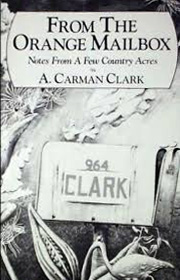
From the Orange Mailbox

Notes from a Few Country Acres
by Arley Carmen Clark

Very nice book written by a teacher and avid gardener. It appears to be a collection of articles she wrote for a weekly column, arranged here by the seasons. Each essay is only a few pages, so it's the kind of book you can dip in and out of easily when you have a short break from something. In a practical, friendly voice the author describes her work in the garden, her leisurely swims in the pond among turtles and loons, hunting bugs with visiting grandchildren, the doings of a various succession of household dogs, musings on the richness of life and reflects on all things around her. She discusses education (retiring from teaching in about the middle of the book) and bemoans the tangled mess of doing taxes. Mostly it is a book about living life well, observing and enjoying nature, and learning by experimentation how to manage a large home garden. I took a few notes on methods to try with plants, and the recipes she shares sound so good, I'm determined to try a few myself.

Rating: 4/5     273 pages, 1985

Feb 9, 2016

TBR 59

You all know what this is! More books I want to read someday...
Beyond Words by Carl Safina- So Many Books
The Golden Age by Jane Smiley- Caroline Bookbinder
Frozen Wild by Jim Arnosky- Bookfoolery
Ghost Boy by Martin Pistorius- Farm Lane Books Blog
The Great Typo Hunt by Jeff Deck- Book Chase
One Plus One Equals Blue by M.J. Auch- Puss Reboots
The Big Tiny by Dee Williams
Fates and Furies by Lauren Groff- James Reads Books
Brooklyn by Colm Toibin- Bermudaonion's Weblog
Pnin by Vladimir Nabokov
Blackass by Igoni Barrett- Farm Lane Books Blog
Pigs in Clover by Simon Dawson-
The Midnight Folk by John Masefield
The Bone Woman by Clea Koff- Ardent Reader
Whitetail Savvy by Leonard Lee Rue
Whitetail Spring by John J. Ozoga
Bear by Marian Engle- Jules' Book Reviews
The Man Who Planted Trees by Jean Giono- A Work in Progress
The Small Heart of Things by Julian Hoffman- So Many Books
Fools Crow by James Welch- Shelf Love
Forgotten by Time by Robert Silverberg
Salamanders and Other Wonders by Will Lea
Lost and Vanishing Birds by Charles Dixon

Feb 7, 2016

The Auk, the Dodo and the Oryx

Vanished and Vanishing Creatures
by Robert Silverberg

This book from the late sixties is about animals that had recently (in the last few hundred years- within human memory) gone extinct, or were presently in danger of extinction. It is a brief examination of what pushed these animals to the brink- usually a low reproduction rate, lack of defenses against introduced predators and unrestrained hunting by mankind. Extinct species discussed include numerous birds: the dodo, moa, passenger pigeon, heath hen, great auk and a few others. Mammals noted are the steller's sea cow, quagga, aurochs and giant ground sloth. There are also lots of animals in the book that were at the time at serious risk. Happy to say, at present time most of these are in still with us: giant panda, california condor, whooping crane, trumpeter swan, java rhino, cahow (a kind of petrel), przewalski's horse, nene (Hawaiian goose), pére david's deer, oryx. Sadly, attention to protection and conservation measures were not soon enough for others- at the time of his writing, java tigers were still around, so was the ivory-billed woodpecker. Now assumed extinct.

There were lots of details in here I never knew before about the fate of passenger pigeons. Descriptions of unfamiliar animals (takahe and moho birds of Hawaii) sent me to the internet numerous times to learn more about them. Did you know that there used to be nine distinct species of moa, ranging in size from the giants twelve feet tall (all I knew of before this book) to the size of the kiwi (only one left extant)? or that dodos were related to pigeons? Mostly I was baffled by the reactions of people in the 1800's when they realized an animal was on the verge of extinction- not a rush to try and save it, but to obtain a specimen for their museum, or just to have the honor of shooting one. Who takes pride in being the person who killed one of the last of a kind? It makes me angry to think of.

Funny, the cover I found to show (my edition has a pretty drab one) has the words of the title in a different order.

Rating: 3/5      246 pages, 1967

Feb 3, 2016

Faith in a Seed

by Henry David Thoreau

This volume compiles some nature writings Thoreau did late in life, which were published after his death. The book contains "The Dispersion of Seeds" and parts of manuscripts titled "Wild Fruits", "Weeds and Grasses" and "Forest Trees." It's a lovely and tedious read at the same time. Thoreau was intensely interested in plant life around Concord and made meticulous observations about how plants were naturally distributed. Most of the book details how seeds are spread by the weather and/or wild animals, the resulting patterns of growth, what types of habitat different seeds find favorable, and most interestingly, the reasons why pine woods are succeeded by oaks and oaks again by pines, if all the trees are cut down. I was surprised to read about how many years seedlings would grow up again after being cut down- eaten by rabbits, mown over, etc- some young trees he dug up and measured were spindly little things above the surface, but underground the taproot often proved to be five, seven, ten-plus years old. Tenacious things, trees. They just keep sending up new life!

While I find the subject matter pretty interesting and Thoreau's writing more accessible than I had expected (I've struggled twice to get through 'Civil Disobedience' which is the opening chapter to my volume containing 'Walden', and failed) at the same time the lists of plants and brief descriptions of how this seed is shaped, how it falls, where it falls, what percentage of it comes up in what part of the woods etc etc can get to be really dry. It has been my go-to-sleep book for a week- a week that felt really long. I'm glad I read it, I admire the work that went into it, but I'm not sure if I will deliberately read it again.

I was also pleasantly surprised at how modern-sounding Thoreau's voice is. Yet certain details distinctly reminded me that I was reading the words of a man who lived in another era. He often proclaimed things from scientific circles that have long since been proven otherwise. Was very skeptical of accounts of seeds being recovered from old sites and successfully germinated after tens or hundreds of years- discredited them entirely. And every now and then casually mentioned the numerous pigeons that fed on certain seeds or fruits. I wondered at this for a bit, then a mention of them flying off elsewhere to be shot in great numbers made me realize: he was speaking of the passenger pigeon! Which is now extinct.

Note: the book was compiled and published in 1993, Thoreau actually wrote the studies between 1856 and 1861. There are extensive notes in the back of the book describing how the writings were compiled, identifying quotations, individuals or incidents Thoreau mentioned, and making note of where his self-editing was unclear (passages he might have meant to delete or insert in different places, etc.)

Rating: 3/5       283 pages, 1993

Feb 2, 2016

deer crossing

Yesterday my youngest pestered me to do a puzzle with her. She quit as soon as the border was assembled but I kept going. Even though this is another cheap papercity puzzle, I found I rather liked it. There's enough texture and color going on, and avoiding use of the box picture as a reference made it just challenging enough. 500 pieces.
I miss reading however. Too many other projects lately and my current book is one of those put-yourself-to-sleep kind of reads. I like it, but it's tedious. I hope to finish it soon and get to something a bit more enjoyable.

Jan 25, 2016

My Weeds

A Gardener's Botany
by Sara B. Stein

This wonderful book is a botanical exploration of the weeds one writer dealt with in her garden. It turned out (once again) to be much more than I expected, full of meticulous detail and scientific information on all aspects of understanding plants- weeds in particular, but many other species as well. Their relationship with insects, with soil organisms and fungi, the process of photosynthesis, their widely varying modes of reproduction, how they have managed to disperse so far and much, much more. Ordinary looking plants -dandelion, hedge rose, even pond scum (duckweed), have so much more going on than I had realized. And to make it all a great read, the author is an excellent writer as well. In one chapter she traces the geological history of her neighbor's pond back 450 million years. In another, she describes how the landscape of her town has change dramatically in just the past fifty years- reverting from cleared farmland back into wood lots. She discusses pesticide use and seed engineering, the strength and deadliness of many chemicals plants produce themselves (to use against their insect enemies). There's even some criticism of Rachel Carson's book Silent Spring, which I was surprised to read at first but it made sense the further I went on. Stein brings the wonders of the plant world alive, all from the starting point of trying to identify the weeds in her yard, striving to understand their mechanisms in order to combat them more effectively. I particularly liked the final chapter, where the author explained her new goal to create a garden that would perpetuate itself after her, plants that would fill the landscape without much room for weeds at all, partnered in the right places to enable ready succession from neglected garden patch to wildflower-strewn meadow to brush and eventually, mature woodland once again.

Rating: 4/5      229 pages, 1988

Jan 10, 2016

Letters from Father Christmas

by J.R.R. Tolkien

Charming, amusing, and a bit sad if you read between the lines. Tolkien wrote some very creative letters from Father Christmas to his children, every year at christmastime, for twenty-three years. The letters are sometimes brief with just greetings and hopes the children will like their gifts, and sometimes much more elaborate, with stories about life at the North Pole and all the mishaps caused by a polar bear, who is very much a central character. Later other characters come in, too- including goblins that break into storage cellars and steal things, penguins that visit from the South Pole, snow-men and cave-bears, and secretary who takes over writing some letters. Tolkien varied the handwriting (including amusing inserts done by the polar bear, interjecting his own comments and little digs at the storyteller) according to which character wrote the letter, included a specific alphabet for polar bears and another for elves, and lots of lovely drawings.
The style of it all reminded me very much of Mr. Bliss (another children's tale Tolkien wrote) but there are also some more sombre undertones to this. Often the letters described some mishap that happened at the North Pole, which explained why the children would receive fewer presents, or not exactly what they had asked for. Statements bracketing the stories of a war between goblins and elves (foreshadowing some elements of Middle Earth definitely) remind one what the atmosphere was like in the thirties. It's a book Tolkien fans will probably find intriguing. I kept thinking as I read it how wonderful it must have been for his kids to receive these messages each year, so carefully crafted by their father.

Rating: 3/5      112 pages, 2004

more opinions:
Nose in a Book
All Booked Up
2606 Books and counting