Jan 25, 2016

My Weeds

A Gardener's Botany
by Sara B. Stein

This wonderful book is a botanical exploration of the weeds one writer dealt with in her garden. It turned out (once again) to be much more than I expected, full of meticulous detail and scientific information on all aspects of understanding plants- weeds in particular, but many other species as well. Their relationship with insects, with soil organisms and fungi, the process of photosynthesis, their widely varying modes of reproduction, how they have managed to disperse so far and much, much more. Ordinary looking plants -dandelion, hedge rose, even pond scum (duckweed), have so much more going on than I had realized. And to make it all a great read, the author is an excellent writer as well. In one chapter she traces the geological history of her neighbor's pond back 450 million years. In another, she describes how the landscape of her town has change dramatically in just the past fifty years- reverting from cleared farmland back into wood lots. She discusses pesticide use and seed engineering, the strength and deadliness of many chemicals plants produce themselves (to use against their insect enemies). There's even some criticism of Rachel Carson's book Silent Spring, which I was surprised to read at first but it made sense the further I went on. Stein brings the wonders of the plant world alive, all from the starting point of trying to identify the weeds in her yard, striving to understand their mechanisms in order to combat them more effectively. I particularly liked the final chapter, where the author explained her new goal to create a garden that would perpetuate itself after her, plants that would fill the landscape without much room for weeds at all, partnered in the right places to enable ready succession from neglected garden patch to wildflower-strewn meadow to brush and eventually, mature woodland once again.

Rating: 4/5      229 pages, 1988

Jan 10, 2016

Letters from Father Christmas

by J.R.R. Tolkien

Charming, amusing, and a bit sad if you read between the lines. Tolkien wrote some very creative letters from Father Christmas to his children, every year at christmastime, for twenty-three years. The letters are sometimes brief with just greetings and hopes the children will like their gifts, and sometimes much more elaborate, with stories about life at the North Pole and all the mishaps caused by a polar bear, who is very much a central character. Later other characters come in, too- including goblins that break into storage cellars and steal things, penguins that visit from the South Pole, snow-men and cave-bears, and secretary who takes over writing some letters. Tolkien varied the handwriting (including amusing inserts done by the polar bear, interjecting his own comments and little digs at the storyteller) according to which character wrote the letter, included a specific alphabet for polar bears and another for elves, and lots of lovely drawings.
The style of it all reminded me very much of Mr. Bliss (another children's tale Tolkien wrote) but there are also some more sombre undertones to this. Often the letters described some mishap that happened at the North Pole, which explained why the children would receive fewer presents, or not exactly what they had asked for. Statements bracketing the stories of a war between goblins and elves (foreshadowing some elements of Middle Earth definitely) remind one what the atmosphere was like in the thirties. It's a book Tolkien fans will probably find intriguing. I kept thinking as I read it how wonderful it must have been for his kids to receive these messages each year, so carefully crafted by their father.

Rating: 3/5      112 pages, 2004

more opinions:
Nose in a Book
All Booked Up
2606 Books and counting

Jan 5, 2016

The Bafut Beagles

by Gerald Durrell

In this delightful book Durrell describes a trip he made to the Cameroons -probably in the late forties- to collect wild animals to take back to England (for a zoo or his own collection I am not sure). He plunges straight into the story without much introduction or explanation, but happily I have read enough of his other books that I recognized the context immediately. Having gained the support of the local headsman, the Fon, via copious drinking bouts and gathered a group of eager hunters and mongrel dogs (the "beagles" of title) he avidly gathers up as many animal "specimens" as possible. This is done by paying nice sums to local people for what they bring him, as well as going out on his own hunting forays. Several times he ran into difficulties convincing the people that an animal he knew of actually existed, as they had never seen one, or that an animal could be safely approached and caught, as they thought some innocent creatures deadly. (Yet they often handled very poisonous snakes with a seemingly careless attitude!) I really enjoyed the story, the straightforward humor and the descriptions of the wildlife. Some species I had never heard of, or didn't recognize right away because the name Durrell used for them was unfamiliar. It took me a minute to realize that the galago is a bushbaby, and I think the colorful skink the natives feared so much must have been a fire skink (going on his description of its appearance alone). I find the agama lizard just as beautiful, although it didn't get much mention (too common) and definitely the most curious creature of all is the hairy frog (also known as the horror frog)! Also described are several kinds of monkeys, flying mice, bush pigs, the golden cat, rock hyrax, numerous excitable squirrels, cane rats, snakes and many others.

At first I found reading the book a bit awkward and uncomfortable, as he communicated with the natives in pidgin English and there are entire conversations written this way (reminiscent of certain parts of Peter Pan). It felt insulting, but there were a few times where moved by sudden excitement or indignation the author would burst out a sentence or two of grammatically correct English, which baffled his native hunting companions. So I guess the people actually spoke that way, and partly through the book I was able to accept this and just read it. The depictions of local customs and characters (especially the Fon himself) were really well-drawn and add a lot to the book. In one particularly funny incident Durrell witnessed a young man and a girl arguing hotly in the street, pursued by an old woman who was beating the man (while he completely ignored her and continued scolding the girl). Durrell watched the charade with interest and being unable to understand what they said, invented in his head a rather elaborate story involving infidelity and witchcraft. Then he asked a passerby what was going on and found out it was simply an irate husband who came home to find no dinner waiting for him, and his mother-in-law got into into the resulting fray! Durrell was disappointed to find out it was just a domestic quarrel, but laughed at himself for thinking otherwise.

Rating: 4/5     254 pages, 1954

more opinions:
Suz's Space
Everything Distills Into Reading

Jan 4, 2016

eight zebras

My four-year-old wanted to do "the big zebra puzzle" with me. It's 500-plus pieces, but we worked it all in one day. It wasn't all broken up properly last time- about half the pieces were stuck to a few others so it went quicker than I'd expect. I kind of feel like this is cheating but she thought it was a great bonus!
It's an older puzzle and I thought I'd find it boring because of the typical straight grid cut. But the pieces all have wavy edges on the vertical sides, and they varied enough to make it interesting.
This one's a keeper.

Jan 2, 2016

2015 book stats

Total books read- 98

Fiction- 41
including
YA- 2
Historical- 2
Fantasy- 5
J Fic- 15
Picture Books- 7
Animals- 12

Non-fiction- 57
including
Memoirs- 8
J Non-fic- 2
Nature- 2
Animals- 51

other formats-
ebooks- 0
Short Stories- 5
Graphic Novels- 4

sources-
Owned- 57
Library- 39
Review copies- 2

abandoned books- 8

No surprises here: I read more nonfiction and even more animal books, wrote about a few picture books that interested me. Somehow the count is off, but that's probably because I didn't keep a running tally this year and figuring out all the numbers by going through lists of posts is a bit confounding- but it doesn't matter too much. You get the general picture. I read more of my own books this year, and crossed a few off my TBR lists as well.

Favorite books of the year? I really must say it was H is for Hawk. Other books that really stand out in my memory were animal related as well: Fish Behavior was a perfect match for my growing interest in the home aquarium inhabitants. Wesley the Owl was amusing, intriguing and personal, on a bird I know so little about. A book that really wowed me with fascinating new information was The Soul of an Octopus. Paul Gallico's The Abandoned was just lovely, a story of friendship and what it must be like to really be a cat. On a completely different note, I must also mention Women Who Run with the Wolves. It's one I recommend highly. So dense with rich material on strength of self, all drawn from mythological figures and fables featuring women.

Dec 31, 2015

Chi's Sweet Home

vol 12
by Konami Kanata

We happily discovered a new volume of Chi's Sweet Home at the library last week, which prompted my older daughter to re-read the entire series. I glanced through the prior volume to remind myself of the storyline- Chi has finally met her mother, from whom she was separated as a young kitten. Her current family now realizes that her original owners are still looking for her. It seems like a perfect moment for her to be reunited with them, as her current family is imminently moving to France (job relocation). But they still waver over what to do, because Yohei is so dearly attached to Chi. Meanwhile the cats take matters into their own paws, as Chi's momma is actively seeking a reunion now, and Chi knows the other kittens are her cat-siblings. She is naturally drawn to them, but while spending more time with her kitty family, still remembers and misses Yohei and the others. Where will Chi finally belong?

It's darn cute like all the other Chi books, but the story here is a lot about moving preparations, family reunion and the internal conflict of finding out you might belong somewhere else. Not so much depiction of cat behavior and kitten antics, which I really enjoyed before. Still, a fun read and a nice ending to the series. i did like the "interview" at the back of the book between the author and one of the cat characters, Blackie. Sad there are no more Chi books, but my daughter and I do want to find and watch the animation of it all.

Rating: 2/5        176 pages, 2015

The Bonobo and the Atheist

by Frans de Waal

As you can tell from the title, this book is about religion, morality and humanism. Particularly, what we can learn or speculate about the evolution and nature of our own moral codes, from how our closest animal relatives behave. While I was expecting it to be mostly about bonobos, it uses a lot of examples from other animals- mostly chimpanzees, some old-world monkeys, elephants and dogs. Its author is a very well-known biologist specializing in the study of bonobos but now I wish I'd read one of his earlier books, as this one lost me. (I don't know if they would have been any better, but there are nine prior titles listed to his name, which seem to be about bonobos or chimpanzees. My guess is they might be more concrete and less meandering, being written earlier in his career?) This book quickly goes into philosophical and religious debates, straying frequently from what seemed to be the topic at hand. Maybe there was a relevant point tied up in it all, but I could not always follow it. I ended up skimming through the entire book, reading the passages that had examples of animals displaying a sense of fairness, ethics, compassion, guilt, etc including what those observations implied, but allowing my eyes to glaze over when it started diving into the tangle of arguments between religious thought and atheism. The book has a lot of acclaim in online reviews at the biggest seller's site, but I can't find it mentioned on any other book blogs.

Abandoned        289 pages, 2013

Dec 27, 2015

Bonobo Handshake

by Vanessa Woods

The bonobo is very similar to a chimpanzee, but with significant differences. They stand upright and have smaller heads, with more humanlike proportions. They live relatively peacefully, don't engage in warfare between groups or commit infanticide. The author's new husband was studying bonobos in the Congo (the only place in the world where they exist in the wild) and she went along to help with the research. The studies, which examined the extent of the bonobos' ability to cooperate, tolerance levels and their hormonal response to the presence of strangers, were conducted at a rescue center that took in young bonobos orphaned by the bushmeat trade and illegal wildlife trafficking. Though her story was just as much about a time and place (heavy on details of local politics and ugly warfare) as it was about the bonobos, I still learned quite a lot about the wild apes. Compared to them, chimpanzees appear brutal and outright vicious. I'm now curious to learn more about them, and have found a few more titles (there are not many published).

This book is definitely not for the squeamish: the author describes horrific atrocities that took place in the Congo, devastating things to live through for humans and bonobos alike. Yet she describes it all in a rather detached, casual manner (with a fair sprinkling of expletives) that sometimes almost made me loose interest in reading. The profanity obviously bothered a reader before me, who marked up the library copy I had with a ballpoint pen, crossing out phrases they apparently found objectionable, and writing in other words in their place. Oh, and there are a number of descriptions of the bonobos engaging in sexual activity. That's another significant characteristic they have- they use sex to diffuse tension. Frequently. Although after carefully observing when, why, and between whom these acts occurred, the author came up with her own ideas for why the bonobos are so free with sex compared to other apes (even youngsters who had never observed adult behavior- being orphaned very abruptly- engaged in what looked like sexual behavior). Surprisingly, my fellow reader with the blue pen didn't mark out or comment on these passages!

Borrowed from the public library.

Rating: 3/5        278 pages, 2010

more opinions:
My Books My Life

Dec 20, 2015

Jane, the Fox and Me

by Fanny Britt

I saw this book on Things Mean a Lot, and looked for it at my library when getting piles of picture books for my kid. It's a story of friendship, loneliness and self-image. Helene struggles in school because her friends have inexplicably shunned her. They whisper rumors and giggle behind her back and write nasty notes on the bathroom wall about her weight and body odor. Untrue things, but Helene believes them and retreats into silence, loneliness and books. She's reading Jane Eyre, and finds a lot of comfort in the story of this plain, ordinary woman from a difficult background who overcame the odds to become someone admired and loved. (That's what Helene gets out of it, I myself haven't read Jane Eyre in a very long time....) But she can't always escape into her reading. There's a class trip to a camp, and Helene dreads having to wear a bathing suit in front of the other girls, having to endure the taunts and ridicule. When she gets publicly humiliated by another girl, she feels her life is ruined. But a momentary encounter with a wild fox lifts her spirits, and then another girl, surprisingly sympathetic, joins the "outcast cabin". Helene finally makes a new friend. She also discovers during a regular visit to the doctor, that her weight is perfectly normal. I really like the message of this book. The difficulties of navigating school days and crowds of kids who can be so unreasonably cruel with their ostracizing cliques balanced out by the solace of books, nature walks (something visually depicted in the book) and finding a person who sympathizes. It did seem to end rather suddenly, and I wished for a bit more depth, but I think the length and detail is just right for the age group. The illustrations by Isabelle Arsenault are very nice. I like the sketchy quality of the pencil drawings (especially their use of value and negative space), which is brightened by watercolor washes on certain pages, reflecting Helene's varying emotions.

I offered the library copy to my eleven-year-old, but she shrugged: "I have lots of books to read already." It's true, she does have a hefty stack on her bedside table. A good problem to have! I'm going to suggest this one to her again someday, I think she's at just the right place to benefit from it.

Rating: 4/5      104 pages, 2012

more opinions:
So Many Books
Lindy Reads and Reviews
Welcome to my (new) Tweendom
Perogies & Gyoza

Dec 19, 2015

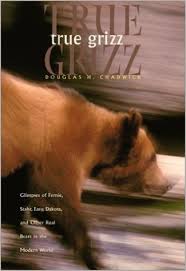
True Grizz

by Douglas Chadwick

This book is based on the author's work as part of a grizzly team. Well, really he tagged along as an informed observer. The team's job was to "educate" grizzly bears that had begun to associate people's homes with food- dogfood, grain for livestock, and you'd be surprised at how many bears love to eat birdseed. Not only did they constantly chase grizzlies away from habitated areas, using bear dogs, rubber bullets and a ton of noise, but also tried to educate local people about how to avoid attracting bears into their neighborhoods (whether it was inadvertent or on purpose, as in the case of a wildlife photographer who regularly put out food and was pleased when bears came by). They also personally removed tons of tempting items- including apples fallen off of trees and roadkill or dead livestock on ranches. In some cases the bears were starved from bad years of natural berry crops and the like, so the bear team would relocate carcasses or loads of apples, to give the bears something to eat in an area away from people. This because during their work tracking, collaring, catching and relocating bears they discovered that in most cases, moving a bear -no matter how far away- didn't work. The bear would simply come back to where it knew it could find food. So their job involved a lot of grizzle bear PR and attempts to give bears a negative association with populated areas.

Most interesting though, were the insights into grizzly behavior, and the stories of individual bears' lives that slowly unfolded through the bits of information learned in brief encounters or tracking data. Bears have very individual temperaments, each its own unique fishing style at salmon rivers, its own response to certain situations. This makes for pretty good reading. I felt bad for the many bears who simply couldn't find room to live in, without running into people. Or the bear that started hanging out at a zoo, interacting with a captive bear there. It came back so many times the zoo finally just put it in a cage.

Rating: 3/5        176 pages, 2003

Dec 18, 2015

Home

by Carson Ellis

This lovely picture book shows a wide variety of places that people call home. Each page is a detailed illustration of a different kind of home- a city apartment, country home, thatched stone house on a mountainside. Some are really fanciful- the old woman's shoe from a nursery rhyme, an underground sea lair (my favorite, with the writhing octopus tentacles and wavy aquatic plants), a diminutive woodland house- for a fairy or elf, you must imagine. There are so many particular details, you can imagine what kind of person lives in each home and the sort of activities they do. The page showing the artist's own home is fun, as you can find objects, paintings and sketches in the room from most of the other illustrations in the book. Also there's a visual thread running through the entire thing- which I didn't notice until the second time I read this to my kid- of a mourning dove. The bird is present somewhere in each picture. Most of all, I loved the details of plants in the pictures- the variety of shapes, the fronds of sea plants and ferns- just lovely.

Note: I did not really think about how prevalent old, negative stereotypes are in this book -in the way it depicts the homes and lifestyles of non-European cultures- until I read the review in the third link below. Now it feels like a slap in the face. My four-year-old definitely wasn't astute enough to pick up on this either, but that's exactly the problem- the book will just define for her what other places and lives are like, if all she knows about Inuits are "that they live in igloos" for example. Sigh.

Rating: 4/5      40 pages, 2015

more opinions:
Things Mean a Lot
Rhapsody in Books
American Indians in Children's Literature

Dec 17, 2015

TBR 58

As usual, I've looked them up and the titles listed in the first section are found at my local library. All the rest maybe I will find them by chance someday. Thanks to the bloggers below, for bringing to my attention yet more books I want to read! (Other titles were found via books themselves).
An Appetite for Wonder by Richard Dawkins- Read Warbler
Carry On by Rainbow Rowell - Reading the End
Foragers, Farmers and Fossil Fuels by Ian Morris- So Many Books
The Republic of the Imagination by Azar Nafisi- So Many Books
Living with Wolves by Jim and Jamie Dutcher
Browsings by Michael Dirda- So Many Books
Challenger Deep by Neal Shusterman from Shelf Love
Leaf by Daishu Ma- So Many Books
Understanding Roots by Robert Kourik- Garden Rant
The Beach of Falesa by Robert Louis Stevenson- James Reads Books
The Mountain and the Valley by Ernest Buckler- Farm Lane Books Blog
Heart and Blood Living with Deer in America by Richard Nelson
Of Sorrow and Such by Angela Slatter- Things Mean a Lot
Maverick Cats by Ellen Perry Berkeley
Community Cats by Anne E. Beall
Heirloom Harvest by Amy Goldman- Vegetable Gardener
A Walk Across America by Peter Jenkins- Caroline Bookbinder
The Natural History of a Yard by Leonard Dubkin - Caroline Bookbinder
The Indestructible Houseplant by Tovah Martin- Garden Rant
The White Lions of Timbavati by Chris McBride
No Room for Bears by Frank Dufresne
Earth Stopped, or Mr Marx's Sporting Tour by T.H. White
Gone to Ground by T.H. White
A Cuckoo in the House by Maxwell Knight
Urban Tails by Sara Neeley

I have been perusing the references listed in the back of books about wolves, lately. Lots of interesting-looking material. I may have already read the last four titles here, but it's been so long I'm not certain and would like to read them again...
Arctic Wolf: Living with the Pack by David Mech
The Way of the Wolf by David Mech
Out Among the Wolves edited by J.A. Murray
Dance of the Wolves by Roger Peters
The Wolves of Minong by Allen Durward
The Ninemile Wolves by Rick Bass
The Decade of the Wolf by Douglas Smith
Brother Wolf: A Forgotten Promise by Jim Brandenburg
Soul of the Wolf by Michael Fox
Cry Wild by R.D. Lawrence
Wolfer by Carter Niemeyer
Praise of Wolves by R.D. Lawrence
Wolves by R.D. Lawrence
Trail of the Wolf by R.D. Lawrence
Secret Go the Wolves by R.D. Lawrence
The Ghost Walker by R.D. Lawrence
The North Runner by R.D. Lawrence
White Wolf: Living with An Arctic Legend by Jim Brandenburg

Rules of Summer

by Shaun Tan

I love Shaun Tan's artwork, but found this one a bit underwhelming at first. It depicts the summer activities of two brothers- not at all in the way you might expect. The landscape can be strange, feeling desolate and empty or just downright weird. You see the kids doing things like inspecting small critters on the sidewalk, playing invented games with racket and ball on a bizarre court, marching in a fantastical parade of windup creatures. Each page is a broad spread of a beautiful, textural painting paired with a short sentence of the "rule" the boy learned during his summer- never leave the back door open overnight or never forget the password. You have to imagine by yourself what the story behind each incident is, but it slowly becomes clear that this book is depicting the rules of a relationship, younger and older brother, through their wildly creative games and explorations. I had to sit down and read it several times, it really started to grow on me after the third perusal. Gradually the kids' camaraderie dissolves as one breaks or forgets some arbitrary rule the other has made up, and then there is a period of isolation, loneliness and dismay, which must finally be alleviated by forgiveness and rescue. It is heartwarming. Ok, I need to read it again right now. The images really are incredibly striking. They evoke a lot of wonder and imagination.

I really do like Shaun Tan. The Arrival is my favorite so far. I found mention of The Bird King: an Artist's Notebook on the flyleaf and now I hunger for that book. I think I'd love it. I just found out my library has The Red Tree as part of a three-in-one volume, which is why I never found its title in the database before! So waiting for that one.

Rating: 3/5       52 pages, 2013

more opinions:
Things Mean a Lot
Waking Brain Cells

Dec 9, 2015

Whitetail Tracks

by Valerius Geist

I have not read much about deer, aside from a few like Bambi or The Hidden Life of Deer. So I expected to find this book interesting, and it really was. The author explains the lifestyle and success of whitetail deer in relation to their evolutionary history. In fact, it seemed that over half the book was about how deer evolved, from small dwellers of the forest floor right after dinosaurs disappeared, into the first recognizable deer some thirty million years ago. It did feel a bit repetitive, and for all the reiteration, some things were not quite explained well. But I did gain some surprising understanding into why deer have a certain type of body language and why they are so incredibly numerous nowadays. Whitetail deer in particular thrive at the edges of things, where disturbed habitat creates a lot of new, lush growth. Places such as river edges or newly cleared land. It's very clear that they will continue to do well alongside man, being one of the wildlife species that easily adapt and take advantage of changes we make to the environment. Reminding me of another book that called certain adaptive species "weed animals"! The author of Whitetail Tracks predicted that eventually whitetail deer would spread their range up through the Yukon into Alaska, and since he wrote it over a decade ago, I checked. Yes, whitetail are present in the Yukon now although apparently not in great numbers. Reports of whitetail sightings in Alaksa spark arguments on hunting forums. I suspect that as northern regions continue to get warmer, whitetails will keep moving too. They definitely are survivors and opportunists.

Another part that was really interesting discussed trophy bucks- why large males with nicely proportioned antlers are so rare in the wild, and how game farms condition bucks to grow large antlers. It was completely the opposite of what I would have assumed, and the historic aspects of this (gamekeepers protecting deer for feudal lords in the sixteenth century) was new info for me.

I borrowed this book from the public library.

Rating: 3/5        176 pages, 2001

Dec 8, 2015

Magic or Not?

by Edward Eager

I thought I was done with Edward Eager, but had missed one that was waiting on library hold for a long time. It just came in a few weeks ago. So this one comes just before The Well-Wishers and of course as I imagined, it explains all the character relations neatly. I did like the dynamic introduced when the kids meet Gordy- a well-meaning but bumbling kind of kid, son of unpleasantly wealthy parents, lonely and not much liked by anybody. The main characters are nice to him because they try to be decent, but there are all kinds of awkward moments when they really wish he wasn't there, or try to avoid his company without hurting his feelings, but in the end they find out he isn't so bad after all, and appreciate Gordy on his own merits. That was a nice touch.

But I'm rather getting ahead of myself. The story is that two kids move to the country and there's a well in their yard. They think it's a wishing well and intend to have magical adventures, along with a few other kids in the neighborhood they meet. The aloof granddaughter of an elderly artistic eccentric, and a friendly boy from across the street as well as Gordy, who shows up later. The magic doesn't quite work out at first, and they get the idea that it only works when they're using it to help others. So they go about looking for people to do good deeds for. This results in some misunderstandings, as when they find a little boy alone in a shop, decide he's lost, take him along looking for home, and get distracted exploring a river in the meantime! It's certainly a book written from other times- horse-drawn vehicles are not uncommon, cars are fancy new inventions, some speech patterns are different (I even had to look up a few words) and the children are pretty much left unsupervised. Being encouraged by adults to play in an abandoned mine shaft, and taking an old boat on a river running into rapids and having to climb around a waterfall, does not really seem safe to me! Even when the kids get minor injuries the adults don't seem very alarmed...

I liked the story well enough, but was a bit disappointed to find in the end it was all a setup, a kind of elaborate prank by some neighbors at first, which the children themselves built upon and kept the pretense going on their own. Ghosts and long-lost secrets and mysteries to solve are not really my thing. This did not crop up until nearly the last chapter, or it probably would have caused me to abandon the book, simply from disinterest. The rest of it is pretty good, though.

I'm a bit puzzled now, because I vaguely remember a book I read from my elementary school library, about a boy who found some magic object that turned him into a cat? I was expecting to run into that story among these; I thought it was an Edward Eager book but I suppose not.  Oh well.

Rating: 3/5         197 pages, 1959

Dec 7, 2015

The Hidden Life of Wolves

by Jim and Jamie Dutcher

This beautiful book describes the social lives of wolves. It's based on six years the authors spent living alongside a wolf pack in Idaho, to study their behavior and social interactions. The insights they gained prove that wolves are caring, family-orientated animals with strong social needs. That they appear to mourn the loss of packmates, use playtime to alleviate aggression across dominance roles and teach each other new skills. It is not related as a storyline, but instead a detailed description of what was learned. The book skips a lot of the basic information that I've seen covered so often lately, and goes more into current issues. It discusses the implications of wolf re-introduction, in this case describing what was done in Idaho, occasionally mentioning the work with wolves in Yellowstone as well. There are a lot of recommendations on how wolves and humans can manage to co-exist, and their ideas on dealing with wolves preying on livestock takes the opposite approach most ranchers and wildlife officials seem to use. In brief: their findings show that removing 'problem' wolves and breaking up pack structure does not help- because young wolves lacking leadership will gravitate to easy prey, and newcomers drifting in to fill gaps will experiment with livestock predation as well. The longer term solution, the Dutchers suggest, is to teach resident wolves that livestock do not make good prey targets, because of the presence of dogs and people. If one pack learns to avoid livestock, it will teach its young that lesson, which can last through generations of wolves. The other big thing I learned from this book was the broad positive impact wolf re-introduction has had on many ecosystems. As this apex predator began preying on elk herds, the numbers of elk did not actually drop but their overall health improved and their behavior changed, which had a ripple effect everywhere. Improving the growth and diversity of plants and smaller animals in more ways than I had realized. What really makes this book a great read though, is not all the lovely writing but the beautiful photographs. It is very much a photo essay, a very striking and informative one.

I borrowed this book from the public library.

Rating; 4/5        215 pages, 2013

Dec 5, 2015

the DARE

So I'm participating in James' (supposedly) final TBR Triple Dog Dare. I just forgot to post an announcement because I've been busy. The Dare basically means from now to April first I will only read books off my TBR shelves. With one exception- this short stack of library books I checked out earlier last month. Most of these titles were on my TBR lists, so they count too I think. But the main goal is to actually get through more of those books that have been patiently sitting on my shelves for so long...
Let's see how it goes!

The Wolves of Yellowstone

by Michael Phillips and Douglas Smith

This book is about the program that re-introduced wolves to Yellowstone National Park in 1995. In actuality it began decades earlier; the first voice advocating re-introduction of wolves was raised in 1944 (Aldo Leopold) but it took over fifty years for all the logistics to be worked out. That's mostly what this book covers- how the planning was put in place and worked through, difficulties that were overcome and views of success. There's very little about the behavior of the actual wolves themselves, especially because the wolves were deliberately given a lot of space- to keep them wild and unaccustomed to human presence. When brought from Canada and placed in acclimation pens they were mainly observed only at a distance. When released their movements were tracked via radio collars, not much else. Thousands of visitors were later delighted to view the wolves engaged in normal behavior. It's a very informative read, and I learned a lot about how much work and delicate public relations it took to complete this project, but missed the intimate style of nature writing I usually enjoy. I wasn't aware of the red wolf recovery program initiated years earlier in North Carolina before; this program in Yellowstone took notes from how that worked and did things a little differently, they outline the reasons and results well. There are lots of additional side paragraphs written by various people who were involved, usually relating the moment of initial release again. The most eloquent one was near the end of the book, by Renee Askins. I appreciated that all the photographs in the book were taken on site, so they are not all gorgeous and staged. Often a notable moment could only be described in words, as the wolves were too quick or nobody had a camera to record what happened. This re-introduction effort is more than a decade old now, so there's lots more up-to-date information out there about what happened to the wolves. I suppose there are other books that have been written since, which can give better insights to the impacts of having wolves back in Yellowstone, simply from the benefit of time. However if you want a behind-the-scenes look at how it was all initially made possible, this is a good resource.

Rating: 3/5         128 pages, 1996

Dec 2, 2015

Wolf

Legend, Enemy, Icon
by Rebecca L. Grambo

Much like the Barry Lopez book Of Wolves and Men, this large coffee-table style volume provides a lot of solid information about wolves. It covers all the basics- pack structure, habitat needs, hunting strategies of wolves and so on. Mostly it is about how humans and wolves have interacted over the centuries, our perception of them shifting over time. Anciently wolves were revered and admired, many feature in creation stories. Men from hunting cultures tell of copying methods they observed wolves using. When people began keeping livestock, wolves were no longer seen in a positive light but viewed as competition. Even worse, during the Middle Ages when wolves often scavenged the dead left from plagues, famine or warfare, they came to be feared as agents of evil. It's taken a long time for our views of wolves to change, but now opinion is swinging around again and wolves are seen by many as noble icons of the wilderness. Interestingly, the author cautions against this relatively new lauding of wolves as well, pointing out that whenever we see the animal through colored lenses, our responses to problems with wolves are skewed. That careful scientific studies should influence our management of wolf populations, not emotional popular opinion. I had never quite read these perceptions explained so clearly before. The book rounds out its discussion of wolves with an overview of the state of wolf populations in different countries, and how re-introduction into many areas is being managed, in particular regarding conflicts with livestock keepers.

A lot of this information wasn't exactly new to me, but the clear way in which it was all explained made it a very nice read. Many of the tales recounted- legends, mythology and creation stories from different cultures, were ones I hadn't encountered before. The photographs by Daniel J. Cox are beautiful (and I appreciate that the author admits they are all of wolves kept in captivity- pointing out how pictures of captive wolves in superb health can gain admiration and support for their wild counterparts, which are seldom seen and probably less attractive, given how often they suffer from hunger, parasites and other ills). There are also lots of quotes and poems about wolves included in the margins, and images of artifacts depicting them, which adds to the richness of this volume.

I borrowed this one from the public library.

Rating: 4/5        176 pages, 2005

more opinions: Canadian Bookworm

Nov 29, 2015

Romeo

the Story of an Alaskan Wolf
by John Hyde

I had not heard of this story until I found the book by chance on a library shelf. It might have been a better read if I had, because although the writing is thoughtful and descriptive, it also has an oddly disjointed quality, jumping into the subject matter without much introduction and wandering between current observations, the biology and natural history of wolves in general, the author's musings on their role in nature and their relationship with man. A good reason to think on all these things: in Juneau, Alaska a young black wolf appeared and for six years in a row resided near the lakeshore during winter months, where he would approach people who were out walking their dogs. The wolf wanted to socialize with the dogs. There are many images and videos online of him doing so. I though it would be really interesting to read about the individual interactions, as the dogs often misread the wolf's intentions, acting aggressive or timid, and Romeo would trick them into playing tag with him. But the book is more a photo essay than anything else, and the author mostly only reports interactions he viewed, just as often mentioning finding the wolf's tracks or hearing it howl, knowing it was in the vicinity but not in sight. His photographs of the wolf and the landscape are simply gorgeous. The brilliance and detail of closeups are stunning, but I really liked the wide shots that showed the wolf a small figure in a vast landscape of ice, snow and glacial formations.

I do want to know more about this wolf; I found there's another book about him- A Wolf Called Romeo by Nick Jans which I will look for someday. His story reminds me a lot of the whale Luna, who also approached people seemingly for companionship and became something of a problem when people were warned not to engage with it, but of course no one could control what the whale did. And the wolf also met a sad fate, as its habit of approaching people finally brought it within easy reach of someone who had no compunctions. Wildlife officials did attempt to teach the wolf to keep its distance from people using noise and harmless missles, but this only caused him to avoid those particular individuals and unfortunately did not save him from harm.

Rating: 3/5       134 pages, 2010