Nov 4, 2015

The Rabbi's Cat

by Joann Sfar

This graphic novel (for adults) depicts a Jewish household in Algeria, through the eyes of their talking cat. The cat has his own opinions about human behavior and their often odd (in his eyes) habits, which all comes out after he eats a parrot and gains the ability to speak. (Later in the book he looses this ability, but can still communicate with other animals and continues his commentary on the side). So the cat adores his mistress, the rabbi's daughter, but the rabbi doesn't want her influenced by a talking cat who is sarcastic and witty and doesn't flinch at lying when it suits his own ends. The cat insists that he can be a good Jewish cat, if he is taught religious law. The rabbi refuses to teach him. But apparently the cat can already read and has plenty of sources to quote. The cat delightedly pitches himself into arguments with the rabbi, his relatives, colleagues and others- all turning words and logic in upon themselves. Not always to get what he wants, but just to confound everyone it seems. Later in the book the rabbi's daughter gets married and leaves the household, and the cat is upset at being shut out of her new life- which household does he belong to now? In the final chapter the rabbi and his daughter travel to Paris to meet her new husband's family. It turns out this family is not religiously observant, which puts the rabbi into all kinds of turmoil, and after shunning his in-laws' household he searches for a nephew he hasn't seen in years. Miraculously he finds this younger relative, only to discover his nephew also has strayed from Jewish tradition, on a different tangent. It's eye-opening and shameful to the rabbi, who promptly goes off and breaks a bunch of taboos in one fell swoop, to see what will happen. Nothing does. Hm.

I thought I would really like this book, but turns out it was just mildly interesting and the ending did not feel very conclusive. Perhaps the second volume rounds out the story, but I don't feel terribly inclined to pick it up. Also, as a small aside, the cat's thoughts are presented in script, which can be hard to read after a while. I suppose the positive of that is it slows the reader down!

Borrowed from the public library.

Rating: 3/5      142 pages, 2005

more opinions:
Opinions of a Wolf

Nov 2, 2015

Adventures with Ari

by Kathryn Miles

Another book about a dog, this one was pretty darn good. Very thoughtful, interesting and funny at times. Also some sad moments. The author relates her first year with a newly adopted puppy, an endearingly cute jindo/husky mix full of spunk and plenty of wild crazy energy. The story is not just about puppy antics, adjustments in the household, training issues and how their resident cat struggled to accept the newcomer. It's about how the author made an effort to pay attention to how her dog saw the world, to follow where the dog led her on walks in the forest and let the canine senses guide them in exploring the natural world. Sometimes this just led them to mud puddles, or to remains of dead animals on the roadside, but there were also many encounters with squirrels, a beaver, a glimpse of a bald eagle and so on. Lots of internal musings on canine characteristics and abilities, nature vs nurture, the relationship of dogs and humans, our impact on the natural world and even economic developments in their small, rural town. Even some side topics that interested me were dipped into, like feral children. I'm familiar with most of the books on dogs and other animals that Miles mentioned; it was good to see someone else's thoughts on them. And the few she discussed or quoted that I haven't read, are going onto my list.

Rating: 4/5      280 pages, 2009

more opinions:
Vulpes Libris

Oct 27, 2015

cleaning house

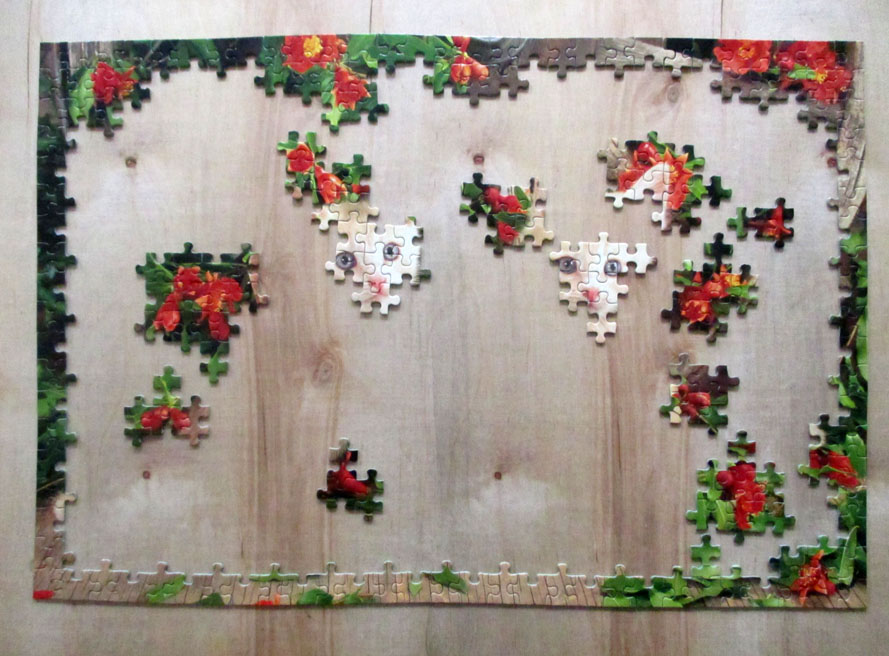
Title is the name of this puzzle, not the fact that it's the first one I'm considering culling from my collection. I like all the blues in the picture, but little else about it. Although the pieces have satisfying variety of shapes, they're quite small and very shiny, also the picture is darker than it looks here, so I had to lean in close (often bumping heads with my kid or crossing each others' view with our hands) and tipping my head constantly to avoid glare. It was annoying. Also, the pieces are flimsy and the upper layer easily tears off; just from moving pieces around my fingernails inadvertently tore up edges or created crease lines on them.  I've learned a lesson from it: don't buy cheap puzzles. This one is made by papercity puzzles.

It's only the second time I've worked this puzzle, and at 500 pieces it was fairly quick even though I did a background/general-to specific strategy and mostly avoided looking at the box picture as a guide. Previously I've taken a photo about every other sitting, but this puzzle was actually assembled in just six sittings. My four-year-old helped. She did the fish's open mouth all by herself, so had her own sitting between pics 2 and 3 and surprised me with it.

Oct 26, 2015

Kitty Cornered

by Bob Tarte

This was a nice read about people and cats. The author tells how, in spite of never liking cats as a child, his household gradually expanded from just one cat to include six. Adding a second cat seemed impossible- what if they don't get along? a third, not so much trouble, and after that it just seemed to happen. They really do seem to be bird people (ducks, chickens, geese and especially parrots, which starred in a prior book) but cannot turn down a needy cat when its owners are about to ditch it. There's a continual kitty shuffle as each new arrival finds its way to fit in. Very apt descriptions of how determined and inscrutable cats can be. Getting their own way, making you laugh one minute, striking out the next, then melting it all with a show of affection. Anybody who's lived with a cat can appreciate this book with its unique, individual feline personalities. Yes there are some headaches and anxious moments as several of their cats go through illness or meet with accidents, but I will let you know it all turns out well in the end (no death).

I have to say I enjoyed this one a lot more than Fowl Weather. Maybe I just was not in the right mood to read the other book, or this one wasn't so heavy-handed with the humor? But in this case the author's little asides and tongue-in-cheek remarks made me chuckle, they didn't seem exaggerated or tiresome as I recall thinking before...

I borrowed this one from the public library.

Rating: 3/5         288 pages, 2012

more opinions:
Bookfoolery
Lesa's Book Critiques

Oct 23, 2015

TBR 57

This list proves I'm still reading all your blogs, even if I seldom find something meaningful to say and leave a comment. Book titles not linked to a fellow blogger are from browsing at the public library, were mentioned in another book I read, or were seen in a gift shop at the Smithsonian Museum of Natural History...
The Wolf Border by Sarah Hall- Shelf Love
Life in Motion by Misty Copeland- Caroline Bookbinder
All the Light We Cannot See by Antonhy Doerr- Shelf Love
Every Boy Should Have a Man by Preston L. Allen- Farm Lane Books Blog
The Oregon Trail by Rinker Buck- Caroline Bookbinder
The Underground Girls of Kabul by Jenny Nordberg- Farm Lane Books Blog
Make Your Home Among Strangers by Jennine Capo Crucet- Reading the End
The Art of Forgery by Noah Charney- Caroline Bookbinder
What the Robin Knows by Jon Young
Bird Sense by Tim Birkhead
Domesticated by Richard Francis
The Narrow Edge by Deborah Cramer
World Without Fish by Mark Kurlansky
Horses Never Lie About Love by Jana Harris
Invisible Beasts by Sharon Muir
Oh, Rats! by Albert Marrin
The Bluebird Effect by Julie Zickefoose
What If? by Randall Munroe
Animalium by Jenny Broom
Cuckoo: Cheating by Nature by N.B. Davies
Unusual Creatures by Michael Hearst
The Hidden Life of Wolves by James Dutcher
Fifty Animals that Changed the Course of History by Eric Chaline
A Concise Chinese-English Dictionary for Lovers by Xiaolu Guo- Melody's Reading Corner
The Utopia Experiment by Dylan Evans- Farm Lane Books Blog
People of the Sky by Clare Bell- recommended by Thistle Chaser
Miracle Dog by Randy Grim
Hawk Hill by Suzie Gilbert
The House of Owls by Tony Angell
The Man Who Talks to Dogs by Melinda Roth
Chimpanzees of the Lakeshore by Toshisada Nishida
Chimpanzees of the Tai Forest by Christophe Boesch
Among the Bone Eaters by Marcus Baynes-Rock
The Chimpanzees of Gombe by Jane Goodall
Lost Animals by Errol Fuller
Zombie Birds, Astronaut Fish, and Other Weird Animals by Becky Crew
Mammals of Ungava and Labrador by Scott A. Heyes and Kristofer M. Helgen (editors)

Oct 22, 2015

How I Photograph Wildlife and Nature

by Leonard Lee Rue III

This instructional book by a successful wildlife photographer outlines his methods and gives advice on getting professional level photos of wild animals. The author covers every aspect of it, from technical details on using camera equipment to the artistic side of things- visualizing and framing a nice composition. Also things like how to manage photography trips abroad and simple tips on handling the business side of things like approaching editors, writing contracts and so on. Even what kinds of socks and outerwear he uses in different situations (this can be crucial!) And tons of helpful tips on little things- how to set up blinds, how to approach bird nests, how to hold the camera steady in various situations, what time of day to go out for pictures, what kinds of animals it's better to get photos in the field or in a studio, how to get good pictures at a zoo, how wildlife behaves differently in a park frequented by tourists as opposed to really remote areas and on and on. I'm not really a photographer so the parts that interested me the most were his advice on approaching wildlife because of what it teaches on their behavior- where to find animals, how to get close to them (or when to stay away and use telephoto lens!) how to be safe in the wilderness, how to lure certain animals closer, what to know about their habits and so on. You can tell the man really knows his stuff. I am pretty sure many of the details about equipment are outdated at this point, although the basics of camera use, light metering and composition are still useful. Also the career side of things have also drastically changed- the author tells about sending sample photos (actual prints) off to editors of outdoors magazines, but when I google his name it's easy to see he sells his work on photo stock sites now. When he wrote the book his focus was mostly on black-and-white photography, and his work is high quality. He makes it clear that while he loves what he does, being a dedicated wildlife photographer is a lot of hard work.

The author has written many other books about wildlife (he is a naturalist at heart) and now I'm going to keep my eye out for them.

Rating: 4/5       287 pages, 1984

Oct 19, 2015

Seven-Day Magic

by Edward Eager

Gladly, this book has all the charm of the first two again. Five kids discover a mysterious old book in the library. It appears to be telling a story about them, only the book isn't complete, the end a run of blank pages. So they figure out it's a magic book and they can have adventures that will fill it up. I'm not sure how it happens they decide their rules are how the magic works, but in a now-familiar pattern they take turns wishing themselves into curious and exciting episodes, that don't always turn out the way they expect. The book can only put them in adventures that come from other books, and I happened to recognize most of these. They go to the land of Oz before it was Oz (apparently), visit the prairie of the Little House books (with their own grandmother as a young schoolteacher), pause on Robinson Crusoe's island, and even have an encounter with characters from one of Eager's other books, with magic of her own. The episode where a baby got turned into a man who still acted and thought like a baby but could now speak, was hilarious. The part where one girl gets carried away by a dragon who is then shrunk down small enough to get pounced on by a cat, very clever. (Dragons and cats have always seemed to have similar temperaments, to me. It made sense they would dislike each other!) And the story of a girl wishing her father would make it big on the stage (he was a backup singer for a television performer) turned out to be a big criticism of television, with the kids all hoping this new invention of entertainment would not shoulder out books in the future. It's also fun that apart from this group of children, the book has different contents for each person who picks it up. All in all, it's a very fun bookish story with references dropped all over the place that I very much enjoyed.

Apparently The Well-Wishers was an anomaly of Eager's; other reviewers mention it is also their least-favorite of the series, and reading Seven-Day Magic has upped my hopes that all the rest I find will be good too.

Rating: 3/5       190 pages, 1962

more opinions:
A Little Reading

Oct 18, 2015

The Well-Wishers

by Edward Eager

This story is about a bunch of kids whose friendship centers around a wishing well in one of their yards, which they assume is magic.The style of this book is slightly different. Each chapter is told from a different point of view, as the kids take turns initiating magic by wishing on the well (with the intent of doing good and helping someone). Except- it doesn't really seem to be magic at all. The situations they get into all have a curious outcome, created by the magic well or just lucky circumstance? They do make good stories, and they're nice studies of human nature and kids just being kids, but not the same sort of thing I got in the prior two books.

My favorite chapters were one where the children help a man whose apple orchard is doomed to being plowed up for a new development, and another where they welcome a new family into the neighborhood by starting a garden and gathering houseplants. There's also one about a lonely reclusive child who is befriended, another about a bully who reaches an understanding with them, one where the young son of the new family resents everyone, and a final 'adventure' where an older girl plays on the kids' belief in magic to get her own way. I found that one the most amusing. The final chapter is kind of awkward, where each kid gives a little wrap-up to their part of the story. Part of what didn't work for me was the voices didn't really vary enough to feel distinct, and I wasn't familiar with the characters. I think this is one I would have liked better if I'd read its predecessor first (or maybe if I'd read it first as a kid...)

I borrowed this book from the public library. After liking Half Magic and Magic by the Lake so much, I wanted to read all of Edward Eager's magic series, but my library system doesn't have Knight's Castle at all, and I'm approaching the others out of order as they come up individually on hold. (Hey, at least that means someone else out there is reading them!)

Rating: 2/5      220 pages, 1960

Oct 15, 2015

Reason for Hope

by Jane Goodall
with Phillip Berman

Jane Goodall is one of the field research scientists I have long admired. I was enthralled by her earlier books about studying chimpanzees in the wild and theorizing on what the behavior of these apes, so closely related to humans, could teach us. While this book mentions many of the highlights of her chimp studies, most of it is about her life before and after the pivotal Gombe studies. She tells of her childhood, what her family life was like, at what young age she displayed great concern for all animals. She describes how her life path led to working for Louis Leakey, how she first arrived in the rainforests surrounding the Gombe, and how the chimps changed her life. There's a switch in focus when she had a son to raise; by then students and other researchers had taken on the bulk of the chimpanzee work. Goodall learned of the often horrific conditions chimps were usually kept in when captive- whether in the pet trade, zoos, or research facilities, and it became her life work to fight for their cause. She does express regrets and not being able to spend time in direct contact with the apes she had grown to know so well, in the peaceful natural surroundings of the forest. Now her work is about environmentalism and educating the public, especially those living in poor areas near threatened wildlife. Throughout the book she also discusses her own spirituality, her faith in mankind despite the awful things she has seen and pondered over (particularly the Holocaust), how she has overcome personal trials, and various small stories about changing attitudes of individuals regarding the need to care for the environment and wildlife. Such an inspiring woman.

And yet I feel a bit disappointed in the book. It doesn't have quite the depth I recall from earlier books that were solely about the chimpanzee research. Sincerity and a good cause, yes. Interesting writing- not really. Overall it is rather bland. I also felt this way about her book on mindful food consumption, but wasn't brave enough to mention it then. I do still think I'd like the read The Chimpanzees of Gombe, but after that I'm afraid I'm loosing interest in her books.

Rating: 3/5       282 pages, 1999

Oct 13, 2015

kodacolor kittens

Here's an old puzzle. It's a 550 piece Kodacolor with teal colored backsides. The pieces are very uniform- I don't think there's a single piece in this puzzle that doesn't have two bumps and two holes (aside from the edges of course), so putting it together is all a matter of matching colors. The pieces are too small to easily visualize slight differences in shape. Surprisingly, I enjoyed this one- the foliage is a challenge. And my kids were all into it just because the kittens are cute!
I didn't make an effort to challenge myself on this one, but just started with the areas of greatest contrast or interest, and worked from there.

Oct 11, 2015

Seven Wild Sisters

by Charles de Lint

Just for fun I read another book connected to The Cats of Tanglewood Forest- this one tells another adventure set decades later. Lillian of the first book is now an old lady. A family of girls lives down the hill- seven red-haired sisters. They all have their own interests and personalities of course, which comes into play significantly in the story. One girl meets Lilian, goes off collecting ginseng root in the forests, and rescues a 'sangman (personification of the spirit of the ginseng I guess) who had been injured. Her good deed is seen as an unwanted intrusion into an ancient quarrel between two groups of fairies- the woodsy root-like 'sangmen and the bee fairies. As one sister gets drawn into the strife, others do also- several sets of twins are taken hostage by either side, there are bargains and fiddling contests (that fail) and strange magical characters and differing codes of honor and fair play among the fairies. Lots of familiar themes with a new turn. I did like that.

But it wasn't quite enjoyable. Too many sisters to keep track of, not enough depth or story for my liking. I wanted more of the cat-man L'il Pater! There were hints of other stories untold- some secret history between Lilian and the Apple Tree Man that I don't recall at all from Cats of Tanglewood Forest, and suggestions of another story that might someday follow this one. I don't know if I'll ever feel motivated to pick it up, though.

It was curious to see some similar themes to another very different book I just read, A Girl of the Limberlost. Here we also had a woman protecting acres and acres of land, refusing to fell the trees for profit, handing ownership to a younger woman with an injunction to keep it whole... People living close to the land, using their own resources. I kind of wished for more of that stuff and less of the fairies, but then it wouldn't have been the same story at all!

Rating: 2/5        260 pages, 2014

more opinions:
Puss Reboots

Oct 9, 2015

A Circle of Cats

by Charles de Lint

This is the original telling of Charles de Lint's fable about a girl who gets bitten by a poisonous snake and saved by a bunch of wild cats. To escape death, they magically turn her into a cat. She doesn't want to be a cat and her first thought is to find out how to get changed back into a girl. At first she believes that fairies turned her into a cat, but an owl sets her straight. This story is rather brief; the girl goes straight to the spirit of the apple tree and the panther Father of Cats himself for her remedy. It's still got a lot of charm and good morale (about repay your debts and making wise choices) but personally I like the expanded version The Cats of Tanglewood Forest better. I'm glad he wrote it. The illustrations by Charles Vess are better in the second book, too.

I saw this one mentioned on Puss Reboots, which prompted me to pick it up at the library.

Rating: 3/5        52 pages, 2003

Oct 8, 2015

A Girl of the Limberlost

by Gene Stratton Porter

If you loved Anne of Green Gables, you're sure to like this book. It has a rather similar story, set in the late 1800's. Elnora lives with her distant, embittered mother on the edge of an Indiana swampland. Her mother has a cold, unfeeling attitude due to the father's untimely death when Elnora was an infant, and yet Elnora is patient, kind and understanding beyond measure. She loves the wild things of the woodlands, especially the large, beautiful moths which she collects and studies. Her greatest dream is to attend school but she has no money to pay for books and tuition, and her mother refuses to help. She doesn't want the assistance neighbors and friends offer, either, but finds a way to use her knowledge of the forest and her moth collection to raise money for highschool. Through many setbacks, Elnora comes through with determination and not a little cleverness in finding solutions as new problems that arise. The storyline shifts directions when a revelation about the past changes her mother's attitude towards her. Later Elnora is attempting to raise college funds when she meets a young man from the city who is spending time in the countryside to convalesce from an illness. You can guess right away that something will develop between these two, but it's complicated by the fact that the young man is already betrothed to a wealthy, primping lady who isn't about to let some unknown country girl disrupt her engagement. It does end well, but the route to that ending was not what I expected, and really made the moral fiber of these characters shine.

It's a really good book, and I'm a bit disappointed that I didn't actually love it. In the first place, I was expecting more nature writing, or at least descriptions of the swamp habitat. There's not much of that. In fact, there wasn't any of it for the first 150 pages. I almost wonder if the book I read was missing some of the original? because a few other reviews I see online mention the first few chapters of the book having wonderful descriptions of nature in the swamp and forest, whereas the first chapter I read was about Elnora going to school... And the parts about moth collecting aren't until the later third of the book.

It's really mostly about relationships and while that is interesting enough to make a good story, the people are a bit too noble and kind in these pages, a bit hard to believe. The turnaround Elnora's mother makes is also hard to credit, so instant and complete. I was also rather dismayed how much importance everyone put on appearances, that Elnora and all those around her were so set on getting her nice clothes to wear so she wouldn't be scorned and laughed at by other kids at school. I think it would have made a much bolder story if Elnora had found acceptance in spite of her old-fashioned, poverty-stricken looks. And it distressed me how much neighbors kept urging Elnora's mother to sell portions of her land for logging or oil drilling, so she could provide for her child. Both mother and child obviously loved the land and didn't want to see it despoiled, yet they couldn't be in accord with each other? And if she so loved the forest, why did she have so few qualms about collecting hundreds of moths and cocoons, especially the rare ones, to sell to collectors? Grated, they kept stating how important it was to educate other folks about wild things, but it seemed a hollow rationale to me.

Am I being too nitpicky? I probably would have adored this book as a younger reader, and I do love the solid message it gives of being honest and forthright, forgiving and true to yourself, kind to those in need, etc. The love story that unfolds near the end of the book is particularly well done. It shows just how true certain people can be, and how spiteful others. How some people are attracted to each other for all the wrong reasons, and how deep love can go when you approach it in the right way (at least, in my opinion). Elnora sure is an admirable character. (Oh, and did I mention she is pretty much a self-taught genius at playing the violin?)

But I do want to read more of this author's work, particularly Freckles, which precedes this story. Its characters and events were alluded to a lot, without enough satisfactory explanation. The author wrote as if she expected her readers already knew half her characters from before, and while I often find rehashing of previous books annoying, here I did want a little more backstory! Maybe I would have appreciated Limberlost a bit more, if I'd read Freckles first?

Bonus material: looking for pictures of the beautiful moths mentioned in the book, I found these images of incredible moth sculptures by artist Michelle Stitzlein

Rating: 3/5      485 pages, 1991

more opinions:
Shelf Love
dear author
bookshelves of doom

Oct 5, 2015

Beloved

by Toni Morrison

Beloved is the story of a family that escaped from slavery, crossing state lines to get away from a situation of horrible abuse. The main character, Sethe, goes through some awful things to reach freedom, and ends up in a lonely house- loosing nearly everyone she cares about- her youngest child dead, her older sons run away, her husband is missing, and the local community shuns her. I thought at first this was because her house is haunted, but it turns out there is something horrific in her past and for this all the faces turn away from her. She is only left with her daughter Denver, who was born while she was fleeing the old plantation. This daughter grew up in isolation with her in the haunted house, until two people appear on their doorstep- one Paul D, a former slave from the same plantation as Sethe, and a strange young woman who is silent about her past and where she came from. Sethe takes her in regardless, and the relationship between these four is rocky, especially because the adults are suffering through the memories of their past, struggling to find new identity as free people- how do you decide what to do, what to become, when all you've ever known is what other people forced you to be...

This book is raw, powerful, and convoluted. I had a hard time with it. Not just because the content is often difficult to read about- the characters suffer through things no one should have to endure and they don't fall down and quit but just keep on going- also because it's told in such a circular style. Constantly turning on itself, as characters remember and relive and re-explain their past, to themselves and to one another. First from one viewpoint, then another, then someone else retelling the story as it was told them by a third. I was baffled, at first, not always sure whether I was reading about the present or the past, until I saw certain events cropping up again, and realized the narrative was looping around. Each time a little more is revealed until you reach the final revelation of what it is Sethe has done, why she is so haunted, why the community avoids her. It's heartbreaking. I can't stop thinking about it.

Such a vivid narrative, and yet at the end I don't think I liked it much. Partly because I'm just not into ghost stories, but I made myself finish this one. Also there are certain things I would just rather not know. I had to shut the book for a day my insides clenched shock brain reacting: how could people do that to each other?! and this happens several times. I hope the author is exaggerating what bad situations were like for slaves in the late 1800's, but she's probably not, which is all the more terrible. Years ago I tried reading The Bluest Eye and just could not get through it. I think of two other books I read not so long ago about a similar time period and events- Cold Mountain and The Book of Negroes- they remind me of each other and they were a lot easier to read. But even though I don't personally like this book, the writing is good and I can't fault her skill. The stories she tells need to be told, but sometimes I'm not sure I want to read them.

Rating: 3/5     273 pages, 1987

more opinions:
Things Mean a Lot
I'm Lost in Books
Estellas Revenge
The Literary Omnivore
Leeswammes' Blog

Oct 1, 2015

Wesley the Owl

by Stacey O'Brien

I laughed, cringed and wowed my way through this book in just two days. It's that good. Stacey O'Brien is a biologist who worked at Caltech and was given the opportunity to raise a disabled owl. She found out quickly that this would be a lifetime commitment- the owl could never be released into the wild, would imprint upon her as its mother (and later, its mate) and could fall into a serious depression if later separated from her. It turns out owls are very sensitive, devoted to their chosen companion and quite intelligent in their own way. It was delightful to read about all the surprising things O'Brien learned about owls while caring for Wesley, and the deep bond they developed. I absorbed all the little details about the owl's development and behavior, but even more fascinating were the uncommon things he did- learning to recognize what certain words meant, expressing delight at playing in water (owl feathers are not waterproof, they usually avoid getting wet) and modifying his vocalizations to communicate what he wanted. It is definitely a special person who will tolerate an owl as a housemate- Wesley needed to eat freshly killed or frozen mice every day (dealing with that sounds rather disgusting), liked to shred piles of magazines and had several unpleasant-sounding habits. Some of the things O'Brien describes doing as matter-of-course during her research work at Caltech also would make my stomach turn. But I liked her descriptions of the camaraderie among scientists and the local mini-culture there, as well as the work other biologists she knew were involved with. And the owl of course true to his wild nature is described as a fascinating, endearing and beautiful creature, even though he has a few disgusting habits.

I will tell you, the book does have a sad ending, and it's not only because the owl reached the end of his (very long, being so well-cared for) lifespan- it's also because the author went through some serious illness and suffering. She remained devoted to her owl regardless. What a great book.

Borrowed from the public library.

Rating: 4/5        229 pages, 2008

more opinions:
Book Chase
Maggie Reads
A Bit Bookish
Bibliophile by the Sea
Puss Reboots

Sep 30, 2015

Adventures in Birding

Confessions of a Lister
by Jean Piatt

The author describes in this book how he got into the hobby of bird-watching. At first just a casual interest, he soon joined the ranks of those intent upon fulfilling a life list of all the different species they've seen. The grand goal is 600, once someone has listed 600 birds they become members of an exclusive club. He picked up the birding passion with his wife; together they explored all nearby locales in search of birds and then began taking trips to further parts of the country specifically to look for birds. Somewhat disorganized and unplanned at first, he soon learned to tap into local knowledge and find the people who could point out where certain birds were to be found. Sometimes they were nesting in one particular thicket on one side of a road only, for years on end! The first portion of the book is about their travels around, meeting with people, associating with other birders, the oft-embarassing moments of mis-identification in the field. Other chapters describe the basic taxonomy of birds, the organization of birding clubs, the rules surrounding official lists and the confusion that ensues when species are re-named or re-assigned thus invalidating some names birders have already counted, and so on. The accompanying illustrations by Matthew Kalmenoff are very nice.

But I'm not the right reader for this book, it seems. I found it only mildly interesting and before long, just tedious. The author likes to use eloquent phrases and quote literature in relation to his feathered interests, but it often came across as stiff or pretentious, to me. This book is not well-known; I only found three reviews online yet they all praise it highly. They all seem to be birders themselves, though. I was curious to learn more about this hobby- I learned that it's probably something I'll never do!

Abandoned        265 pages, 1973

Sep 29, 2015

Pukka

the Pup After Merle
by Ted Kerasote

A year or two after the famous Merle passed on, his owner got a new puppy and named him Pukka. This is Pukka's story. How he came into the author's life, got to know neighbors, learned doggy skills and basic obedience, went adventuring with his new owner on hikes and even river trips. It's told from the dog's perspective, which in this case is charming and I think would make the book appealing for younger readers too. It's mostly presented in photographs, and they are very nice. The scenery is gorgeous, the photos taken in the Seattle, WA area of course make me feel nostalgic. And the puppy is darn cute. He doesn't do anything extraordinary, but such a nice dog and the storyline shows how a puppy can become well-adjusted, learn new situations and some basic rules, and in this case, have freedom to roam while near home but accept leash laws when out and about on public streets (they live in a rural area of Wyoming). This book has a different feel from Merle's Door, very casual and an easy read- I finished it in one sitting.

Borrowed from the public library.

Rating: 3/5       200 pages, 2010

Sep 28, 2015

transposed

Four days ago I forgot to mention the oddest thing I came across while reading Wild Heritage. Typos always jump out at me- spelling and grammar errors, letters switched around, mistaken homonyms and so on. But this was something I've never seen before. Does this passage make any sense when you read it as printed? (page 112 in my edition)
Nope. You have to read the two lines highlighted yellow first, followed by the two highlighted in blue.
Somehow when the book was printed, these four lines got switched around. It really puzzled me when I first read the page, could not figure out what was wrong at first! Have you ever found a strange typo or printing error in a book? (I have another book on my shelf that has the first twenty pages included twice).

Sep 27, 2015

The Fishes

Life Nature Library
edited by F.D. Ommanney

This book is all about fish. Their evolution, biology, habitat, food sources, reproductive strategies, parenting methods, schooling behavior, migration routes, etc. Even just the basics about how they sense the world around them and navigate was interesting. The diversity of fish life in the world is really astounding, and the book just touches on some of the many different species, but I think does a good job at highlighting the wide variety of forms fishes have adapted, and different means by which they make their living in the water. Yes it's an old, outdated book but the pictures are pretty good for their age, and I learned a lot of facts. For example, about the heart structure. All these years of reading about animal life, why did it always escape my attention that fish have a two-chambered heart, most reptiles and amphibians a three-chambered heart, and that of mammals and birds, four chambers. This makes sense, but I never thought about it before. The last few chapters describe some then-new scientific studies that tracked where fish go in the ocean, using a variety of tagging devices in the hopes that fishermen, sportsmen and others would return them when found. Even though the return rate was less than 5 percent, they put so many tags on fishes it still generated useful information. There's also a chapter that discusses how the fishing industry was beginning to a see decline in stock numbers, and strategies to remedy that (interesting look at how it was managed in different countries, which I'm sure is all very different now).

Rating: 3/5       192 pages, 1963

Sep 26, 2015

frederick the literate

Just finished this one today- my kids squabbled over who got to put in the last few pieces. It's a 1000-piece Hasbro, the artwork Frederick the Literate is by Charles Wysocki. I admit I like this one because of the subject matter, and that's the only reason it's a keeper. The surface is too glossy, so you have to keep tilting your head against light bouncing off the pieces. The pieces are very uniform in shape, and they don't fit completely snug, so you can't pick up a section and move it, it all falls apart. When I had a group of pieces fit together and found out they go elsewhere on the puzzle, I'd have to move that section one piece at a time, unless there was a clear path to slide it all. The picture is a little dark, but there are still enough hues and textures to make it interesting.

(click on an image to see larger and view them in succession with the arrow key)
The fun part about this image are all the book titles, guessing (some are really obvious) what real books they derived from:

Rat Holes of the World
Cat-o-Nine Tales
The Caterbury Tales
A Tale of Two Kitties
Poems by Robin Wing
The Little Brown Mouse
The Killer Sparrow of Ipswich
The Feline Comedy by Kitty Mewpur
Caterwaul's Catalog of Hairballs
Holy Cats by Lord Myron
The Three Mouseketeers
Field Guide to the Garbage Can: a Catechism
The Sardine in All its Splendor
How to Catnap with a Smile by Z. Snooze
How to Smell a Rat by Nasal Nosegay
a series of Renowned Mouse Traps
Delicious Field Mice I Have Known by Thomas Cheshire

This last one makes me grin because I'm pretty sure the title is a play on this book. You can read more about the original painting here (but know that if you scroll down and read his bio, the photo of the artist as child is kind of freaky).

Sep 24, 2015

Wild Heritage

by Sally Carrighar

In the sixties, field studies of animal behavior was a very new science. Sally Carrighar wrote this book to dispel many myths about animal behavior- particularly the Victorian notions that animals acted out of brutality or nobility etc., and the reactive ideas from the Industrial Age that attributed animal actions to mere mechanical response via insinct. The truth seems to lie somewhere in the middle- yes, animals are driven by instinct but they also have intelligence, basic emotions and individual preferences; thus Carrighar shows how similar animals' motives can be to our own. She divides her book into four main sections, exploring what were then-new observations on wildlife behavior in regards to parenting and raising the young, courtship and mating, the use of aggression and play or creativity. It's an intriguing collection of accounts, but somewhat dull because of its age. The book is solidly placed in its timeframe- when Carrighar wrote, Adolph Murie, George Schaller and Jane Goodall were currently young scientists conducting new field studies, with many of their significant discoveries yet to be made. Other great names which are only history to me, were contemporaries to her and spoken of as such: Nikolaas Tinbergen, Konrad Lorenz, Lois Crisler, Ernest Thompson Seton. For me the book was mostly a summary of things I've already known or accounts I've already read; the originals are much better sources. So the book is interesting in its historical aspect but very dated: a lot of its information is old hat now, and things she puzzled or wondered at have long since been explained. However I was surprised to find once again the incident of the boy in the badger's den once again related- although much briefer here. I wonder if she took her account straight from Seton's book.

Rating: 3/5        276 pages, 1965

Sep 22, 2015

My Teacher is a Monster!

by Peter Brown

Bobby is sure his teacher is a monster. She stomps and growls and yells at kids. Especially when he throws paper airplanes in class. Bobby often goes to the park to play and forget about his teacher. But one day he is shocked to find his teacher in the park! There's an awkward conversation. Then Bobby rescues the teacher's hat when it blows away. He finds out she likes ducks, he shows her his favorite hill, she gives him paper to make an airplane to fly. The teacher relaxes a bit too, dropping some of the formal language she uses in class by the end of their time at the park. Back in school, the teacher still stomps and yells at times, but Bobby also earns her praise now and knows she can be friendly.

The great thing about this book is that for the first ten pages the teacher looks like a monster. Then as she and Bobby reach an understanding, her image slowly begins to change- the skin is lighter, the features softer, and by the last page she looks like a normal person.

I borrowed this book from the public library.

Rating: 3/5     34 pages, 2014

more opinions:
Jen Robinson's Book Page
The Book Chook

Sep 21, 2015

Great Cat Tales

edited by Lesley O'Mara

A short story collection featuring cats. I was expecting to find more familiar fare here, but only knew two of the stories- Rudyard Kipling's famous "The Cat That Walked by Himself" and a chapter from one of James Herriot's books about a lady with a houseful of cats. I wouldn't say the selections were great- most of them good, several quite forgettable, a handful I really liked. A number of stories are about people jealous of cats- the wife jealous of the husband favoring the cat, the husband jealous of the wife loving the cat, the lover trying to do away with a cat that hates him, and so on. Common thread. There's even a story of a cat that's jealous of another cat that shares its household, and how its manners change when the second cat disappears... Also lots of stories about winsome, noisy and very opinionated siamese cats. I wonder if siamese cats were still a rare, exotic breed in the eighties? or did the editor who selected the stories just happen to like them.The authors include Mark Twain, Sylvia Townsend Warner, Doris Lessing, Emile Zola, Lloyd Alexander, P.G. Wodehouse and many others I didn't recognize. My favorites were-

"How a Cat Played Robinson Crusoe" by Charles G.D. Roberts- about a cat who accidentally gets left behind at a summerhouse on an island, and must find ways to survive the fall, winter and spring alone.

"A Fine Place for the Cat" by Margaret Bonham- a rather slovenly lady decides to purchase a siamese cat when her older cat passes away. She wants something different, to impress her neighbors. The new cat arrives from the train and it is so strange to her she at first thinks it a hideous monkey-like creature. But the cat immediately attracts the admiration of the fish-man (who peddles his wares door-to-door) and thus something develops between them. A nice story.

"The Story of Webster" by P.G. Wodehouse- a young man, bohemian artist type, gets saddled with his rich uncle's cat, and he feels that the cat's stares reprimand him so much, he starts to change his ways. To the astonishment and alarm of his artist chums and his girlfriend.

"Midshipman, The Cat" by John Coleman Adams- some boys are attacking a small cat on a waterfront, and a novice sailor rescue the cat, who promptly adopts the crew and boat as his new home. He proves to be a remarkable, bold and resourceful cat. The story of his antics aboard ship and what happened after the summer's cruise was over, made me smile.

Rating: 3/5       254 pages, 1989

Sep 17, 2015

Wild Animals at Home

by Ernest Thompson Seton

This book should really be titled Wild Animals of Yellowstone Park, because that's exactly what it is. One by one, Seton tells about the different mammals that live in Yellowstone. At the back he gives a list of all the known mammals in Yellowstone, and it turns out he only left a few out of his descriptions: raccoon, shrew, flying squirrel, wolverine, vole, weasel- because he did not personally encounter them. Unfortunately, his descriptions of the wildlife leave something to be desired. He wrote them at a time when not much was actually known about the animals' habits, so for many it's just a brief page telling where the animal is found, what it eats, that's about it. Now and then he has a story to share- Steon is much more in his element (or at least more fun to read) when he's telling a story. He has a lot to say about skunks because he used to keep them as pets, and a lot to say about bears because they hung out around hotels and garbage dumps in the park. He frequently mentions sneaking up close on animals to capture photographs of them, then proudly shows said photos in the pages- but they are very dated, unfocused, grainy and overall just amusingly poor in quality. His drawings and sketches weren't quite up to par what I recall from other books either- a lot of them are very humorous and cartoony in style, but I like his detailed, realistic artwork better.

Well, so the text about animals is mostly brief descriptions with some secondhand observations, popular lore of the time and now and then a personal story Seton has to tell. Two segments were very familiar to me- the bears hanging out around the dump and the silly dog teased by coyotes- both are related in far more detail in Lives of the Hunted. There is one chapter in the book however, which is the entire reason I am keeping it on my shelf. It's about badgers. And while speaking of badgers, Seton tells of a boy in a prairie town near Winnipeg who has a natural affinity with animals, gets lost in a storm, takes shelter in a badger den and is befriended by the badger, who had just lost her mate and young to a trapper. The boy lives with the badger for two weeks before he is found and brought back home. I instantly recognized this story: it's Incident at Hawk's Hill! The names are all different, Seton says it was at Bird's Hill, but I'm sure when Eckert novelized the story he changed names for privacy. All the more this makes me think the badger story really was based on truth.

Rating: 3/5         226 pages, 1913

Sep 15, 2015

Hurry Home, Candy

by Meindert DeJong

I thought perhaps I had read this book as a kid, and it did become more and more familiar the further I went. It's a story of a little stray dog, at first loved by two little kids, but frequently mistreated beaten by their mother (a strict housewife) and then lost during a storm. Wandering between houses until frightened by bigger dogs it ends up half-starving in the countryside. Due to rough treatment when it was very young, the dog is timid and in particular, terrified of brooms (used as punishment) so it avoids people. Happens to find safety from a pack of dogs under a farm woman's wagon, so the dog is travelling with her when an accident occurs, and everyone thinks he is her dog. While the woman is in the hospital he's taken to the dog pound, where although the surroundings and noise are terrifying, for the first time the little dog starts to respond to kindness from the pound man. But there are always brooms around, and the dog's phobia causes him to flee and hide again. He finally gets adopted by a retired ship captain, who looses him (once again, because of a broom). Then an incident with bank robbers get published in the newspapers, and the dog happened to be there, and the original children who had him as a little puppy see the pictures. They also see that the captain is offering a reward for his return. The kids don't care about their lost puppy anymore, they want new bicycles so go looking for the puppy in hopes of the reward money. Eventually it's another woman in the neighborhood who saw the dog scavenging around her back porch earlier in the story, who coaches the children on how to catch the frightened dog (but they are inept at following her directions), and helps the captain lure him home again. The dog gets there of his own accord, the captain finally recognizes his broom phobia, banishes brooms from his house, and now the little dog has a place to belong, without fear.

Yeah, it sounds rather convoluted and the parts at the end where all the different people who had seen or helped the dog came together to get him found and back to his new home, was a bit too convenient. But it is a really tender story showing things from the dog's perspective, how easily a fear can get instilled in a young animal and affect its life for a long time, while people don't realize the reasons behind its behavior.

I think this author often tended to write books about down-trodden or misunderstood animals; the other one I've read by him is about a stray dog that starts hanging out around a chicken coop- I really like that one. And others have titles such as: Billy and the Unhappy Bull, The Little Stray Dog and The Cat That Walked a Week (to find its way home?) This one, Hurry Home, Candy, was a Newbery Honor book.

Rating: 3/5        244 pages, 1953

Sep 14, 2015

You Will Be My Friend!

by Peter Brown

Lucy the bear wants to make a new friend. So she visits all the forest animals, eager and friendly. But a bit lacking in social skills. She's too boisterous and talkative for most of them, I can exactly picture what kind of outgoing, slightly annoying four-year-old child this bear personifies. The pictures of Lucy trying to squeeze into a rabbit's hole, belly-flopping into a frog puddle and trying to give a skunk a bath are cute and funny. She's well-meaning and nothing but persistent- but the other animals all look annoyed or at best, startled by her tactics. Getting frustrated, Lucy starts demanding that the other animals play with her, but of course that doesn't work either. Finally, when she least expects it, a flamingo comes along who likes to play Lucy's games. Phew, a happy ending!

Really cute book, and I'm sure lots of kids know what it's like to be in Lucy's shoes (or have been on the receiving end). It's by the same author who did The Curious Garden.

This book was borrowed from the public library.

Rating: 4/5      36 pages, 2011

Sep 13, 2015

The Dog Who Came to Stay

by Hal Borland

This quiet book is a story of life in the countryside, life with a good farm dog. Well, I don't know if I could entirely call it a quiet book, as there are plenty of dogfights, fierce encounters with bobcats and porcupines, confrontations with rude trespassing hunters and poachers. But overall, it has a calm, quiet voice. It's full of nature writing- just as much a story of the changing seasons, the wildlife and forest around the farm as it is about the dog. How he came to their farm, a wandering stray who gradually settled into their lives. The story tells of the dog's personality, his intelligence and flaws, his run-ins and friendships with other dogs in the neighborhood, his skills at hunting and his yearly battle against woodchucks (when the dog saw that his people didn't want woodchucks in the garden, he took it upon himself to go after any woodchucks in the area). It's obviously a book written from a different era; the dog is disciplined with slaps and a rolled-up newspaper (but his new owners are concerned that he shows fear of brooms and mops- they surmise he must have once been beaten with those objects, which they consider abuse). The dog is welcomed in the house but forbidden certain rooms and sleeps outside in a refurbished woodshed- oddly enough people complain about this on other reviews sites but if you pay attention in the book, the author tells how when the weather was particularly bad or the dog recuperating from injuries, they invited him to sleep in the house and the dog made it apparent he preferred to sleep in the hay in his shed. (Where he was locked in to keep him from roaming at night and being a nuisance to neighbors or wildlife). One aspect of the book I most liked was reading about how readily the man could communicate with his dog, understanding its intentions and wants from body language, facial expression, the tone of its bark or whimper, general demeanor. I think any dog owner can appreciate the depth of connection a person and dog can develop.

You might be glad to know that although the dog is old and showing his age near the end of the book, it does not end with his death but shows him gracefully entering his 'golden years' in the home he has chosen.

In many ways this book reminded me of Where the Red Fern Grows, but a more in-depth story written for adults.

Rating: 3/5     192 pages, 1961