Dec 16, 2011

The Very Best Daddy of All

by Marion Dane Bauer

This little board book shares a theme with the Ashley Wolff ones about animal daddies and mamas. The Very Best Daddy of All shows how different animal fathers care for their offspring, and then at the end highlights a human father's love for his child. Birds bring dinner, a fish builds a house, a penguin snuggles his chick, prairie dog plays with his pup, fox brings food home so the vixen can care for the cubs, etc. The one that surprised me was a frog leaping at a snake with the caption Some daddies face every danger, so you will be all right. I had no idea frogs would attack a snake to defend their tadpoles! The pastel illustrations are soft and vivid, the words have a gentle rhyming flow that doesn't feel forced. It's easy to fall into a little singsong while reading it aloud. I enjoyed turning these pages with my baby daughter.

rating: 3/5 ....... 34 pages, 2004

Dec 15, 2011

The Alphabet

with Wild Animals
by Melanie Watt

You read through lots of alphabet books when you have little kids. And you start to notice the similarities and differences between them. For example, most of them seem to begin with A is for Alligator and end with Z is for Zebra. Lots of other animals are fairly common for certain letters of the alphabet: E- elephant, K- kangaroo, Y- yak, etc. What's really interesting is to see what animals the authors can come up for the hard letters like Q or X.

This version is completely charming. The illustrations in The Alphabet: Learning with Animals are simple yet descriptive, and the backgrounds show each wild animal's appropriate habitat with very few elements. It's just right for little kids. I also really like that the opening spread shows all the featured animals grouped together. Something different, and nice. Some of the more unusual (for an ABC book) and interesting animals here are the quetzal (a fantastic Central American bird), narwhal, monarch butterfly, salamander, tuna fish, orangutan, xerus (a ground squirrel) and unau (the two-toed sloth). I did have a few small quibbles with the book, though. One is the W animal: wapiti. I thought elk was a more common name for this animal, I don't know why you would introduce children to the less-used term (I would also have used the sloth for S not U, but I know it's hard to think of a U animal! the last book I saw had unicorn). The elephant's trunk on the E page looks awkward: too big, like a chopped hose. And the rhinocerous looks like he has cloven hooves, not three-toed feet. Small things, but I started to notice them after so many readings.

rating: 3/5 ........ 30 pages, 2003

Dec 14, 2011

Why Don't Pengins' Feet Freeze?

and 114 Other Questions
by New Scientist

Another book I found just browsing library shelves. Of course, it's not about penguins. It's a kind of trivia book, full of questions asked by readers of New Scientist magazine. All kinds of quirky and curious things you might wonder yourself, like: what makes your hair turn grey? do fish die when lightning strikes a body of water? how do gnats avoid raindrops? how do you make ice cubes without bubbles (as seen in commercials)? how does temperature affect the taste of food and drink? etc etc. A lot of the answers got quite technical in the details of physics or chemistry that causes certain effects, and sometimes I have to admit I got a little lost, even though I could tell the answers were written for laypeople. And here's the one little problem with this book. The answers in Why Don't Penguins' Feet Freeze? are not uniform in quality. They're not written by the same author, or even by a team at the magazine. They're sent in by other readers, and vary quite a bit. (Some of them have impressive little list of credentials after their names, others just list their name and you wonder who they are or what they know). Quite often completely contradictory answers are printed next to each other and there are even some that are obviously making a joke of the whole thing. They did make me chuckle, and it was interesting to see different ways of explaining the same phenomenon, but a few times I was still left wondering which response was the most accurate. It didn't bother me too much, but other readers might find this uneven quality dissatisfying.

I want to see them answer the question about the hummingbird my sisters and I used to pose to each other as kids when we drove around in our large volkswagon van: if a hummingbird is hovering in the car and it takes off suddenly, will the bird keep moving along with the car or get smashed against the rear window? (I think this was mostly answered by the question in the book about how a floating balloon behaves in a moving car, but somehow I think a living creature powering itself, like a hummingbird, might act differently?)

rating: 3/5 ........212 pages, 2006

Dec 12, 2011

Architecture Shapes

by Michael Crosbie and Steven Rosenthal

Another little board book that's been visiting our house from the library this week. Architecture Shapes introduces children to shapes by juxtaposing a line drawing (circle, square, diamond, oval, etc) next to a photo where that shape is prominent on a building (mostly windows). The final picture shows several buildings together and suggests finding different shapes on the page. I keep looking for a star there, but can only find the other shapes mentioned in the previous pages. This is because my daughter's favorite page is the star, she keeps patting it with her hands (I think because it looks very three-dimensional).

It's a nice little book, but not one of my baby's favorites. She usually looses interest halfway through. I think she's just a little young to be learning shapes yet (her interests right now are animals, bright colors and people's faces). This is a book we'll probably look for again later on, when she's a tad bit older.

rating: 3/5 ........ 16 pages, 1993

Dec 9, 2011

Flower Confidential

by Amy Stewart

I wanted to read this author's book about earthworms, or the one about her first gardening efforts, From the Ground Up. But the only other Amy Stewart title my library had was Flower Confidential so I brought that home instead. And it's been quite an interesting, educational read.

This book is all about the cut flower industry. Amy Stewart traveled from California to Ecuador to Holland to see exactly where our flowers come from- the ones you see in the grocery store, in the corner florists' shop, or order online for Mother's Day. The first part is about flower breeding, from the old-fashioned (eccentric guy who hand-pollinated all his lilies but his place was always in disarray. They speculate that his lilies were so hardy because they had to be in order to survive the unsanitary conditions!) to the modern: gene-splicing in attempts to get new flower varieties, even the quest for a blue rose. Then she visits several growing operations, from local and almost-organic in southern California to low-wage pesticide-ridden in Latin America. It's funny, I never thought about flowers being a similar product to food but there are many parallels. Just like produce, the flowers that have been bred to withstand travel and handling have also lost their scent. Flowers are produced cheaper in other countries, so they get shipped from far away. Organic flowers, grown without pesticides and harsh chemicals, are just coming into vogue. Next the reader gets to visit the huge flower auction in Holland, which was fascinating. And then revisits florist shops on home soil, peeking into their doings. Last of all is a look at the mad rush that is Valentine's Day, and how florists cope with the demand. All of it was interesting, and eye-opening for me. I learned a lot about how flowers are propagated and cared for in mass numbers, how they travel around the world, how the demand for them rises and falls (most curious were some of the historical bits about what flowers were popular among Victorians, for example). And I kept jotting down notes of flower names, so I could look them up on my computer and see what they were. I'm familiar with peonies, snapdragons, chrysanthemums, etc but these had me seeking a visual: dianthus, clarkias, mignonette, lisianthus, tuberose, alstroemeria... Some I had seen before, just didn't know their names. Beautiful!

I enjoyed this book a lot more than reading Wicked Plants. This book had a nice, conversational narrative that took the reader along on a journey of discovery. Wicked Plants felt more like a detailed list. Interesting still, but the format is not as fun to read.

rating: 4/5 ........ 306 pages, 2007

more opinions:
Books and Other Stuff
Maggie Reads

Dec 8, 2011

Eva and Her Animal Friends

by Ulla Kampmann

This is a book that got weeded out of my daughter's library. She recently got a new bookshelf and it's crammed full (smaller than the old one) so a few had to go. (Most of the board books went to a different shelf just for the baby). Eva and Her Animal Friends is one I've had a long time and can't remember where I got it.

I actually really like the story: a little girl named Eva is getting ready to visit the zoo and talking to some animals in her backyard. The fox is very vain and thinks he's the most beautiful, clever creature around. The sparrow is practical, busy and forever worrying about her children. The bunny is just a little innocent fellow. They all want to know about the zoo, which the sparrow tells them about- having visited herself once (she has a cousin who lives in an elephant's cage). They learn that lions have long tails, brown fur and loving eyes. Elephants have wrinkled skin, big ears and are very smart. Eva goes off to the zoo with the idea that she can bring a lion home for a pet- or maybe an elephant (the sparrow's recommendation). When she gets there, she realizes at once that neither animal is suitable for a pet, and settles for an ice-cream cone instead. The next day, the animals in the yard wake up early and find a strange creature among them. At once they assume this is the new pet Eva brought back from the zoo- but is it a lion, or an elephant? It has brown fur, a long tail, loving eyes and wrinkles and large ears. What can it be? They are all puzzled until Eva arrives to tell them about it.

It's a charming little tale. My only problem is the pictures. They're awkward, look like a child drew them and scribbled in with markers. I really don't care for them at all (and neither does my kid). So even though the story is enjoyable, she doesn't want to look at the book. I really wish this book were reissued with new illustrations. As it is, my copy is probably going to get recycled- it's missing all the front pages (including the first illustration) and has quite a few tears with old, yellowed tape and a very worn cover. It's sad, but one that must go.

rating: 2/5 ........ 30 pages, 1967

Dec 6, 2011

Nam, Nam! Yum, Yum

by Catherine Hnatov

This cute little board book is quite simple. Bold, three-color illustrations show animals eating their favorite foods while the facing page describes what they're doing, in both english and spanish. The color mentioned on each page is the only one featured against black-and-white, so it makes a good contrast to help infants become familiar with colors. I like the simplicity of it. My favorite page is the donkey (eating red apples), he's just so charming! Yum! Yum! is very short, only twelve pages, but sometimes that's just right for little attention spans.

rating: 3/5 ........ 12 pages, 2011

Dec 5, 2011

I Love My Daddy Because

by Laurel Porter-Gylord

Another beautiful board book illustrated by Ashley Wolff, I Love My Daddy Because is a companion to I Love My Mommy Because.  It shows how animal fathers help care for their young, in many of the same ways human fathers do. Kids can see puffins bringing food to their chicks, beavers and muskrats building a home, a fox teaching caution. My favorite pages are of the eagle sitting with his baby, the lion snoozing with his cub, the chimp laughing with his offspring. The only spread I don't care for so much is the one where the animals play hide-and-seek. Spider monkeys, anoles, jaguars, parrots, toucans and sloths all hide behind busy patterns of leaves. Search as I might, I still haven't been able to find the second sloth. But it's a small matter. The gentle words reminding us of bonds between parent and child (whether human or animal), and the lovely pictures make this a great book to snuggle with your little one.

rating: 4/5 ........ 24 pages, 1991

Dec 4, 2011

Move!

by Robin Page and Steve Jenkins

This is one of the picture-book duds I brought home. The cover of  Move!is really attractive- it has one of those pictures that shift when you tilt it (is there a term for that? can someone tell me?) Inside, each spread describes how a pair of animal moves (walking, swimming, floating, diving, running, etc) and then one of the animals continues to the next pair on the following spread. For example, on one page a snake climbs a tree, alongside a praying mantis climbing a grass stem. On the next spread, the mantis is flying, next to a roadrunner also flying. It's a wonderful example of how different animals use the same methods of getting around. The illustrations by Steve Jenkins, done with cut paper are full of different textures, and just beautiful.

So why doesn't she like it? My seven-month-old only wants to look at the cover, once I start reading she squirms and complains and turns away. I've tried the book on her three times now, and she just doesn't want to sit through it. (It's not just the moment, either; I've picked up another book right after and she sat quiet for that one, happily patting the pages). I think part of the problem is that the concept is a bit advanced for her. I'm thinking she'd be more interested when she's two or three, able to jump and run with her own body, interested in imitating the animals. Just not there yet. And I think by the time she is at that point, she won't be interested in board books anymore. It would be nice if there was a regular, paper version of this one to share with an older child.

rating: 2/5 ........ 32 pages, 2009

a note: I've been listing the picture books in my index here by the illustrator's name, not the author's. Because to me, the illustrations are almost more important in a children's picture book. It's certainly what I look for when I'm trying to find new books to share with my kids.

Dec 2, 2011

this never ends

the TBR pile! thanks to...
The Kitchen Counter Cooking School by Kathleen Flynn- books i done read
Love at First Bark by Julie Klam- Caribousmom
Birdology by Sy Montgomery- The Stay at Home Bookworm
I'm the King of the Castle by Susan Hill- Kyusi Reader 
The Heroine's Bookshelf by Erin Blakemore- The Lost Entwife
As For Me and My House by Sinclair Ross- My Porch
State of Wonder by Anne Prachett- Sophisticated Dorkiness
In a Single Bound by Sarah Reinersten- Caroline Bookbinder
Half Brother by Kenneth Oppel - Farm Lane Books Blog
Bird by Zetta Elliott- Puss Reboots
Island of Wings by Karin Altenberg- Books Under Skin
the Girl's Guide to Homelessness by Brianna Karp from Shannon's book Bag
You Deserve Nothing by Alexander Maksik- Farm Lane Books Blog
Emotional Geology by Linda Gillard - Opinions of a Wolf
Gluten -Free Girl by Shauna James Ahern- Sophisticated Dorkiness
At Home by Bill Bryson- So Many Books
Emily, Alone by Stewart O'Nan- You've GOTTA Read This!
Wild Life by Molly Gloss- A Work in Progress and So Many Books

Dec 1, 2011

You Had Me at Woof

by Julie Klam

Searching for love in her life, Julie Klam has a dream where a small black-and-white dog leaps across a field of flowers towards her. And pretty much, that's when she fell in love with the Boston terrier breed. First came Otto, a dog she simply loved to pieces. Then she (with the reluctant approval of her husband) became involved in a Boston terrier rescue group, and started fostering homeless dogs. All different sorts of little dog characters came through her home, some incorrigible, some adorable. There was the dog who pooped all over the house, another that bit people, a third that did nothing at all, just lay there. The story that endeared me most was of Dahlia, a very aged dog no one liked much until she brought a wonderful surprise into their home.

You Had Me at Woof is an amusing, lighthearted and sometimes surprising read. The author admits openly that she does almost nothing to train her dogs, they're completely spoiled. It made me wonder a little how the rescue group gave her dogs to foster, as their behavior problems didn't get much help from her. But then, at least they had a safe roof over their heads while looking for their forever homes. It was really interesting to read about the operations of the rescue group- I didn't really know how they functioned before, and it seems like (at least this one) they are basically just a collection of big-hearted people doing what they can to help dogs in need, without asking anything in return.

Sometimes the writing in the book bothered me a bit. There were certain gaps in the story, regards to the author. For example, she never explained why she can't drive- even though it comes up as an issue a few times. Reasons for events or changes in her life also get glossed over. I didn't mind that so much- I liked that the book was more focused on the dogs, and perhaps she just didn't want to share details about her life. But it was just confusing as a reader to suddenly have an aspect of her situation different, with no explanation at all.

One thing I particularly liked was that the "life lessons" weren't overly obvious, not shoved in your face. Each chapter had a title like "How to Uncover Truths" or "How to Mourn the Loss of a Friend" (yes, some dogs die in the book. It didn't make me overly sad, though- probably because I just didn't get attached to them as characters). Sometimes I would get to the end of a chapter and then look back at its title and think about the contents before I realized that it all summed up that title "lesson". The one I didn't get was called "How to Feel Good About Your Neck." What does that mean? is it some cultural reference I don't get? can someone explain?

Rating: 3/5                       226 pages, 2010

Nov 30, 2011

Busy Kitties

by John Schindel and Sean Franzen

This is the board book featured in my post about the baby's shocked expression! It's a real appealing book with bold pictures of cats in various activities.  Begins by saying Busy, busy kitties. What are they doing? and continues with simple captions that rhyme across each spread of pictures: Kitty strolling, kitty rolling / Kitty hissing, kitties kissing...etc. All the pictures are really cute or expressive, and show cats doing cat things- sprawl in the sun, drink from a dripping faucet, cry insistently for noms. My baby likes this book especially, whether because she recognizes cat faces (we have two) or recognizes me talking about them, I'm not sure.

Busy Kitties is part of a series, all in the same format, all featuring animals. We've brought home from the library at various times Busy Birdies, Busy Bear Cubs and Busy Elephants. My daughter liked the birds okay, the bear cubs and elephants not at all. Her favorite is the cats. There's lots of other books in the series, featuring penguins, dogs, pigs, chickens, barnyard animals, horses, etc. I'm sure to find some others that she'll like!

rating: 4/5 ........ 20 pages, 2004

Nov 29, 2011

Circle + Square

by Jill Hartley

Since I'm reading my own books at a rather slow pace (not much free time, I'm afraid) but going through lots of picture books with the baby, I figured might as well feature the kid books here. After all, there's good and bad of those just like any other book. I'm more likely to only feature the "good" books for now, as I do a quick evaluation and only bring home the ones I like best (or think the baby will like). Later when she's big enough to pick her own books at the library we'll bring home some not-so-good ones and those will probably get mention here, as well, if I keep this up. I've been looking forward to exploring the picture-book section at the library again, when she's more able to appreciate the stories. Right now learning to turn the pages, not chew them, is her focus.

So, Circle + Square is one of the board books my six-month-old has been enjoying recently. It has no words, just bright photographs featuring objects that either have circular or square shapes, or both. Not only are the colors vivid and kid-appealing, but the pictures are paired so that each spread has a nice color harmony. For example, a photo of blue-and-green highlighted bubbles floating against a background of dark evergreens is next to a picture of clear marbles with blue-green swirls sitting on dark pavement. It just looks nice together, and adds to the visual appeal of the book. The only thing that throws me off is seeing a skull on the first page! (paired against black-and-white dice in a child's hands) but it doesn't faze my daughter at all (she probably doesn't even know what it is) and after learning that the author is from Mexico it makes sense; probably some Dia de Los Muertos figure. Some of the more striking images include an array of vividly-striped spinning tops, the insides of a gumball machine, a boquet of bright flowers, a table full of what looks like jello molds (all shaped like cups, many colors), a huge swirly lollipop obscuring a child's face and a bunch of little prickly cacti wrapped in pink tissue paper. The square book is small enough to be easily held, my baby has just started turning pages by herself and this one she always seems eager to see the next picture.

rating: 3/5 ........ 24 pages, 2008

Nov 28, 2011

Quiet Time with Cassatt

by Julie Merberg and Suzanne Bober

This charming little baby book features paintings by the famous artist Mary Cassatt. All the pictures feature children, and are accompanied by simple, rhyming text describing the picture. My favorite is the last page, on a pink background it has a detail of Cassatt's work Breakfast in Bed and says Fresh and clean, on cool white sheets, it's cuddle time before we sleep. (The fact that the painting is of morning time and the words make it sound like bedtime doesn't bother me; I didn't know that until I looked up the title of the picture!) Such a nice little book, Quiet Time with Cassatt is a wonderful way to introduce some great artwork to your little one.

Other titles in this "Mini Masters" series include Painting with Picasso, A Picnic with Monet, Sharing with Renoir, Dreaming with Rousseau, Sunday with Seurat, In the Garden with Van Gogh, Dancing with Degas....  I really wish I could search for more at my library but for some reason they don't catalog the board books. I can't search for them, and even though I check them out, they don't show up on my list. I find that very odd. Maybe they just loose too many to bother keeping track of them? I'll just have to rummage through the board-books shelves and see if I can find more.

rating: 4/5 ........ 22 pages, 2006

Nov 27, 2011

The Tiger

a True Story of Vengeance and Survival

by John Vaillant

This is another book I picked up just because it was on the library shelf. For some reason the zoology/natural history sections in my nearby public library are woefully small (either that, or all the good books are usually checked out!) so whenever I'm there I simply glance over the two meager shelves, ticking off the ones I've read already, and bring home whatever is new.

The Tiger was a book I'd never heard of, and turned out to be an excellent, compelling read. It's a detailed piece of narrative nonfiction, centered on one brief incident in the Russian Far East, where a man-eating tiger was hunted down by a band of men picked specially for the job. Although the events beginning with the tiger's first kill and ending with the hunt span only a few weeks, the author takes readers back eons and across a broad sweep of countries in exploring humans' relationships with big cats in order to further understand the motives both of the tiger and the men who injured it. Because it becomes quite clear that this tiger was not a man-hunter until he got shot at by someone. For years beyond counting men had lived in the taiga alongside tigers, and rarely been harmed. They respected, in some cases even worshiped, the magnificent cats, and kept their distance. But this tiger had been injured by a man, and apparently took umbrage. After hunting down and killing one man, he went on to deliberately hunt for others (it seems, because his injuries made it difficult for him to kill normal game). It was tricky business to dispatch the tiger, not only because the animal is so dangerous, so silent and unseen, so powerful and capable of thinking (ample proof is given). But also because of the difficult time people have living in this remote wilderness. Most people in the area where the tiger rampaged lived in desperate poverty, and many of them turned to poaching tigers for a profit (selling the bodies across the boarder to China, where they are used in traditional medicine). Teams of men were stationed in the forest to thwart poaching and protect the tigers; it was these very men who were called upon to help hunt down the rouge man-eater.

Vaillant spends a lot of time in his book going into the details of each man's life; both the first and second victims of the tiger, and the leader of the group that hunted him down. He also delves into the tangled history of the area, painting a very clear picture of what affected the men's morale and drove some to such measures as to kill a tiger. At times I felt like the narrative was sidetracking; but whether I found myself reading about Bushmen living alongside lions or speculations on early man's hunting/scavenging roles, it all tied back into the main story of the tiger. I learned so much about tigers, and about Russia, and it was all intriguing. Helped immensely by the fact that it's also very well-written, with clear, descriptive language and beautiful prose. I appreciate that in a non-fiction book. Some of them can be very dry. Although this one is hefty, and took me some time to get through, it was a wonderful read.

Rating: 4/5 ........329 pages, 2010

more opinions at:
Books Under Skin
book addiction

Nov 20, 2011

What's Michael?

Planet of the Cats
by Makoto Kobayashi

Volume 11. More adorable, humorous kitty comics. One about a cat who ranges far and wide, known by everybody it seems. Another about Michael's son, young tabbycat now who gets a crush on a girl-kitty in an apartment and tries to woo her. Cat and baby ruining mom's morning sleep. Older couple amusing themselves by bothering their sleeping cat. Michael's antics ruin a phone conversation his owner is trying to have with a friend.
 
Most of this book was the Planet of the Cats storyline, about a spaceship crew that crashes on a planet populated by sentient cats, who are horrified to find strange monsters among them. They erroneously classify them as elephant seals and put one of the crew in the circus; another member tries to rescue her with hilarious and disastrous results. It wasn't until I read another synopsis online that I figured out it was a parody of The Planet of the Apes, which I've neither seen nor read. So I guess if I was more familiar with that story, I'd appreciate this part more. As it was, I just found it bizarre.

But I liked the first half, and got quite a few chuckles out of it.

Rating: 3/5 ........ 104 pages, 1995

What's Michael?

Sleepless Nights
by Makoto Kobayashi

Volume 10. More kitty adventures. Michael's kitty-wife Popo ruins his naps because she likes to snuggle but always pushes him off the edge (of whatever surface they're snoozing on). The cats of one household are mortified when their owner shaves their fur because of the summer heat. Michael can't sleep and ruins everyone else's night, too. A curious kitten gets stuck inside a speaker. A high school is full of cats instead of students, but they can't help but break all the rules. A cat-food company struggles to figure out why cats refuse to eat their food but like the competitors'. Among other stories. And there was another Dracula appearance, but it was just so weird.

One thing I finally realized about these books; Michael the tabbycat cat always looks the same, but he appears in different households. In some homes he's a single cat, in another he has his kitty-wife and offspring, in a third he lives with four other adult cats. He lives with a single woman. He lives with a young couple who has a baby. He lives with an older couple. He prowls the alleys. He lives in an American Southern mansion. Or.... he scares off Dracula with his cute wide-eyed face!

It's just so ridiculous it's funny. Oh, and I like Michael far better than I ever did Garfield. Why doesn't my library have more of these books?

They've got my daughter reading more, too. She's into the Little House series right now, but balks at doing the assigned fifteen-minutes reading for her homework every day, even though she likes the book. But this morning after an (ominous-seeming) long stretch of silence I went to see what she was up to and found her curled up under a quilt with one of the What's Michael? books. She'd found the stack on my bed. 'Mom, these books are so funny!" I'm tickled that she's enjoying them so much.

Rating: 3/5 ....... 88 pages, 1995

Nov 19, 2011

What's Michael?

The Ideal Cat
by Makoto Kobayashi

Volume 9. Owners take the idea that a sleeping cat must not be disturbed to extremes (this one even made my husband laugh; we know what that's like! If the cat's napping on your lap, so reluctant to get up and do anything). Ugly duckling story retold as a puppy somehow gets raised by a cat, to the dismay of the mother and amusement of the kittens (and utter confusion of the dog). A photographer tries in vain to get a candid shot of a cat, who keeps spoiling the right moment. Dracula is terrified of cats, who inadvertently save the lives of people just by being there. Sweetest cat in the world goes berserk after eating catnip. Those are just a few of the little stories!

It's easy for me to relate to and chuckle over the incidents of living with a cat; their nature seems to be the same no matter what human culture they are a part of. It's the fantasy bits in these comics that I don't quite get; sometimes I see where the humor is supposed to lie but it just doesn't make me laugh, other times I puzzle over the whole thing. I mentioned this to my husband and he remarked that humor must be one of the hardest things to translate, across cultures. That makes sense. It doesn't mitigate my enjoyment of these books, though.

Rating: 3/5 ........ 86 pages, 1995

What's Michael?

A Hard Day's Life
by Makoto Kobayashi

Volume six of the Japanese comic series about a cute tabby housecat.

I first encountered this series several months ago and was intrigued if a bit puzzled. It's been rolling around in the back of my mind that I wanted to read more, especially after I found a few panels online from the first book, which looked really amusing. So I looked them up at the library. In my entire public system, they only have five of the books, starting with this one, number 6. So I won't get to read the first few, which disappoints me (unless I buy them). O well. I checked out the lot and brought them all home. Made for some enjoyable evening reads.

There are so many little storylines. The cat's cuteness delaying his owner's departure for work every morning. The cats attacking a cicada that wanders into the house. The owners worrying themselves sick about the cat being left behind when they go away for the weekend. The cats' need to investigate every odd noise or new appearance in the household. A little kitten ingratiating his way into a sushi restaurant. Then there are segments a bit more odd: a man who hates cats trying to repel his girlfriend's cat without offending her. The main cat, Michael, dressed and acting human, going out for a night-on-the-town. A fugitive veterinarian (yes, hiding from the law) sneaking around helping out distressed cats, in this case, breaking into some lady's house to give her a lesson in litter-box cleaning!

Ha ha.

Rating: 3/5 ........ 86 pages, 1995

Nov 16, 2011

A Buffalo in the House

by R.D. Rosen

When I first spotted A Buffalo in the House  on the library shelf, I thought it was about the guy featured on the tv show Fatal Attractions (about people who keep dangerous animals as pets, often with disastrous results). It wasn't the same man and bison, but a story even more interesting.

Roger Brooks' artist wife Veryl Goodnight was the descendent of a couple who had helped save the buffalo from extinction, bottle-raising two orphaned calves in the 1870's. She decided to create a sculpture of her great-great-great grandmother (I don't know how many greats) feeding the calves, and so when the opportunity came for them to take in their own orphaned calf they were thrilled. Veryl used the calf as a model for her sculpture, and her husband Roger became increasingly attached to the animal. He started out living in the house, but eventually Charlie the buffalo became too big and potentially dangerous. He was moved to a corral outside but continually poked his nose in windows, browsed on flower shrubs, and went for walks in the countryside with Roger. When the bison was at his "teenage" stage they tried to introduce him to his own kind, hoping to integrate him into a regular herd. But an accident injured his spine and left him disabled. Amazingly, Roger kept the buffalo, increasingly dangerous not because of his nature (he was very gentle for such a huge animal) but because he was now prone to bad falls (and very difficult to get back on his feet again).

The story of Roger's dedication to Charlie is one I could not put down. Interwoven in the narrative is a brief history of the American bison, from their near-demise to the handful of people who protected the animals and helped bring them back from the brink. The latest chapter in this story astonished me; I had no idea that the bison herd which lives in Yellowstone was threatened- of all things by cattle ranchers in Montana. This book was written four years ago and apparently the killing is still going on- bison which migrate out of the park in search of food are shot because of supposed threat to grazing cattle (even though there's never been a documented case of a cow catching a disease from a buffalo). Spurred by his love for Charlie, Roger Brooks worked tirelessly to get the Yellowstone herd protected, but it hasn't happened yet.

rating: 3/5 ........ 242 pages, 2007

Nov 14, 2011

Mama's Milk

by Michael Elohon Ross

I looked for this book specifically because I wanted more with illustrations by Ashley Wolff. Similar to I Love My Mommy Because, it shows different animal mothers caring for their offspring. Only in this case, the entire focus is about breastfeeding. Mama's Milk has a nice gentle rhyming quality. It begins showing a mother nursing her baby in bed Cuddle little baby warm and tight Mama's going to feed you day and night then each page shows a different animal mother nursing her infant(s). In the middle spread there is a picture of a mother nursing her baby in a park (while another mom nearby feeds a toddler in a stroller with a spoon), another picture shows a mom holding a baby in a sling leaning over to see a mother cat with her kittens, and the final picture shows a mother fallen asleep in a chair with her nursing baby. Delightful is the variety of animal moms- not just the ones you'd expect to see like horses, pigs or bears but other less-familiar animals like the platypus, a bat, and an armadillo- all nourishing their babes with their milk. I like that the book showed a variety of aspects regarding breastfeeding- nursing at night, in public, at home, by humans and animals alike. At the end of the book is a spread with little thumbnails giving some facts about each animal featured. I found this particularly interesting: did you know that an elephant will nurse her baby for up to five years? or that kangaroo milk is pink? Lovely little book, Mama's Milk is one I enjoyed just as much as my daughter.

rating: 4/5 ........ 24 pages, 2007

more opinions at:
the Petite Bookshelf
Breastfeeding Mum's Blog
Carma's Window

Nov 13, 2011

I Love My Mommy Because

by Laurel Porter-Gaylord

I've discovered that I'm kinda picky about what board books I read my daughter. She likes bold colors and faces (especially of other babies) so I end up choosing ones that have photos or very lifelike illustrations. There's lots of books with cute sketchy or cartoony pictures but I always pass these over for some reason; thinking she won't make much sense of those kind of pictures. How do I know, though?

Anyway, one of my favorite board books for her right now (which we've borrowed from the library several times) is I Love My Mommy Because with illustrations by Ashley Wolff. I was really drawn to it for the pictures. The paintings have beautiful texture and colors and they all show mother animals doing things for their babies that really occur in nature. The book starts out with the words I love my mommy because she reads me stories, showing a mom reading to her child. Then each page names something mothers do for their children, but showing different animals performing the care: She feeds me when I'm hungry shows an ewe suckling her lamb She rocks me to sleep the sea otter holding her pup in the waves She lets me play in the mud a mother sow and her piglets, etc. It's just a lovely little book and I enjoy reading it to her again and again.

There are two editions of this book. I like the board book one better, not only because it's easier to read with a baby but because the cover illustration is more attractive. The other edition has a picture of a child with a mother cat and her kittens- and (in my opinion) the artist is just better at doing animals than people so it's not quite as charming.

rating: 4/5 ........  24 pages, 1991

Nov 11, 2011

Walking Wisdom

by Gotham Chopra

Picked this book up from browsing the public library shelves, it looked interesting. It's a musing, meandering book full of introspective thoughts on life- from the viewpoint of a man who is the son of a famous (although I never heard of him before) spiritual self-help kind of guru. And it's about their dogs, and their father-son relationships, and what it's like having a toddler... and it didn't work for me. It was just too jumbled. I was enjoying the thoughts, but finding it hard to see how they fit together. I kept getting confused on who was who, and which dog belonged to which generation (he talks about his childhood dog, and the one he owns currently). I realized how bad my concentration was when a description of one of the dogs as a teacup bit of fluff that fit in two hands gave me a double-take; I'd been picturing it as a husky-type dog. I flipped back looking for a description of it but couldn't find any...

My lack of interest reflects more on me than on the book itself; I just wasn't following it well. I don't know if I'll pick it up to try again, though.

Abandoned ........ 254 pages, 2010

TBR Double Dare

I'm joining in on CB James' TBR Double Dare for 2012!

Last year I didn't quite make it to the end, this time I'm hoping to accomplish the goal and clear some real space off my shelves. It goes from Jan to April, read stuff only off your shelves, nothing new that comes into the house, no library borrowing, just get to those books that have been sitting patiently in a row... yeah!

Nov 7, 2011

The Blessing of the Animals

True Stories of Ginny, the Dog Who Rescues Cats
 by Philip Gonzalez

This was a light read. Very good for these last few days of stress my family is going through, when I just catch a few minutes of quiet time with the baby now and then. Read a few pages, not much heavy thinking, pick it up again later. That's why it took me so long, a book I'd normally get through in less than a day.

The Blessing of the Animals tells more about Ginny, a dog in New York City that engages in cat rescue. When I saw the picture on the cover I recognized her immediately from the first book about her, The Dog Who Rescues Cats  (which I've read but don't think I reviewed it on the blog yet). To make the story short, she's a dog that the author Gonzalez adopted from a shelter after he suffered a disabling work injury. Gonzalez didn't care much for cats at the time, but soon discovered that his dog did, and she was constantly finding them hiding away in tight places. Most of the cats Ginny found were in need of help- injured, sick, abandoned, starving. Gonzalez took them into his home, took them to the vet, found some new homes and kept others. Eventually he ran out of space- he had nineteen cats in his apartment, so those that weren't found homes in several weeks' time were let back out onto the streets (all spayed and neutered) and then provided with food via one of his many cat feeding stations. Some people vilify the guy for feeding hundreds of stray cats but he points out that he's helping the population, because he always traps and fixes the homeless cats so they can't reproduce, and finds homes for those he can. As of the writing of the second book, he and Ginny had rescued nine hundred cats!

Ginny is a schnauzer/husky mix, with a winsome face and an odd ruff of long, wiry fur around her neck. Some people think she's sent from God, that her way of finding cats is a miracle. Personally, I don't think there's anything miraculous in how she can locate cats in trouble, hearing or sniffing them out. Her affection for them, and theirs for her, is wondrous. My own thoughts, from reading how she approaches cats, grooms them with nibbling teeth, and is reluctant to socialize with dogs, is that maybe she thinks she is a cat. Her past is unknown; maybe she was fostered by a cat mother? Who knows. But her dedication to digging cats out of trouble- from dumpsters, vehicles, pipes, once a pile of cut sod in the back of a landscaping truck, another time a box of broken glass- has earned her the admiration of many.

I was a bit disappointed that most of this book narrated how the author handled his dog's newfound fame after the publication of the first; a lot of it is about events they attended, meeting with publishers, visiting schools, going on talk shows, etc. I was really more interested in the stories of the cats, there wasn't quite enough of that.

Anyway, if you like animals and are in for a light, easy read, this is a nice heartwarming little book. You can find articles (and video) of Ginny the dog online by just googling her name connected with "rescues cats."


rating: 2/5 ........ 177 pages, 1996

Nov 3, 2011

Merry Hall

by Beverly Nichols

This read was delightful. I'm sad I didn't discover Beverly Nichols sooner, and happy there are more books of his to search for. It's thanks to A Work in Progress that I found this author!

Apparently his gardening books are the "less serious" of Nichols' works, but I'd be happy enough to just read them. Merry Hall begins the trilogy where he describes acquiring an old mansion with extensive grounds and attempting to restore its gardens. He is a man obsessed with plants, enchanted by flowers. While he kind of inherits an old, crotchety gardener who has worked at the manse for years and maintains a stupendous vegetable garden (envied by ladies around), Nichols himself dreams up, designs and attempts to put into place new lawns and pools, flowering shrubs and tall walls of living greenery, while at the same time tearing out plantings by the previous owner he finds hideous. Lots of commentary on that subject! Anyone who's ever moved into a new house with a piece of land on it and tried to remake it according to their own taste can probably relate. I really like this man for his eagerness to do gardening experiments: if he sees a plant he likes while traveling, he thinks nothing of gathering some seed or digging up a young plant and smuggling it home! he even hides an avocado pit in his pocket at a dinner party to sneak home to his greenhouse (from the way he spoke of the "avocado pear" it must have been a rare fruit to encounter). Quite amusing are his descriptions of neighbors and acquaintances, most of whom want to share their own opinions on what ought to be done with his gardens. And then there are delightful tidbits like his chapter on plants that give you flowers in winter, or one that describes his efforts to grow all the flowers needed to reproduce in life a painting of a floral arrangement that he loves. The book made me laugh out loud quite a few times, and smile to myself many others, and dream big ambitions of my own garden. I can't wait to get my hands on another Nichols volume, though I fear it will be difficult (my library only has this one title by him).

Borrowed from the public library.

rating: 4/5 ........ 320 pages, 1951

more opinions at:
The Captive Reader
BookNAround

Oct 29, 2011

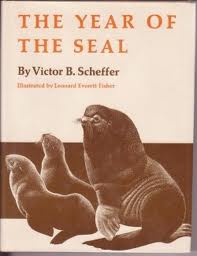
The Year of the Seal

by Victor Scheffer

A companion book to The Year of the Whale, Year of the Seal describes the life of an Alaskan fur-seal and its companions. I found it more interesting than the whale book, probably because seals are a bit easier to relate to, but also more disturbing in some ways. Most of the book tells about one female seal, and what she does from day to day in the different seasons; she comes to land to breed and raise a pup, leaves it periodically to go fishing in the ocean, then roams widely through the seas but returns again to land the following year. The story also follows the doings of one of her pups, and a little bit of the adult male or bull seal as well, to show how their habits differ. Interwoven with the seals' lives are the activities of men, and this is where it gets troublesome. There are hunters who "harvest" the seals' skins for their thick warm fur, and biologists who count their numbers and study their behavior. Their main motive for doing so is to determine how many seals can be taken each year without decimating the population. But they also do some studies just (it seems) for knowledge' sake. Things like chopping the ears off a hundred seals to mark them and see if they come back the next year to the same spot. Killing a bunch of seals by different methods just to see which is more efficient. The worst, I felt, was when they had caught a few pups for a study and in order to keep them alive, every day would go out to the seal rookery, find a pup that had just been fed by its mother, kill it and feed the milk from its stomach to the captive pup. It seemed such a waste.

Of course, the seals suffered and died of natural causes, too. Orcas and parasitic worms, stormy weather and fights among themselves. The huge bulls often trampled pups that got in their way, or attacked them to vent frustration. Some pups' mothers never returned from the sea and these slowly wasted away. It's all quite brutal. And yet the seals are full of life, apparently vigorous and healthy, and there are many passages beautifully describing their grace in the water, their speed and agility chasing fish, the quiet and tender moments between mother and pup, etc. All the misery seemed to jump out at me, though. Maybe that's why this book has gone unread for so many years (the last time its due date was stamped is 1995).

Still, I liked this one better than the whale book. Bought at a library sale.

rating: 3/5 ........ 205 pages, 1970

Oct 24, 2011

Wicked Plants

by Amy Stewart

Wicked Plants is a little book stuffed full of data on plants that do harm to people. Whether by poisoning, causing rashes and itching, intoxicating or overwhelming the environment- noxious weeds are a real headache! It was curious to see how many plants nowadays considered very dangerous were used in times past as medical remedies (often with very bad results for the patients). And I'm no longer surprised at how new arrivals in the Americas ages ago were afraid to eat tomatoes; related plants in their family are poisonous (such as deadly nightshade). I was surprised to find how many other plants commonly grown in gardens can be toxic: sweet peas, rhododendrons, azalea, certain kinds of lawn grass, celery! Of course, you'd have to eat a ton to come to harm, and quite a few I can't see why anyone would ingest it at all- azalea leaves, really? but lots of other plants that resemble edibles or have attractive-looking berries it's easy to understand why kids put them in their mouths, or even hikers who think they know what plants are safe. There's also info in here about mushrooms. And did you know olive trees can cause terrible allergic reactions? even lime peel! I could go on and on but you should just read the book and save me the trouble. Incidentally, the part about Lincoln's mother mentioned in the subtitle (The Weed That Killed Lincoln's Mother and Other Botanical Atrocities) doesn't appear until near the end, so you have to read the entire book to get to that part. It's all worth it, though!

Also this book sent me googling about ten different plants to see what they look like, in spite of the delightful illustrations. Which is always a good sign of how much it triggered my curiosity, sending me online to learn more. Borrowed this one from the public library.

rating: 3/5 ........ 233 pages, 2009

more opinions:
I know a lot of you have read this book but my google reader returns nothing I can pin down and searches online yield so much stuff which aren't book reviews that I have no time to wade through. So if you're a book blogger and you've read and posted about this book let me know and I'll add a link to you here!

Oct 22, 2011

Relentless Enemies

by Dereck and Beverly Joubert

I've been eying this book on its display shelf every visit to the library for the past few weeks, and finally I just gave in and brought it home, even though it's big and heavy (we were walking). And I'm glad I did; it was a wonderful book.

Relentless Enemies is one of those large-format coffee-table books full of gorgeous photos of wildlife. It's based on three years the authors spent living among lions and buffalo in the Okavango Delta of Botswana, studying their interactions and filming. (I really want to see the film they produced now; I really loved their film Eye of the Leopard so I'm sure I'd like this one as well). The unique thing about this area, besides that no people are allowed there (no tourists, nada) is that most of it is swampy. The lions wade and hunt and travel through water day after day. What fascinated me most was to read about how the three lion prides they studied each had their own different strategies of hunting buffalo in the water. While the pictures dominate the book, the writing is beautiful, thoughtful, even poetic and so it was just as much a delight to read through as to enjoy visually.

Rating: 4/5 ....... 175 pages, 2006

Oct 20, 2011

Demon Fish

by Juliet Eilperin

Sharks, one of the creatures most widely feared and loathed by humanity, kill less people a year than accidents with toasters or chairs! (How someone dies from a toaster encounter I don't know). Our fear of sharks has led us to ignore what's been happening to them, but as Juliet Eilperin succinctly describes in her book Demon Fish, their numbers are rapidly plummenting. They've been killed because we fear them, killed because they get caught in equipment set to catch other fish, killed because we want to eat them to show off (the shark components of shark's-fin soup add nothing to the flavor of the dish) and killed as their habitats are destroyed. Some say: who cares? they eat us. Let them die. But as top predators in the ocean, sharks fill a very important role of keeping other species in check. Not to mention that they are beautiful in their own right, unique creatures we are just beginning to understand.

Some of the amazing things I learned about sharks in this book (I'd heard of some of these things before, but never read about them in detail)

Sharks are ancient. They predate the dinosaurs!
Shark skin is very tough, made out of the same material as teeth.
Some sharks lay eggs, others give live birth.
A few sharks even give virgin birth. That's right: no dad.
Some baby sharks eat their siblings in utero.
There are about five hundred known species of shark.
Most sharks are small, and many of them have beautiful patterns. Look at this one.

So I learned a lot about sharks, what makes them different, how scientists study them, how our actions are pushing many of them towards extinction and why we should care. And of course, take steps to halt their demise.

Borrowed from the public library.

Rating: 4/5 ........ 295 pages, 2011

more opinions:
We Loved DC
All Fins Attached

Oct 18, 2011

an aside

For the first in a long time, I have been inspired by something I read to make a purchase. Thus the presence of this post, about a food item, on my book blog!

It was from reading Honeybee, which first sparked my interest in local, or monofloral honey. So for the first time ever, I have bought some special honeys, and they do have very different flavors.
The first one I got was an orange-blossom honey from the local supermarket, Wegman's. It has a light amber color like clover honey (which is all I'm used to eating in regards to honey) and tastes a lot similar. It has a definite, sharp citrusy zing, kind of as if the honey had orange zest in it. And a nice tingly aftertaste that seems to linger in the roof of my mouth.

Then just a few days ago we went to a local produce stand at an Amish farm we like to visit, but only go two or three times a season because it's quite a bit of distance from us (at least a twenty-minute drive). I usually get eager about their homemade jams and sauces, but this time noticed there was a shelf full of monofloral honey! I got all excited when I saw the tupelo honey, which I read about in Robbing the Bees, and had a hard time deciding which other type to try. They had starthistle honey, blackberry, apple blossom and many others I can't remember now. I was intrigued by the avocado one so we got that.

You can see the difference in the colors here. The Tupelo honey is amber too, a bit darker than orange blossom. The avocado honey has a rich, dark almost red-tinted color. We tried just a bit smeared on crackers to compare the flavors.
The tupelo honey is very sweet and astringent. Its flavor reminds me of something else but I haven't been able to put my finger on it. The avocado honey has an incredibly rich, heavy flavor like molasses. It left the longest aftertaste on my tongue. I can't decide which I like best and have to figure out some special cooking or food combinations to do with these. They are a bit pricey- the tupelo jar cost $10, the others about $6 each, but we are going to savor them. I don't know if they're exactly local- I think tupelo trees only grow in Florida, for example- but I know our farmer's market has honey produced by local hives. Next change I get, I want to try some of theirs, too.

Oct 14, 2011

Drawings of the Masters

Flemish and Dutch Drawings from the 15th to the 18th Century
by Colin Eisler

Another art book I got from a library sale recently. I picked it up because in thumbing through saw a wonderful drawing of an elephant by Rembrandt, also several awesome lions, and figured there'd be more. I was right- there was much more. Just a few are of animals: a boar's head, a scruffy-looking bull, a donkey, a beautiful little monkey with a chain on his neck, several cows in a group and quite a few horses (mostly with figures). There's also a wonderful page full of little studies of garden vegetables which made me wish I could draw plants better, and two that quite made me laugh. One is a drawing called Men Shoveling Chairs. Seriously. I was glancing at the plate titles in the front of the book and my eye wandered down the usual kind of names: Portrait of a Young Man, Virgin and Child, Landscape with a Bridge, etc. then I saw Men Shoveling Chairs. What!? I turned to that page and it was exactly that: four men with long-handled paddle-like shovels thrusting them under piles of three-and-four-legged stools and chairs. I still puzzle over what it means or why the artist drew it, but it makes me laugh nonetheless. The other amusing one is a drawing by Hieronymous Bosch called Tree-Man in a Landscape which reminds me how even centuries ago people would idly sketch fantastic things they just dreamed up: a "man" with an egg-shaped body (cut away to show figures around a table inside), his legs are trees and his feet boats, his hat has a jug on top out of which tiny figures climb on a ladder, an owl sits on a branch growing from his back. It's entirely fanciful and curiously delightful to peer at.

Of course there are lots of the types of drawings you'd expect to find: the portraits and madonnas, landscapes and buildings. They all show me something to aspire to, but I was really glad that I found something to smile about, too.

The style of the drawings ranges from very rough, simple line sketches to highly detailed meticulous wash studies and finely hatched pen-and-ink works. Some you can imagine the artist having spent hours working on, others just a few moments. There are lots of amazing studies of folds from the clothing people wore, and a wide variety of faces. The introductory text describing the artwork and its changing styles through the centuries and via different artists wasn't nearly as incomprehensible as I feared, actually pretty interesting. But of course, I mostly enjoyed just looking and looking at the pictures.

Rating: 4/5 ........ 140 pages, 1963

Oct 12, 2011

Metropolitan Zoo

by Joseph Bell

This book has been sitting on my shelf a long time, picked up from a library sale who-knows-when. I read it through several bouts of nursing the baby, taking time to look closely at all the pictures. Metropolitan Zoo is a collection of images from the Metropolitan Museum of Art that all feature wild animals. There are paintings, drawings, sculpture, embroideries, jewelry and other forms of art. Each image is described, not only explaining the medium and style, the artist's inspiration (whether from life or completely fanciful) and a bit of history, but also something about the animal. In particular, the author points out when the details of the artwork show something factual about the animal's life or habits, and when they got it dead wrong! I noticed myself a few small details: in the painted screen of white-handed gibbons (shown on the cover), the male is holding some kind of insect in his clenched fist. In few pages showing lions, I saw that quite a number of them depicted the Barbary lion, now extinct in the wild, whose mane extends along the belly. And one left me with a question: what is the other, un-named animal in the detail of the unicorn tapestry shown? Next to the hyena (which doesn't look much like a hyena) is a creature with a striped tail like a raccoon (only skinnier) but the longer neck and finer face of a weasel. A civet? I keep turning to that page, trying to puzzle it out. The artworks feature lions, elephants, rhinos, deer, squirrels and many other mammals. There are also quite a few pieces depicting snakes and other reptiles, and lots of various and beautiful birds. It's a book I thoroughly enjoyed looking through, and should be very popular with anyone who loves animals or art (or both, like me!)

I want to get my hands someday on the other edition they've printed featuring cats from the museum's artwork.

Rating: 5/5 .......112 pages, 1985

Harvest for Hope

by Jane Goodall 
with Gary McAvoy and Gail Hudson

Concerned about many alarming trends she's noticed around the world Jane Goodall wrote this book about "mindful eating." In it she talks about all sorts of things revolving around what we, as humanity eat, and how current practices are destroying our environment and what we can do (on an individual level) to make a difference. Some of the things she talks about in Harvest for Hope include the presence of chemicals and poisons in our food, water shortages, bio-engineered crops, the awful treatment of animals in large-scale operations, overfishing of the oceans and loss of species diversity. Some of the information and predictions for the future are downright scary. On a positive note she talks about the many rich food cultures around the world, organizations that teach schoolchildren how to grow and cook their own produce, farmers that go back to using "deep organic" practices in order to heal their land and produce healthier food, the growing numbers of farmer's markets and restaurants that use local food, the importance of vegetarianism (in all its forms) for our health, the well-being of animals and the reduction of resources overuse, etc. She hasn't quite convinced me to go vegetarian but I am more determined to make an effort to buy local and organic food when I can. Even if it costs more and I can't buy as much, eating a bit less can only be good for me!

rating: 3/5 ....... 296 pages, 2005

more opinions at:
Sayin' Stuff
She Writes, Right?

Oct 10, 2011

more TBR

Rin Tin Tin by Susan Orlean- seen on Sophisticated Dorkiness
Healing Paradise by Gay Courter- noticed by Superfast Reader
One Fine Day by Mollie Panter-read about on A Work in Progress
The Gardener's Year by Karel Capek- Captive Reader
Small Wonder by Barbara Kingsolver- Stuff as Dreams Are Made On
The Curious Gardener by Ana Pavord- Captive Reader
Flower Hunters by Mary Gribbin and John Gribbin- Captive Reader
Sex on Six Legs by Marlene Zuk- A Striped Armchair
The Curious Gardener by Ana Pavord- Garden Rant
Second Nature by Michael Pollan- Stuff As Dreams Are Made On

The Orchard: A Memoir by Theresa Weir
It's a Long Road to a Tomato by Keith Stewart
The Pioneer Woman: Black Heels to Tractor Wheels by Ree Drummond
those three from Caroline Bookbinder

The Proof of Love by Catherine Hall- Farm Lane Books Blog
A Stolen Life by Jaycee Dugard- We'll Always Have Books
Seeing Trees by Nancy Ross Hugo- Commonweeder
Cluck: From Jungle Fowl to City Chicks- Garden Rant
Feathers! by Thor Hanson- Sophisticated Dorkiness
Your Farm in the City by Lisa Taylor- Garden Rant 
Night Waking by Sara Moss- Farm Lane Books Blog
Urban Farming by Thomas J Fox- Garden Rant
Beside the Sea by Veronique Olmi- Farm Lane Books Blog
Chick Days by Jenna Woginrich - Garden Rant
My Name is Mary Sutter by Robin Oliveira- Books and Movies
A Lucky Child by Thomas Buergenthal- Diary of an Eccentric
The City Homesteader by Scott Meyer - Garden Rant
Sugar Snaps and Strawberries by Andrea Bellamy- Garden Rant

The Seventh Well by Fred Wander- Diary of an Eccentric
Making It: Radical Home Ec... by Kelly Coyne and Erik Knutzen- Garden Rant
Bending Toward the Sun by Leslie Gilbert Lurie- Diary of An Eccentric

Four Hedges by Clare Leighton
A Countrywoman's Notes by Rosemary Verey
The Garden in the Clouds by Antony Woodward
The Curious Gardener's Almanac by Niall Edworthy
all those last four from Captive Reader